

A special, AI PM glossary (requires a free subscription). Print it and hang it on the wall.
Last updated on 8/9/2026.
Contents:
1. AI Product Management
Agentic Engineering (aka. Vibe Engineering)
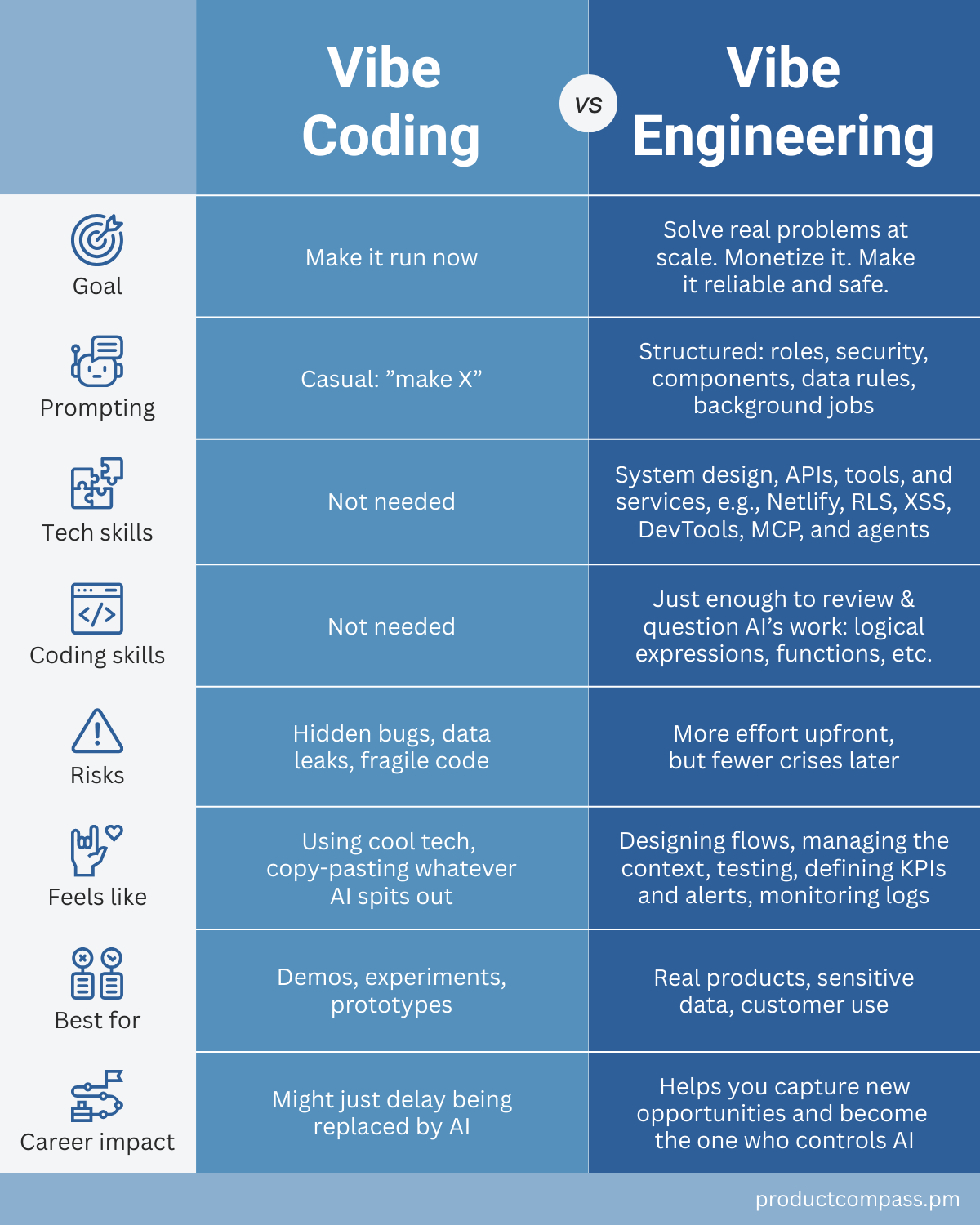
Building software with AI agents using real engineering discipline: clear specs, version control, tests, evals, artifact review, security checks, and production standards. It keeps the speed of AI-assisted building while adding the constraints needed to make the result scalable, secure, and maintainable.
The term was popularized by Andrej Karpathy in 2026. The same shift from vibe coding to engineering discipline was explored in Sep 2025 in The Product Compass newsletter:
AI Literacy & AI Intuition
The ability to understand foundational AI concepts (e.g., LLMs, AI Agents, MCP), perform error analysis, and iteratively refine prompts or models based on hands-on experimentation. I recommend developing it by working with AI, not studying theory.
AI Product Manager
A PM who works on AI-powered products and features. Unlike traditional PMs, AI PMs must understand the technology and develop an AI intuition.
AI-Powered Product Manager (aka AI-Native PM)
A PM who uses AI as part of their day-to-day work: research, synthesis, discovery, prototyping, writing, analysis, and delivery. The distinction is about how the PM works, not necessarily what product they manage.
Paweł’s note: soon, this may stop being a separate category. AI will likely become part of the default PM toolkit.
Product Manager
The team member especially responsible for the two risk areas:
Customer value: Do customers want this product or feature? Can we actually deliver on the value promised?
Business viability: Will it work for different parts of the business?
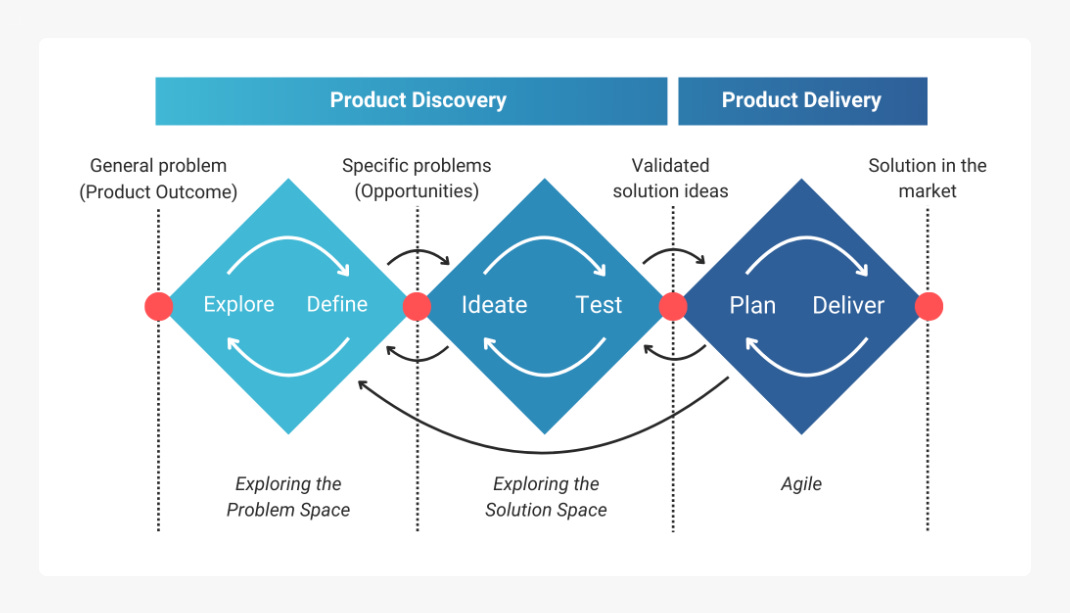
The most important activity for a PM is participating in Product Discovery. Its goal is to address key risks before implementation, to avoid wasting time and resources.

Spec-Driven Development
Writing a clear specification of what should be built and using it as the source of truth that an agent (and its loops and tests) work toward.
Opinion: It never worked for humans. Waterfall lost to agile because you discover what you actually need while building, not in a spec written up front. Thariq's field guide is the clearest proof it's the same for agents: the unknowns surface during the work and after it.
The fix isn't hunting down every unknown unknown either. It's communicating the context beyond the goal, the why and the strategy and the constraints, so the agent navigates the unknowns you never listed.
I've been calling this intent engineering since January 2026.
Vibe Coding
Building software by describing what you want to an AI and accepting what it produces, with little attention to how the code works. It is fast and great for prototypes, but it skips the engineering needed to make something you can scale, secure, and maintain.
Also see ‘Agentic Engineering.’
Recommended reading for this section:
2. Generative AI: Basic Terms
Deep Learning
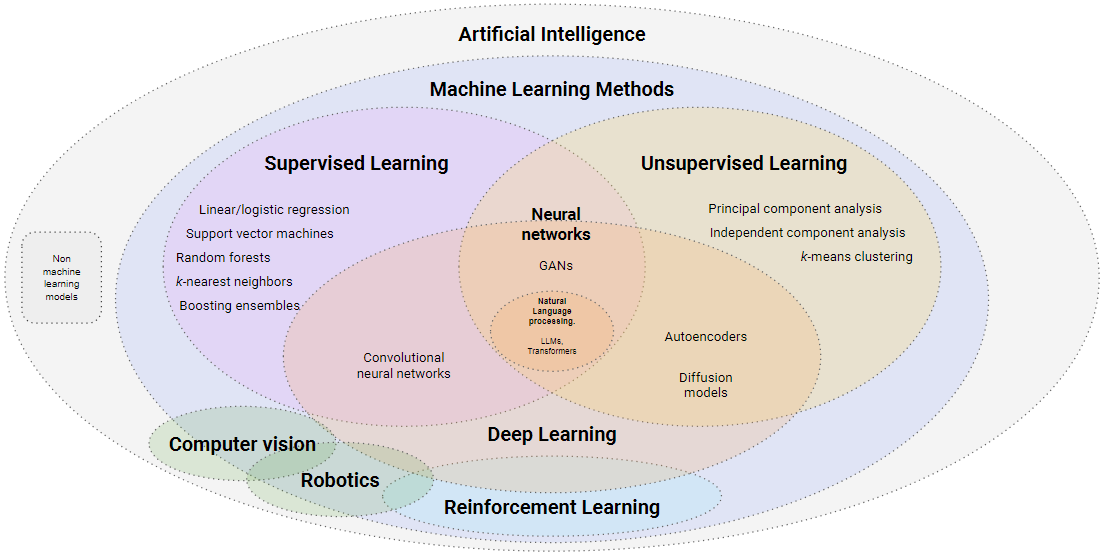
A subset of machine learning that uses neural networks with many layers (deep neural networks). It can be applied to supervised, unsupervised, and reinforcement learning.
Direct Preference Optimization (DPO)
A preference-tuning method that aligns a model directly on preferred vs rejected outputs without a separate reward model.
Fine-Tuning
The process of adapting a pre-trained model with additional training so it behaves better for a specific task, domain, style, or preference. Common approaches include supervised fine-tuning (SFT) on examples of desired outputs, and preference/post-training methods such as DPO, ORPO, and KTO.

Generative AI (Gen AI)
AI systems, typically based on large pre-trained models, that generate new content (such as text, images, audio, or code) by learning patterns from large datasets.
Kahneman-Tversky Optimization (KTO)
A model-alignment method that learns from desirable vs undesirable outputs rather than pairwise preference comparisons.
Odds Ratio Preference Optimization (ORPO)
A reference-model-free preference optimization method that uses odds ratios to favor preferred responses during fine-tuning.
Reinforcement Learning
A training method where a model learns by interacting with an environment. It receives rewards for desired actions and penalties for undesired ones (e.g., AlphaGo).
Reinforcement Learning from Human Feedback (RLHF)
A technique to align LLMs with human preferences. It involves training a reward model based on human ratings of model outputs and then using that reward model to guide reinforcement learning that updates the LLM.
Supervised Fine-Tuning (SFT)
Fine-tuning a model on examples of desired inputs and outputs so it imitates the target behavior, format, or domain.
Supervised Learning
A training method where a model learns from a labeled dataset, meaning each piece of input data is paired with a correct output. This is the basis for fine-tuning.
Transformers
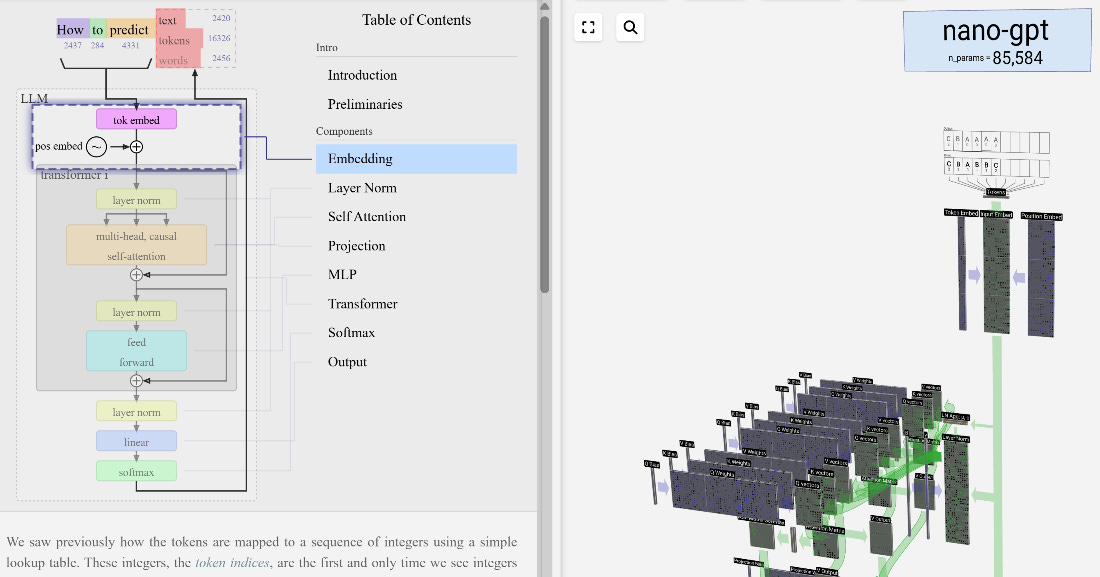
A neural network architecture designed for sequential data, like text. Its key innovation is the self-attention mechanism, which weighs the importance of different parts of the input.
Unsupervised Learning
A training method where a model learns from unlabeled data, discovering patterns and structures on its own.
Recommended reading for this section:
3. AI Models
Agentic AI (Agentic AI)
The full product system around a model: prompts, context, retrieval, tools, memory, evals, UI, permissions, and operations.
Language Action Models (LAM, advanced)
Models designed not just to understand language but to take action based on it, such as interacting with software or APIs.
Large Language Models (LLMs)
Models trained on large datasets to generate and understand human-like text. They combine supervised, unsupervised, and deep learning, making them excellent for natural language understanding and generation (e.g., ChatGPT).
Latent Concept Models (LCM, advanced)
Powerful models that excel at capturing nuanced or hidden concepts within data.
Masked Language Models (MLM, advanced)
Models trained to predict masked or missing words in a sentence. This approach helps them master context and understand language structure deeply.
Mixture of Experts (MoE)
An architecture that combines outputs from multiple specialized "expert" models. It intelligently routes queries to the most relevant expert, improving performance and efficiency.
Reasoning Effort
A setting on reasoning models that controls how long the model thinks before answering (e.g., low/medium/high). Higher effort means more reasoning tokens, higher cost, and slower answers, not necessarily better ones. Also see ‘Test-Time Compute (Inference-Time Scaling).’
Paweł’s note: I ran 210 timed runs across effort levels. On routine tasks, every level gave the same answer at a different price. Measure on your own tasks before paying for “high.”
Reasoning Model
A model trained to work through a problem in explicit steps before giving an answer, rather than responding in one shot. It tends to do better on math, code, and multi-step logic, and usually costs more and runs slower in exchange.
Segment Anything Models (SAM, advanced)
Models designed for precise image segmentation, capable of identifying and outlining objects in an image with high detail and accuracy.
Small Language Models (SLMs)
More compact models that are ideal for efficiency and speed, especially in resource-constrained environments or for specialized tasks.
Test-Time Compute (Inference-Time Scaling)
Spending more computation while answering a question (more reasoning steps, more attempts, more checking) to get a better result, instead of relying only on a bigger trained model. It is a way to buy quality at answer time rather than at training time.
Vision-Language Models (VLMs)
Models that handle both text and images, bridging the gap between visuals and language to understand and generate content based on both modalities.

Recommended reading for this section:
4. Prompting & Context Management
Autonomy Boundaries
Explicit limits on what an agent may decide or do without human approval.
Chain-of-Thought (CoT) Prompting
A prompting technique that encourages a model to solve a problem step by step instead of jumping straight to an answer. In products, you usually should not ask the model to reveal hidden/private reasoning. Ask for a plan, concise rationale, intermediate checks, or a brief explanation of the answer when that helps the user.
Constraints
Rules that narrow acceptable behavior, outputs, tools, data, or actions for an AI system.
Context Engineering
The practice of deciding what information goes into the model’s context window for a given task, and in what form. As tasks move from single prompts to agents, choosing and structuring the right context (instructions, retrieved data, memory, tool results) matters more than wording any single prompt.
Recommended reading:
Context Management
Since the model has a memory limit, you need to be smart about what info you include. Context management means deciding what matters most, trimming what doesn’t, and structuring it in a way the model can understand and use. Specific techniques include prompt engineering (yes, it’s not dead, despite what some say) and RAG. Some make the mistake of including fine-tuning, but it’s not a context management technique - it modifies the model itself.
Context Window (Token Limit)
The amount of information a model can consider in a single request, measured in tokens. It may include the user message, system instructions, prior conversation, retrieved documents, tool results, and other context. If the request exceeds the limit, the system may truncate, summarize, reject, or lose earlier context depending on the implementation.
Desired Outcomes (Evidence)
Concrete measurable success criteria that let an agent, evaluator, or PM know whether the work succeeded.
Extended Thinking (Thinking Budget)
A mode where the model is given room to reason step by step before answering, with a budget that caps how much of that reasoning it can do. More thinking budget can improve hard-problem accuracy at the cost of higher latency and spend.
Few-Shot Learning
Instead of zero examples, you give the model a few. Just enough to show what kind of response you want. Great for formatting tasks, tone matching, or guiding the model when clarity matters without fine-tuning.
Health Metrics
Metrics that show whether an AI system or agent is behaving reliably over time. Used to prevent system degradation while pursuing the current objective.
Intent Engineering
Describing what you want and why, with success criteria and boundaries, rather than dictating each step. It shifts your job from writing instructions to specifying the outcome and letting the agent work out the how.
Recommended reading:
Objectives
The desired end state an agent should pursue, distinct from the step-by-step instructions. It should explain why the objective matters. Also see, “Desired Outcomes.”
Prompt Engineering
Crafting instructions that steer a model’s response in a single interaction. It covers wording, examples, formatting, constraints, and output structure. Prompt engineering is still useful, but for agents it is only one layer: Context Engineering decides what information the agent gets, and Intent Engineering defines the goal, outcomes, and boundaries it should work within.
Prompt Caching
Reusing the model’s processing of a repeated chunk of context (such as a long system prompt or document) across calls instead of paying to process it again. It lowers cost and latency when many requests share the same large, stable prefix.
Prompt Injection
An attack where malicious instructions are hidden in prompts to trick an LLM into bypassing its safety protocols, disclosing private data, or deviating from its intended behavior. For example, telling the model to ignore earlier instructions. A real security concern in AI systems.
ReAct
A prompting/agent pattern where the model alternates between reasoning about what to do and taking actions with tools.
Strategic Context
Business, user, market, or product context that helps the model choose better tradeoffs.
System Context
Product, technical, policy, data, and operational context the AI needs to act correctly inside a system.
Temperature
A setting that controls how creative or predictable the model’s response is. Low values make it focused and safe. High values let it get more varied or helpful for brainstorming, less so for factual tasks.
Zero-Shot Learning
Instructing an LLM to perform a task without providing any examples in the prompt, relying entirely on its pre-trained knowledge.
Recommended reading for this section:
5. Retrieval-Augmented Generation
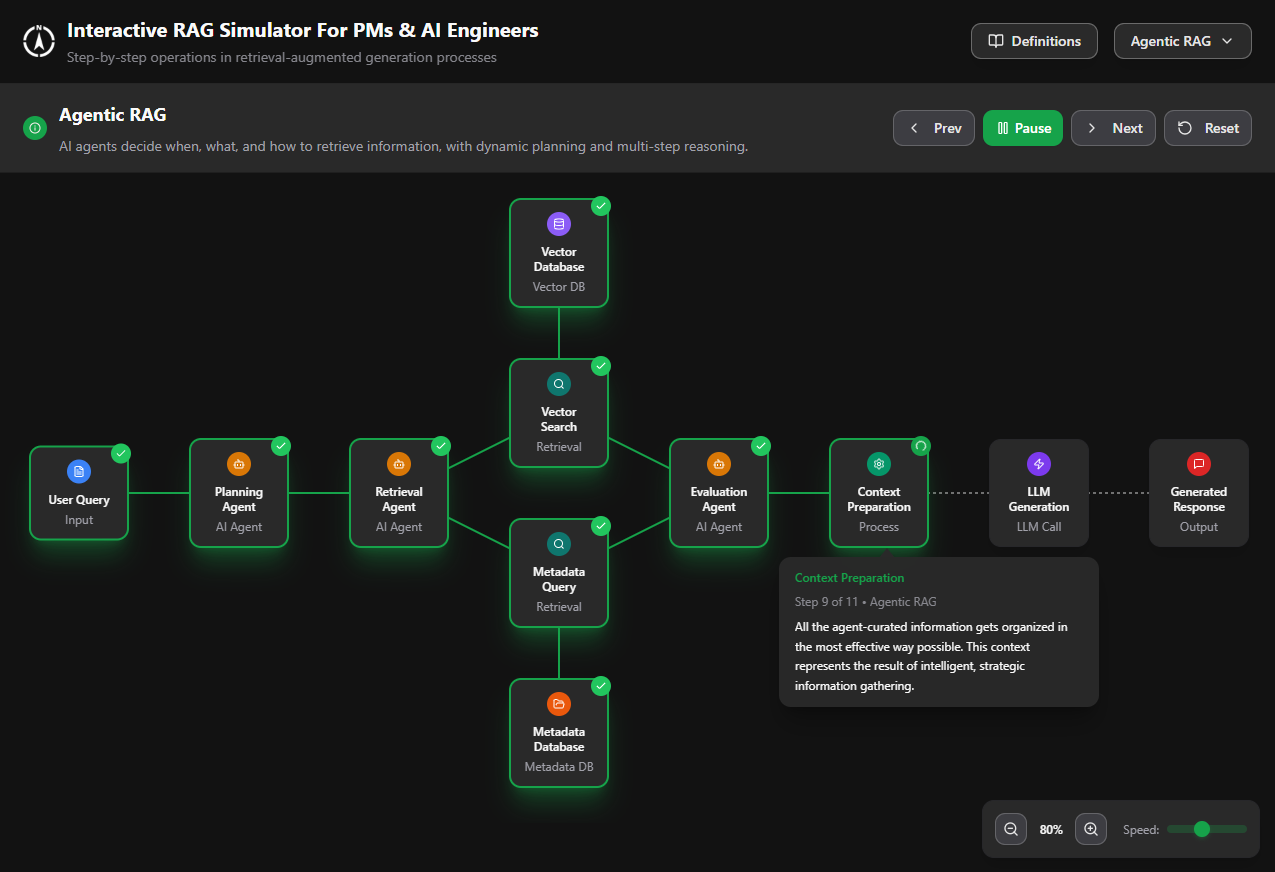
Agentic RAG
A version of RAG where the AI decides on its own when to retrieve information, what to retrieve, and how to use it.
Adaptive RAG
Enhanced RAG that makes retrieval and generation process more dynamic and self-correcting, adapting to the complexity of a query and the quality of retrieved information.
CAG (Cache-Augmented Generation)
An alternative to RAG. Instead of retrieving data during each interaction, CAG loads relevant information into the model’s context beforehand. This speeds things up and works well when the data is stable and fits in the model’s memory. It is also called Context-Augmented Generation.
Chunking
Splitting documents into retrievable pieces so the system can fetch the most relevant context.
Document Search
Searching over documents or files to retrieve useful context for an AI answer or agent action.
Embedding
A way to convert data, like text or images, into numerical vectors that capture meaning. These vectors help the model understand relationships between different pieces of data and allow for similarity searches.
Graph Database
A database optimized for relationships between entities, useful when connections matter more than isolated documents.
Hybrid RAG
A retrieval approach that combines multiple retrieval methods to improve the quality of context provided to the model. Typically, it merges dense retrieval (using vector similarity) with sparse retrieval (like keyword-based search or BM25). This way, it captures both semantic meaning and exact keyword matches, making the retrieval more robust.
HyDE (Hypothetical Document Embeddings, advanced)
A method that boosts retrieval by having the model generate a fictional answer to the query. That generated answer is turned into an embedding, which is then used to find real documents that are similar. This helps connect short queries to more complete responses.
Knowledge Graph
A structured map of entities and relationships that helps AI systems reason over connected information.
Knowledge System
The full setup that determines what an agent can know: files, memory, RAG, vector stores, graphs, tool results, and instructions.
Markdown
A lightweight text format often used as durable, readable context for agents.
OKF (Open Knowledge Format)
An open specification introduced by Google Cloud in 2026 for representing knowledge as a directory of Markdown files with YAML frontmatter. OKF formalizes the LLM-wiki pattern: curated context, metadata, and links that humans can edit and agents can read without a proprietary tool or API. It is useful for portable agent knowledge bases, especially when knowledge should live near docs, code, or a team wiki.
Previously, we discussed similar structures in What I Learned Building a Self-Improving Agentic System with Claude.
Reranking
A technique used in RAG that improves retrieval results by reordering the initial set of documents or chunks. A model evaluates which items are most relevant and puts the best ones at the top.
Retrieval-Augmented Generation (RAG)
A method where an AI system retrieves relevant information from external sources such as documents, databases, vector stores, or file systems, then uses that information as context to produce a better answer. Retrieval can happen before generation or dynamically during an agent run when the agent decides it needs more information.
Second Brain
A personal or team knowledge base that agents can read from and update across work. The term was popularized by Andrej Karpathy in 2026. Previously, we covered it in What I Learned Building a Self-Improving Agentic System with Claude.
Vector Databases (Vector Stores)
Specialized databases that store and search embeddings efficiently. They are built to handle high-dimensional vectors and find similar items quickly, even at large scale.

You might also benefit from out Interactive RAG simulator:
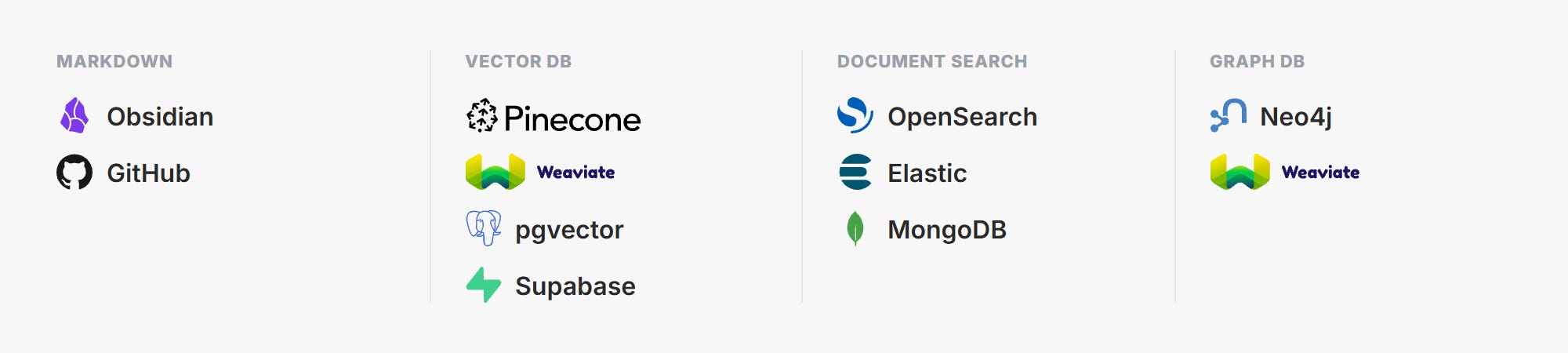
Popular tools:
Recommended reading for this section:
RAG types from the Guide to Context Engineering for PMs
Point 5, Three Essential Agentic RAG Architectures from AI Agent Architectures
Case study from Base44: A Brutally Simple Alternative to Lovable
Three CLAUDE.md Blocks That Make Claude Get Smarter Every Session
What I Learned Building a Self-Improving Agentic System with Claude
6. AI Agents
Agent Instruction File (CLAUDE.md / AGENTS.md)
A repo or workspace file that gives an agent standing instructions, project context, and operating rules.
Agent Payments Protocol / AP2 / A2P
A protocol layer for authorizing and securing payments initiated by agents.
Agent SDK
A developer toolkit by Anthropic for building agents with tools, instructions, memory, handoffs, and eval hooks.
AI Agent
A system where a model works inside a harness that gives it tools, context, permissions, memory, guardrails, and feedback. The agent can decide what steps to take, which tools to use, and how to adapt as it works toward a goal. The model matters, but the surrounding system is what makes the agent useful and reliable.
AI Chain (advanced)
A setup broader than prompt chaining, where different components (including prompts, code, external tools, or even other models) are connected in a sequence. Each component passes its output to the next, forming a pipeline. AI Chains are often used to build full workflows, not just chains of prompts. For example, we extract info using an LLM, validate it with code, enrich it with an API call, then ask the LLM to write a final summary. Think n8n.
Agent-to-Agent (A2A)
A protocol that allows AI agents to talk directly to each other. It supports things like sharing results, passing off tasks, or negotiating responsibilities between agents.
Agent-to-User Interface (A2UI)
A protocol for agents to return structured, interactive UI instead of only text.
Agent Memory
The information an agent carries beyond a single conversation, such as past results, user preferences, or learned rules, so it does not start from scratch each run. Storing every interaction is not the same as learning. Memory only compounds when experience gets curated into rules the next run follows.
Agentic Workflows
Automated systems where an LLM and supporting tools are connected through predefined logic. The steps are set in code, but the LLM adds intelligence by handling inputs, making decisions, or generating content along the way.
Computer Use
A capability where an agent operates a computer the way a person would, by reading the screen and controlling the mouse and keyboard. It lets an agent work with software that has no API, at the cost of being slower and more error-prone than direct tool calls.
Handoff
Passing work from one agent, system, or human to another with enough context to continue safely.
LLM Workflow
A structured process where LLM calls, tools, rules, and deterministic steps are arranged to complete a task.
Managed Agent
An agent hosted and operated by a platform, where infrastructure, scaling, or some orchestration is abstracted away. For example Amazon Bedrock AgentCore, Claude Managed Agents.
Model Context Protocol (MCP)
An open standard introduced by Anthropic for connecting AI models and agents to external tools, APIs, and data sources in a consistent way. MCP is mainly about agent-to-tool and agent-to-data connections. Agent-to-Agent (A2A) is the separate pattern/protocol family for agents communicating with other agents.
Multi-Agent System
An architecture where several AI agents work together to solve tasks. Each agent may specialize in something different. They communicate, share information, or divide responsibilities to handle complex problems.
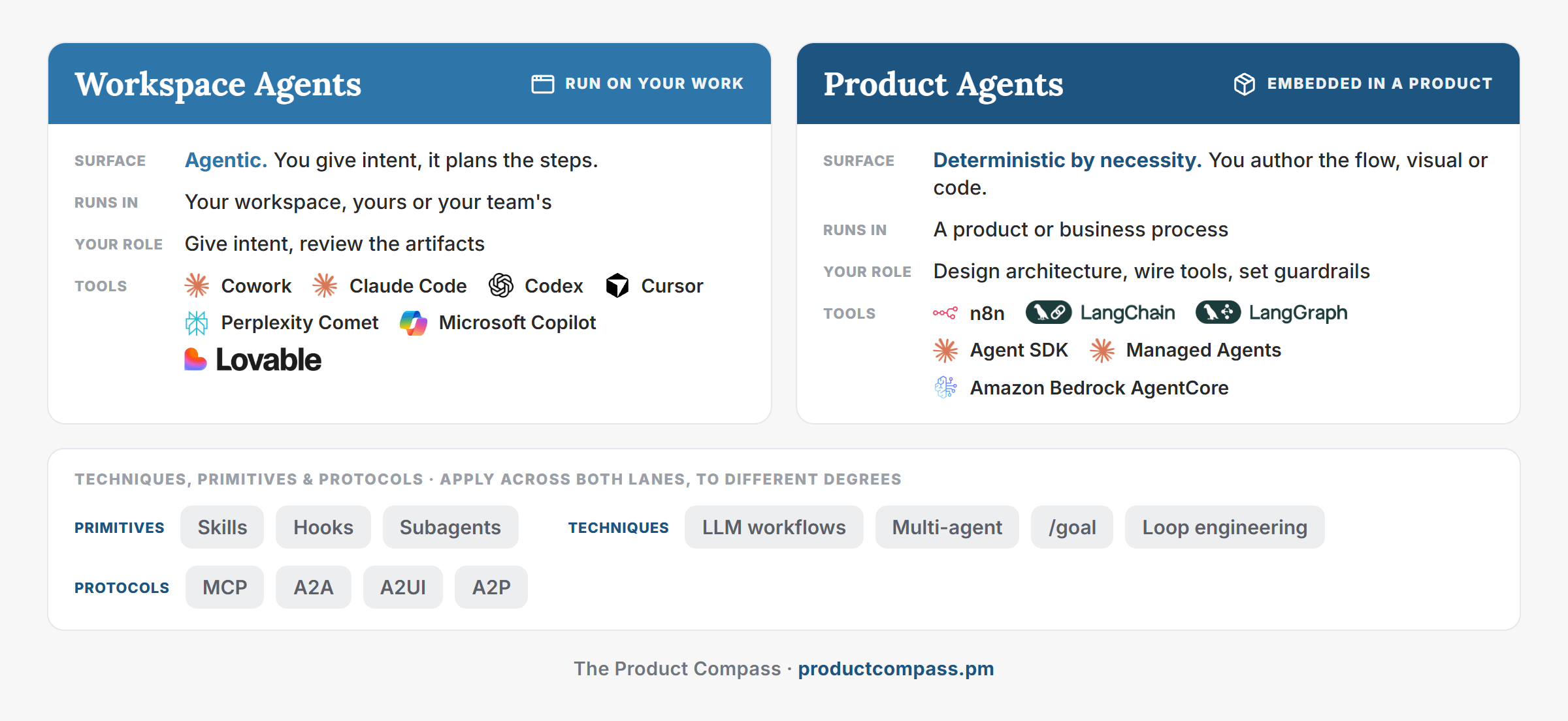
Product Agent
An agent embedded inside a product or business process that runs for users or teams with designed tools, guardrails, and handoffs. For example n8n, LangChain, LangGraph, Agent SDK.
Prompt Chaining
A method where you split a task into smaller steps and run them through the LLM one at a time. Each step is handled with its own prompt, and the output from one step is passed into the next prompt. This helps guide the model through complex tasks or multi-stage reasoning. For example, we ask the model to summarize a text, then ask it to generate a title based on that summary.
Subagent
A separate agent that a main agent spawns to handle a focused piece of work, then reports back. Splitting work across subagents keeps each one's context clean and lets parts of a task run in parallel.
Tool Use (Function Calling)
When a model is given a set of tools or functions it can call (search, code execution, an API, a database) and decides when to call them and with what inputs. This is what lets an agent act on the world instead of only producing text.
Workspace Agent
An agent that runs on your own work: research, discovery, writing, prototyping, coding, analysis, and delivery tasks. For example, Claude Code, Codex App, Cowork.


Recommended reading for this section:
7. Agent Loops & Orchestration
Agentic Back-Pressure
Signals that push back on an agent and constrain what it can do next, such as a failing test, a type error, or a rejected build. Back-pressure keeps a loop from drifting by forcing each pass to satisfy a real constraint before it continues.
Agent Harness (aka. “Orchestration”)
The supporting system around the model that makes an agent useful: retrieval, tools, memory, verification, and guardrails. The harness, not the raw model, is where most of the reliability and leverage of an agent actually comes from.
The term was adopted by the AI community in February 2026, we’ve been discussing it in The Product Compass newsletter since July 2025:

Agent Loop
An agent that repeats one cycle (act, check, adjust) and keeps going until a stop condition is met. The check inside the cycle is what makes it a loop and not a fixed routine, e.g. cluster a feedback backlog into themes, re-cluster, and stop when the themes stop changing.
Compounding Slop
The failure mode where a loop runs unattended with a weak stop condition and produces more and more low-quality output that nobody reviews. A loop running unattended is also a loop failing unattended, so the same technique either compounds value or compounds garbage depending on the check that ends it.
Dynamic Workflow
A process that adapts within a single run, branching on what it finds, then finishing. One pass, no repetition, e.g. read each incoming ticket, decide if it is a bug or a feature request, and route each to the right queue.
Graph Engineering
Designing an agent system as a fixed graph: predefined steps and branches, with the model working inside each node. You decide the paths in advance instead of defining “done” and letting the agent iterate. Also see ‘Agentic Workflows’ and ‘Loop Engineering.’
Paweł’s note: this is the state machine your n8n flow already is, wearing a new name.
Hook
A trigger or extension point that runs code, checks, or automation before or after an agent action.
Loop Engineering
Designing the system that runs the agent instead of writing each prompt by hand. You define the goal, the iteration, the independent check for “done,” and the cadence, then let the loop do the task. The phrase was popularized in mid-2026, but the underlying control loop is old.
Maker-Checker (Sub-Agent Split)
A loop design where one agent does the work and a separate, independent agent (or test, or model) decides whether it is correct. Keeping the maker and the checker apart is what keeps a loop honest, since an agent grading its own output tends to approve it.
No-Code Agent Builder
A visual tool for building agent workflows and automations without writing most of the code, e.g., n8n.
Open Loop vs Closed Loop
A closed loop feeds its result back in and adjusts on the next pass, so it self-corrects toward a goal. An open loop runs once and stops with no feedback. Most agent loops worth building are closed loops, because the feedback is where the value comes from.
Orchestrator (Fleet)
The controlling agent or system that starts other agents, hands them tasks, watches their results, and decides what runs next. Running many agents under one orchestrator is sometimes called managing a fleet, and the orchestrator is where you observe failures across runs and stop the bad ones.
Orchestration-First Design
Designing the steps, tools, constraints, checks, and handoffs around a model instead of relying on open-ended autonomy.
Ralph Wiggum Loop
The simplest possible loop: feed the same prompt to a coding agent over and over with a fresh context each time, relying on tests and the build to push the work toward correct. Named by Geoffrey Huntley (early 2025), it is the ancestor of today’s loop techniques and runs one task at a time.
Routine
A fixed sequence of steps an agent runs the same way every time, with no judgment and no stop condition. It just ends when the steps are done, e.g. pull the open tickets, sort by date, post the list to Slack.
Self-Prompting
When the agent writes its own next prompt instead of reusing one you wrote. This is the real shift behind calling loops the successor to prompt engineering: you design the prompt generator and the goal, not each individual prompt.
Scheduled Task (Cron Trigger)
A clock that starts a routine, workflow, or loop on a cadence such as hourly or daily. The schedule is a separate question from whether the thing it starts is actually a loop, e.g. run the competitor scan every morning at 8.
Stop Condition
The rule that decides when a loop is finished and should exit. It is the hardest and most valuable part of a loop, because a loop with a loose or missing stop condition runs forever and piles up low-quality output instead of stopping at a good result.
Skill (SKILL.md)
A reusable, named capability you write down in a file so an agent can load it on demand and apply it the same way every time. Skills that encode your specific decisions and procedures compound in value, while skills that just restate what the model already knows add little.
Tool Result
The output returned by a tool call, which becomes context for the agent’s next decision.
Recommended reading for this section:
8. Data & Feature Management
Concept Drift
A specific kind of Data Drift where the underlying relationship between inputs and the target variable changes over time. For example, if customer behavior evolves, a model trained on past preferences might no longer make accurate predictions.
Data Annotation / Labeling
The process of tagging or categorizing raw data to create a labeled dataset for supervised learning. This step is essential for training models to recognize patterns and usually requires a lot of manual effort. Another context in which we use these terms is error analysis (part of AI evals).
Data Augmentation
A method used to expand and diversify a training dataset by making slight changes to existing data. Examples include rotating images, adding noise, or rephrasing sentences to help the model generalize better.
Data Drift
When the data a model sees in production starts to differ from the data it was trained on. This shift can reduce accuracy because the model is no longer operating in the same conditions it learned from.
Feature Store (advanced)
A feature store is like a shared database where machine learning teams keep useful data pieces (called features) that help models make predictions. These features are cleaned and ready to use, so teams don’t have to rebuild them every time. It also makes sure the model uses the same information when it’s being trained and when it’s used in the real world.
Model Drift
This is a broader, more casual term than Data Drift and Concept Drift. It usually means that a model's performance is getting worse over time but doesn’t specify why. It might be caused by data drift, concept drift, or something else like bugs.
9. AI Evals (AI Evaluation Systems)
Action-Based Evals
Evals that judge whether the agent took the right action, not just whether the final text sounded good.
AI Evaluation System
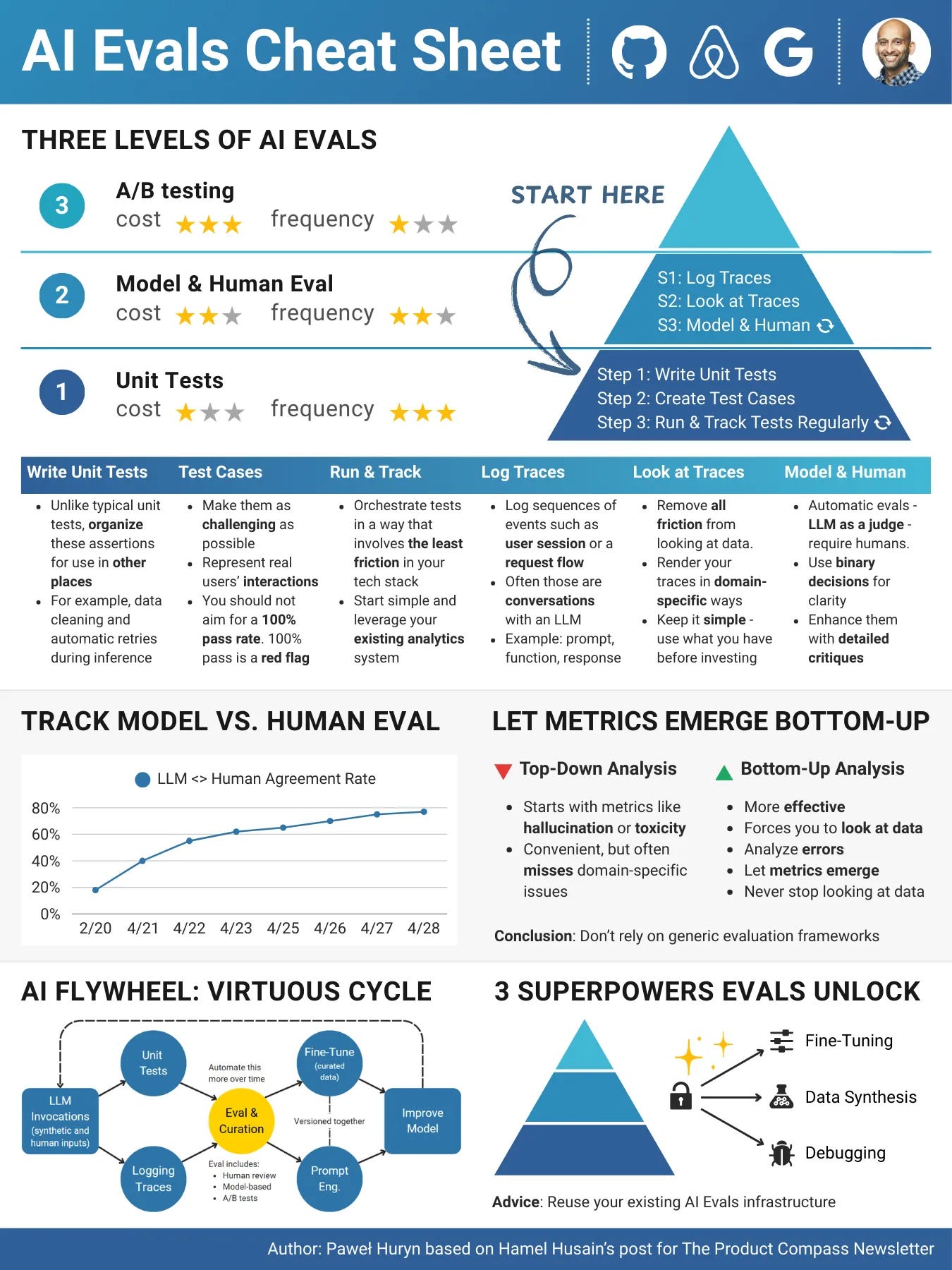
A system for measuring whether an AI product works in practice. It can include code-based evals, LLM-as-judge checks, human review, action-based evals, observability, traces, production monitoring, and error analysis. Good eval systems measure not only final outputs, but also whether the agent took the right actions and behaved reliably over time.
AI Observability
Monitoring the behavior of AI systems through traces, tool calls, costs, latency, errors, eval scores, and user outcomes.
Axial Coding
Grouping labeled errors into higher-level failure modes during qualitative error analysis.
Bottom-Up vs. Top-Down Analysis
Two approaches to defining AI metrics. Bottom-up analysis identifies application-specific failure modes directly from the data. Top-down analysis applies generic metrics (like hallucination or toxicity) that may miss domain-specific nuances.
Code-Based Evals
Automated evaluators implemented as deterministic scripts (e.g., using Python with XML, SQL, or regex checks) that objectively flag specific, rule-based failure modes.
Error Analysis
The process of reviewing model outputs (LLM traces), labeling errors, and classifying them into distinct failure modes. This is repeated iteratively until no new failure modes emerge and is a high-ROI activity in AI product development.
F1-Score
The harmonic mean of precision and recall, providing a single score that balances both metrics.
Failure Modes
Coherent and non-overlapping categories of errors that emerge from analyzing LLM traces (e.g., hallucination, incorrect format, or missed instruction). Each binary failure type is easy to recognize and forms the basis for targeted metrics.
Human Eval
Human review of outputs, traces, or actions to judge quality, safety, usefulness, or correctness.
Model Eval
Evaluation of a model’s behavior on a defined task set, separate from evaluating the whole product system.
LLM Traces
A record of an AI system’s run, usually including the user query, prompts or messages, retrieved context, tool calls, tool results, metadata, costs, latency, and final output. Traces are the raw material for debugging, observability, evals, and error analysis. They do not always include hidden model reasoning.
LLM-as-Judge Evals
Evaluation modules where a secondary LLM acts as the "judge," assessing outputs against a single failure mode in a binary pass/fail format. This is useful for complex or subjective checks but requires monitoring for alignment with human judgment.
Open Coding
The early error-analysis pass where reviewers label traces freely before consolidating categories.
Precision
A metric that measures the proportion of true positives out of all positive predictions (True Positives / (True Positives + False Positives)).
Recall (True Positive Rate, TPR)
A metric that measures how often a system correctly identifies the cases you defined as positive: True Positives / (True Positives + False Negatives). Define the positive class first. If “positive” means a passing output, recall asks how often the judge says Pass when a human said Pass. If “positive” means a failure mode, recall asks how often the eval catches that failure when it is truly present.
Synthetic Traces
Artificially generated LLM traces created by sampling combinations of hypothesized failure dimensions. These are converted into natural-language queries and run through the model pipeline when production data is scarce.
Theoretical Saturation
The point in an error analysis cycle when reviewing additional LLM traces yields no new failure modes, indicating that the failure taxonomy is complete.
True Negative Rate (TNR)
A metric that measures how often a model correctly identifies a negative case. For judge alignment, this answers: "How often does the judge say 'Fail' when a human said 'Fail'?"
Unit Tests
Deterministic checks for specific expected behavior in code, prompts, tools, or AI workflows.
Recommended reading for this section:
10. Deployment & Operations
AEO (Answer Engine Optimization)
Optimizing content so AI answer engines can understand, cite, and present it as a direct answer.
Branching
Separating development work into isolated code branches before merging and shipping.
CI/CD (Continuous Integration/Continuous Deployment)
Automated testing, building, and deployment pipelines that help teams ship safely.
Dev/Test/Prod Environments
Separate environments for building, validating, and running production software.
Edge Protection / WAF
Web application firewall protection that blocks malicious traffic before it reaches the app. E.g., Cloudflare.
GEO (Generative Engine Optimization)
Optimizing content and entities to appear accurately in AI-generated answers and summaries.
Hosting
Running an app or agent on infrastructure users can access reliably.
JWT
A signed token format commonly used for authentication and authorization, known, e.g., from Clerk.
Latency
The time it takes for an AI system to respond after getting a request. Lower latency means faster responses, which is especially important in real-time applications like chatbots or fraud detection.
MLOps / ModelOps
A set of tools and practices that help teams manage AI models throughout their lifecycle. This includes training, testing, deploying to production, monitoring performance, and updating models as needed. The goal is to make working with AI models as smooth and reliable as software engineering.
Model-as-a-Service (MaaS)
A way to use pre-trained AI models through a cloud API, without needing to build or host the models yourself. Examples include the OpenAI API or Gemini API. This lets teams quickly add AI features to their apps with less effort and cost.
Penetration Testing
Security testing that actively probes an app for exploitable weaknesses.
Performance Testing
Testing how an app behaves under load, latency, or resource constraints.
RLS (Row-Level Security)
Database rules that restrict which rows a user or service can access.
Secrets
Private credentials such as API keys, tokens, and passwords that must be protected.
SEO
Optimizing pages so search engines can discover, understand, and rank them.
SQL Migration
A controlled database schema change, such as adding tables, columns, indexes, or constraints.
Usage Limits
Caps on requests, tokens, spend, actions, or tool calls to control cost and risk.
Throughput
The number of requests or tasks an AI system can process in a given time, such as per second or per minute. High throughput is important for scaling and handling many users at once.
XSS (Cross-Site Scripting)
A web security flaw where attackers inject scripts into pages viewed by users.
Popular tools:
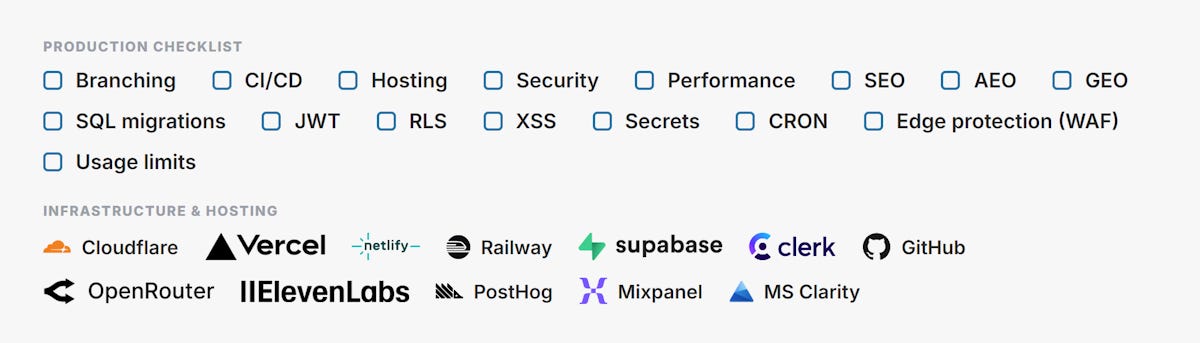
Recommended reading for this section:
PM Skills 2.0: Red-Team Your Roadmap, Then Check the Code Before You Ship (free prompts and commands, incl. /ship-check, /security-audit-static, /performance-audit-static)
11. Model Performance & Cost
Inference
The process of using a trained model to make predictions on new data. In the case of large language models, this means generating a response based on the input prompt. It’s what happens when you “ask” the model something.
LLM Limits
Practical constraints of language models, including context size, latency, cost, reliability, hallucination risk, and tool-use errors.
Time to First Token (TTFT)
The time it takes from sending a request to when the first token of the response appears. Even if the full answer takes longer, a fast TTFT makes the system feel more responsive to the user.
Tokens Per Second
A measure of how fast a language model generates output. It tracks how many tokens (chunks of text) the model produces each second. Faster speeds mean quicker responses and better user experience.
Quantization
A method to shrink the size of a model and make it run faster. It works by converting the model’s internal numbers from high precision (like 32-bit floats) to smaller ones (like 8-bit integers). This helps reduce memory usage and speed up inference with only a small drop in accuracy.
12. Safety, Ethics & Alignment
AI Slop
Low-quality, generic AI-generated content produced at high volume with little human judgment. It usually looks plausible on the surface but adds no real value, and it is the typical output of an unattended loop with a weak stop condition.
Bias & Fairness
AI models can pick up biased patterns from the data they were trained on. This can lead to unfair or harmful outcomes, especially when decisions affect people. Fairness means detecting, reducing, and preventing those biases from impacting results.
Eval-Driven Development
Building an AI feature by first defining how you will measure whether it works, then improving the system against that evaluation set. The evals become the spec: you fix the underlying cause of each failure and re-run the full set until outputs clear the bar.
Paweł: This approach directly contradicts the spirit of AI Evals
Recommended reading:
Explainability / Interpretability
The ability to understand why a model made a certain prediction. This helps people trust the system, find errors, and meet legal or ethical standards. Techniques might show which inputs mattered most or how decisions were made step by step.
Guardrails
Controls that keep an AI system inside allowed behavior. Guardrails can include prompt rules, permissions, tool allowlists, validators, policy checks, human approvals, runtime blockers, rate limits, and output filters. For agents, guardrails should be architectural, not just polite instructions in the prompt.
Hallucination
When a language model makes something up and presents it as if it were true. The response might sound convincing, but the facts are incorrect or completely invented. This is a major issue for tasks that require accuracy or trust, especially in AI Agents and Multi-Agent Systems.
Human-in-the-Loop (HITL)
A setup where humans stay involved in the AI’s workflow. People might review outputs, make the final decision, or correct the model when it’s unsure. This helps improve safety, quality, and accountability, especially in sensitive or high-risk situations.
Red Teaming
Actively trying to break, misuse, or stress-test an AI system before users or attackers do.
13. Neural Networks & Transformers
Activation Function (advanced)
A mathematical rule inside a neuron that decides how it reacts to input. It helps the network capture complex patterns by adding non-linear behavior to the model.
Backpropagation (advanced)
The learning process used in neural networks. It calculates how much each weight contributed to the error and then updates those weights to reduce the loss in future predictions.
Feedforward Network (advanced)
A part of the transformer that processes the results from the self-attention step. It’s a small neural network that helps the model refine its understanding before passing data to the next layer.
Loss Function
A way to measure how far off the model’s predictions are from the correct answers. It gives the model feedback during training so it knows what to improve.
Masked Attention (advanced)
Used in transformer decoders to make sure the model doesn’t look ahead when generating text. This is important during training so the model learns to predict the next word without cheating.
Neural Networks
A type of machine learning model inspired by how the human brain works. It’s made up of layers of connected units called neurons. Each neuron processes input data and passes signals forward to help the model learn patterns.
Positional Encoding (advanced)
Since transformers don’t process data in order by default, this adds information about the position of each token in the sequence. It helps the model understand the order of words.
Self-Attention (advanced)
A key mechanism in transformers that lets each token in a sequence look at the others. This helps the model understand relationships between words, even if they’re far apart.
Tokenization
The step where input text is broken down into smaller parts, called tokens. These can be words, characters, or subwords. The model processes these tokens instead of raw text.
Weights of a Model
The internal settings of a neural network that get adjusted during training. They control how strongly each input affects the model’s prediction and are what the model "learns" over time.

Recommended reading:
Keep Learning
Thanks for reading The Product Compass!
You might also explore our practical step-by-step guides available in the AI Product Management section and office hours recordings.