

I added three blocks to my CLAUDE.md a month ago. By week three, Claude was applying 24 project-specific rules it had written itself — rules I never prompted, extracted from patterns across dozens of sessions.
What You’ll Learn:
A Knowledge Architecture block that turns Claude into a system that learns across sessions — not just a tool that forgets
A Decision Journal block that logs every meaningful choice with full reasoning, so Claude (and your team) never re-debates settled decisions
A Quality Gate block that gives Claude concrete evaluation criteria — because agents can’t objectively judge their own work
A schedule suggestion that keeps the whole system from going stale
The full integrated CLAUDE.md — all three blocks ready to paste
0. Memory Without Reflection
Claude remembers. It writes its own memories, reads your CLAUDE.md, follows your conventions. But it doesn’t reflect on what it knows.
It captured that your pricing test showed 40% churn. It captured that a competitor dropped their free tier. It captured that onboarding users churned less. Three separate observations in three separate sessions — and Claude never connected them.
Memory without reflection is just storage.
Claude now ships with built-in configuration — the .claude folder, settings files, rules. Boris Cherny, the creator of Claude Code, shared how his team uses CLAUDE.md internally — every correction becomes a rule, checked into git.
That’s a good foundation. But it’s a correction log. The system doesn’t promote patterns on its own. It doesn’t test its own hypotheses. It doesn’t evaluate whether its work meets project-specific standards.
The community has built impressive tooling on top of this. Some repositories catalog 135+ agents, 42 commands, and hundreds of plugins. Powerful systems for teams that want deep infrastructure.
Most builders need something they can paste in 90 seconds that makes Claude measurably better by next week.
Three blocks. Each one targets a different failure mode — learning, deciding, evaluating. Together, they turn memory into a system that reflects, connects, and compounds.
1. Knowledge Architecture — The Learning Loop
The problem: Claude captures observations but never revisits them. Insights from last week's session don't inform this week's work. There's no mechanism to test whether a pattern holds, promote it when it does, or discard it when it doesn't.
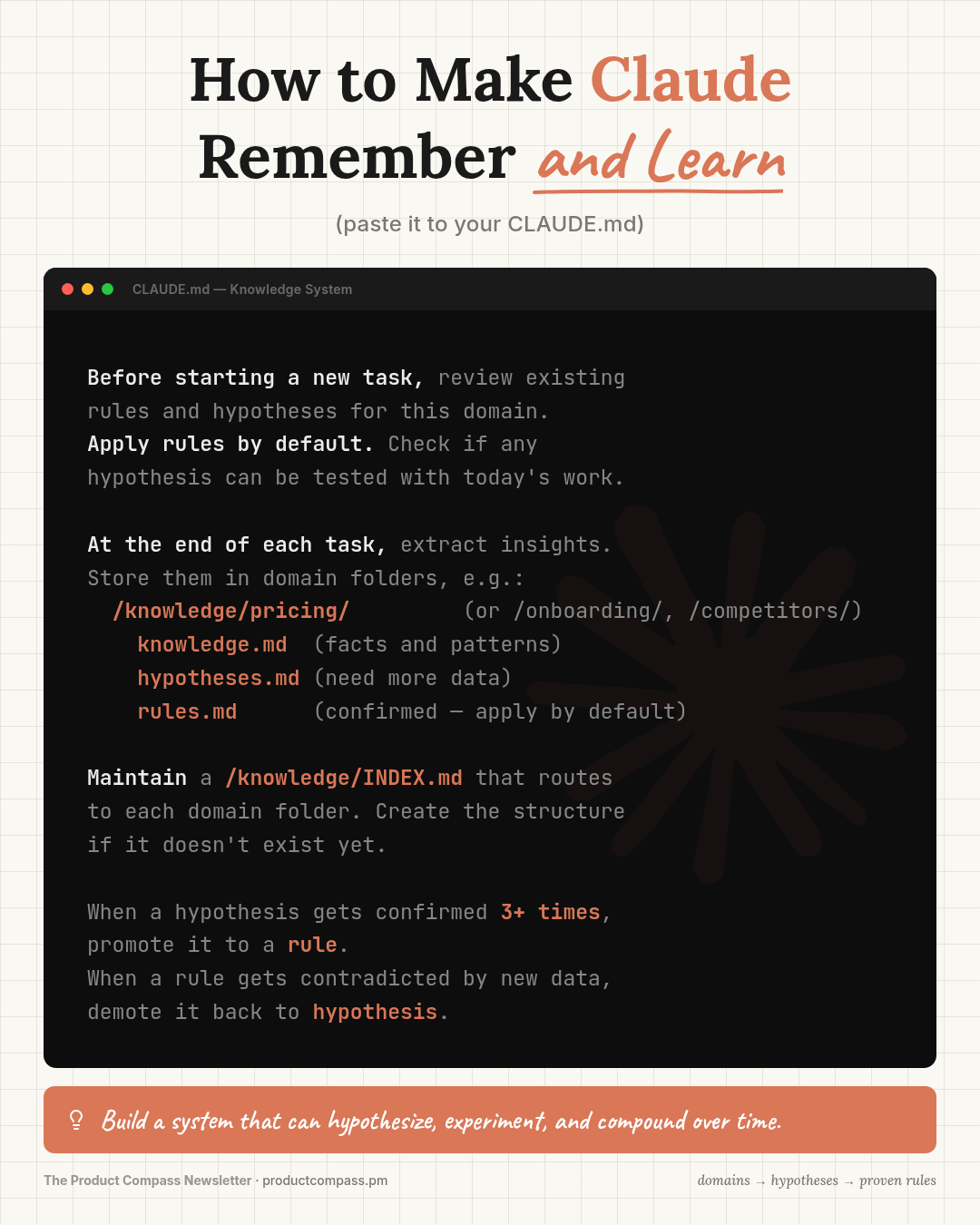
The snippet:
Before starting a new task, review existing rules and hypotheses for this domain.
Apply rules by default. Check if any hypothesis can be tested with today's work.

At the end of each task, extract insights. Store them in domain folders, e.g.:
  /knowledge/pricing/         (or /onboarding/, /competitors/)
    knowledge.md  (facts and patterns)
    hypotheses.md (need more data)
    rules.md      (confirmed — apply by default)

Maintain a /knowledge/INDEX.md that routes to each domain folder.
Create the structure if it doesn't exist yet.
When a hypothesis gets confirmed 3+ times, promote it to a rule.
When a rule gets contradicted by new data, demote it back to hypothesis.
How it works: Before every task, Claude reads the existing knowledge — active retrieval, not passive storage. The value isn't in the files. It's in Claude checking them mid-session before making a recommendation.
After a month, I had a folder with 24 rules Claude applied automatically. I didn’t write those rules. They emerged from dozens of sessions. Claude was measurably better than day 1 — not because of better prompts, but because the system had been learning the whole time.
Want to build with Claude? Join our AI Agents Claudathon — ship real agentic products with Claude Code. No experience required. Limited to 60 students.
2. Decision Journal — Reviewable Reasoning
The problem: Someone asks why you picked Postgres over DynamoDB. Or why you killed the freemium tier. Or why the onboarding flow skips the team invite step. Nobody remembers. So you spend 30 minutes re-debating a decision that was already made.
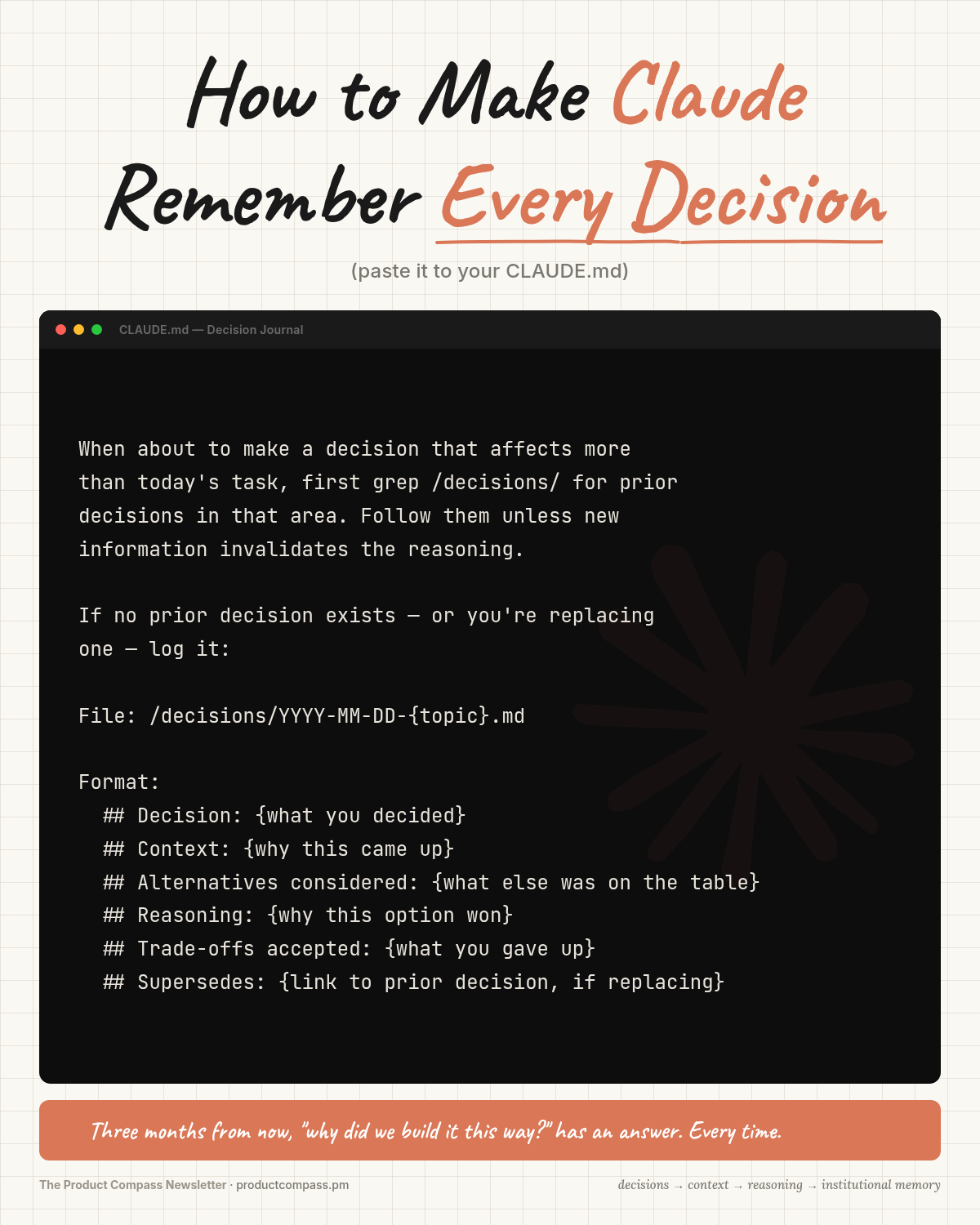
The snippet:
When about to make a decision that affects more than today's task,
first grep /decisions/ for prior decisions in that area.
Follow them unless new information invalidates the reasoning.

If no prior decision exists — or you're replacing one — log it:

File: /decisions/YYYY-MM-DD-{topic}.md

Format:
  ## Decision: {what you decided}
  ## Context: {why this came up}
  ## Alternatives considered: {what else was on the table}
  ## Reasoning: {why this option won}
  ## Trade-offs accepted: {what you gave up}
  ## Supersedes: {link to prior decision, if replacing}
How it works: If you’ve worked with Architecture Decision Records, this will feel familiar — same principle, enforced by Claude instead of team discipline.
When decisions get replaced, the Supersedes field creates a traceable chain. Robert Ogilvy suggested this addition and the retrieval-first ordering, and both made the journal sharper.
A month in, the patterns surprised me. The decisions I was most confident about had the worst hit rate. The ones where I forced myself to write out three alternatives before choosing were right 80% of the time.
Keep reading with a 7-day free trial.
What’s inside the paid section:
The third block — Quality Gate — and why Claude can’t evaluate its own work without it
A self-maintenance instruction that keeps the whole system from going stale
How the three blocks reinforce each other (the compounding thesis)
The full integrated CLAUDE.md — all three blocks + schedule suggestion, ready to paste
3. Quality Gate — Evaluation Criteria That Compound
The problem: Claude finishes a task and tells you it’s done. You ask if the work is good. Claude says yes — confidently, every time.
Anthropic’s own engineering team documented this: when asked to evaluate work they’ve produced, agents confidently praise it — even when the quality is mediocre. The agent that built the thing can’t objectively evaluate the thing.