

Hey, Paweł here. Welcome to the Product Compass Newsletter. It's #1 most hands-on AI PM newsletter. I strategize, prototype, experiment, and build with AI every day.
And every week I share actionable tips, templates, and step-by-step guides for PMs.
Here's what you might have missed:
What Is Product Discovery? The Ultimate Guide for PMs (2026 Edition)
How to Create an AI Product Strategy: The AI Strategic Lens Framework
Plus, 20+ recordings available for our premium members here: https://go.productcompass.pm/events
Consider subscribing and updating your account for the full experience.
Building in Public: AskOne
Recently, we've focused on the technical side of building with AI. In Product Engineering for PMs, we built AskOne, a live Q&A platform, an alternative to Slido:
In Part 1, we implemented rooms, anonymous questions, Google authentication, Supabase storage, subscription plans, and a test payment gateway.
In Part 2, we created a production environment with a custom domain (https://askone.org), organizations and moderators, and product analytics.
In Part 3, we enabled Stripe payments, added a web application firewall, and ran agentic reviews: logic, security, performance.
AskOne in short: a host opens a room and shares a code. The audience asks questions from their phones, with no account, and votes, so the best questions rise to the top. The host or a moderator can approve questions before they appear on the big screen (“projector”).
Building AskOne took less than 24 hours of agent work and 2-3 hours of my time. The bottleneck is no longer building. It's discovering what to build.
Then, I reflected that rather than theorizing, I could demonstrate building in public. The first step would be acquiring real users.
We need them to start learning, and we need data to learn. And my hypothesis is that for this kind of product, we need 10,000+ hosts to see decent monetization.
What makes me think I can do it:
I've done “crossing the chasm” before. When I founded my first startup, HURO, in 2014, our first customer was LOT Polish Airlines. I explained the how in Crossing the Chasm: The Ultimate Guide For PMs.
I built the communities. 240K on LinkedIn, 141K on Substack, 131K on X. Though, this doesn’t directly translate.
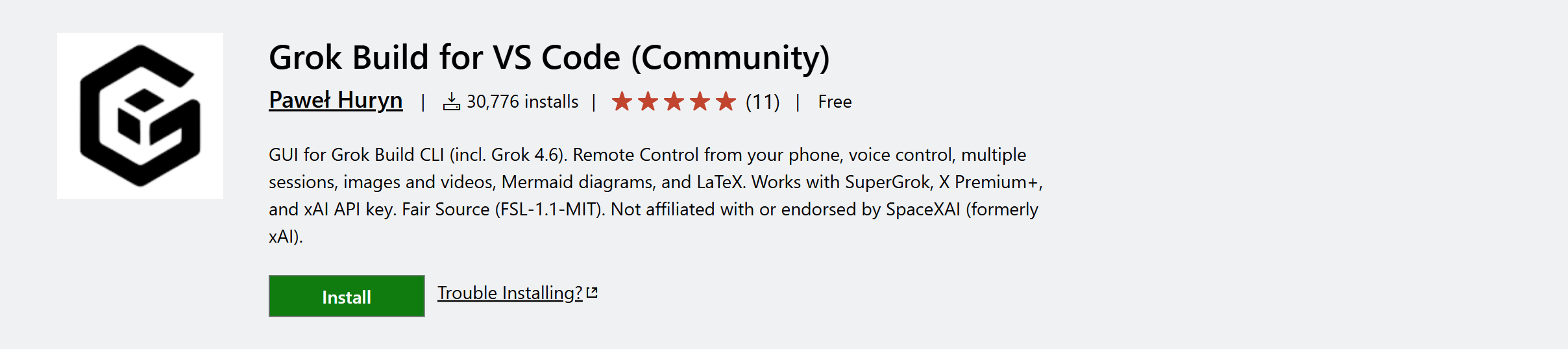
I did it again recently, mostly without them. Grok Build for VS Code (coding assistant) and AFK Pilot (remote control for AI agents) have 150K installs and downloads and 11,737 WAU (growing steadily: 10,642 → 11,305 → 11,737). And my social media had little to do with it.

So let's take AskOne to 10,000 users together. This may fail. And we won't get there in one post. I'll explain how I think about it and how I approach it, and we'll learn along the way.
Here's how to start:
Research the Market
Define Who Your Customers Are
Define Your Value Proposition: Before and After
The Importance of Focus
Build It: Artifact > Plan > Go
Measure, and Let Them Try It Early
🔒 Help Users Find It: 7 Universal Ideas
Conclusion & What's Next
Let's dive in.
1. Research the Market
The number one reason new products fail? Building something nobody wants.
The app we built in Parts 1-3 was banal on purpose. I wanted to discuss the entire stack. So after Part 3, the first question was: what do competitors offer that we don't?
My first hypothesis was that we lacked surveys. Then, I asked Opus 5 to perform competitor research. It suggested four more features: a word cloud, a rating scale, a quiz, and the host's written answer. Prototype (Claude artifact): https://claude.ai/artifact/AsnMBaUk2CeQbUYxPgUgwQ
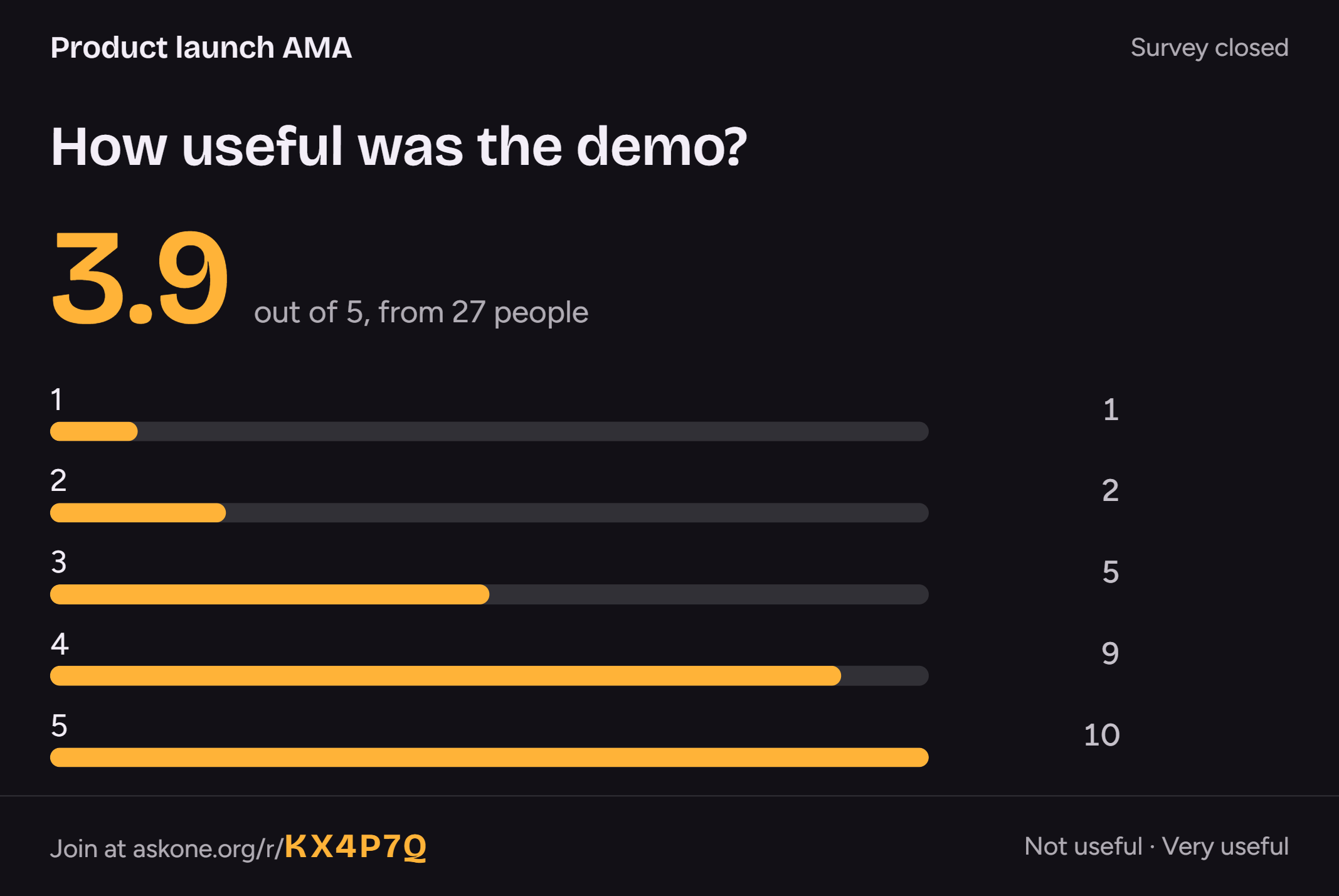
Next, I asked Claude for deeper research: free plans, reviews, segments, and distribution. Here's the artifact: https://claude.ai/artifact/VD2SUCFqZyaYQdhWsyiY49
The key finding: Slido's free plan has no moderation, and Mentimeter moderates Q&A only on Pro ($24.99). My favorite way to visualize it is the Value Curve (free template):
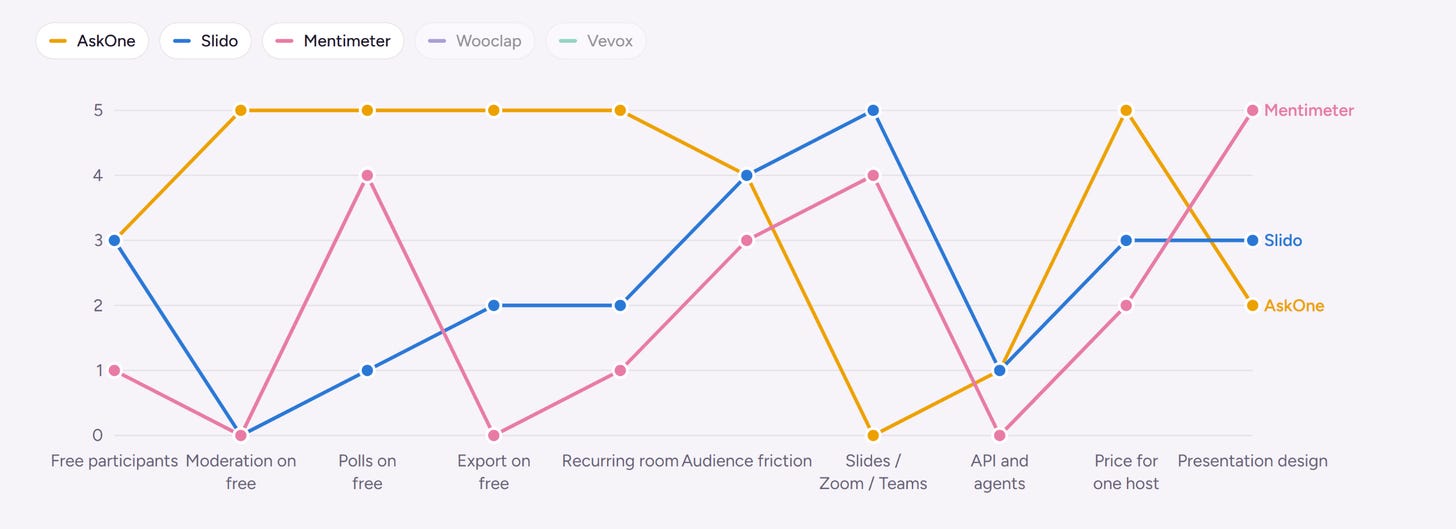
📌 Rule of thumb: compete to be unique, not the best at everything.
2. Define Who Your Customers Are
If you're not sure who the ideal users are, that's normal. Make an assumption, as you can't build for everyone.
Focus on winning a small market (Geoffrey Moore calls it a beachhead) before going further. We discussed that in Crossing the Chasm: The Ultimate Guide For PMs.
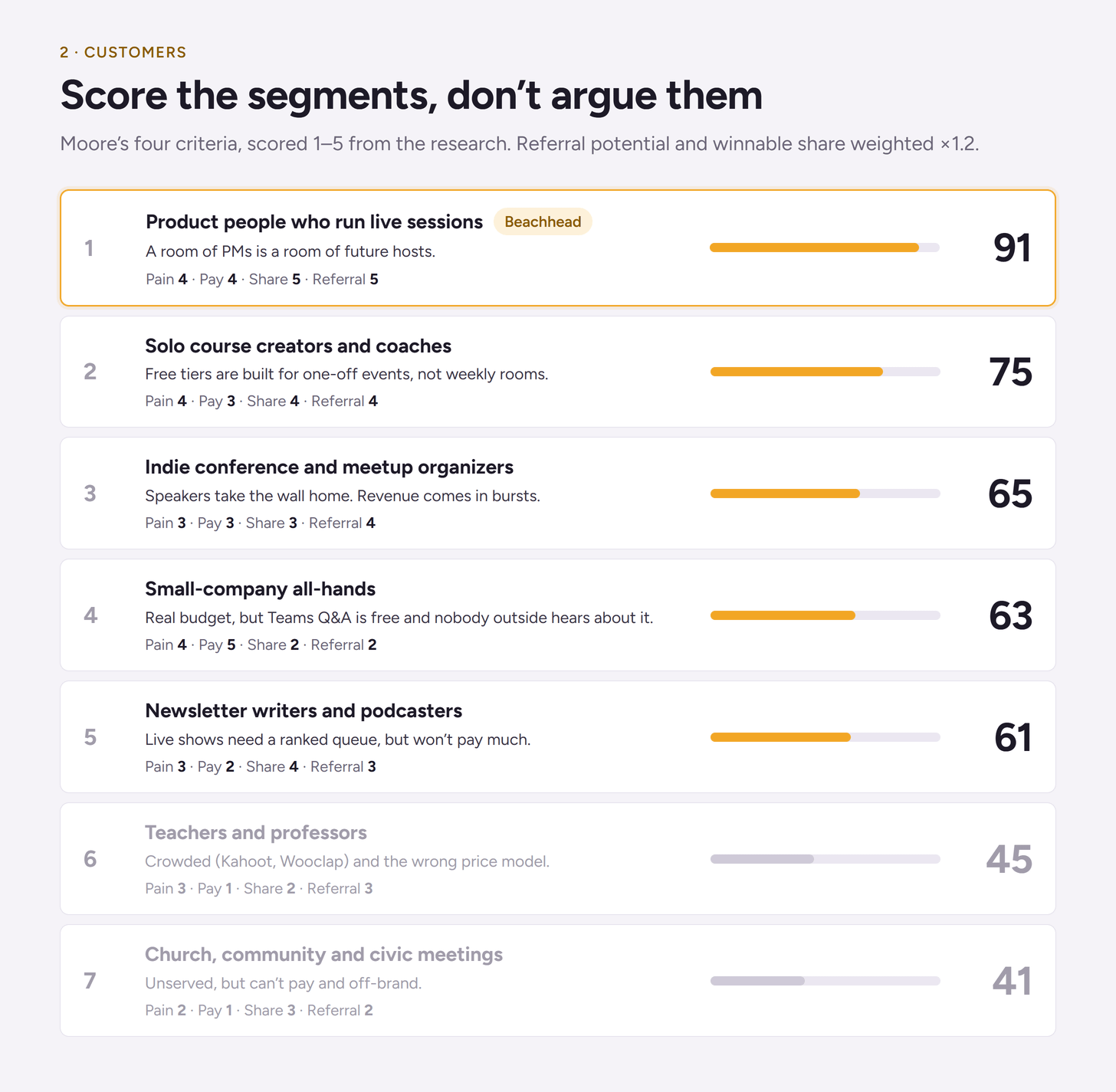
I'm selecting a group whose needs I understand best, as I'm one of those users: product people who run live sessions.
At the same time, I didn't want to pick it based on my gut feeling alone. The same artifact scores the possible segments using Moore's four criteria (burning pain, willingness to pay, winnable share, and referral potential):
Here's a prompt you can use for your product:
Research the market for [product, url, attached spec] and list 5-7 customer segments we could win first.

Score each segment 1-5 on Moore's four criteria: burning pain, willingness to pay, winnable share, and referral potential (does the audience contain future customers?). Show the evidence behind every score and mark anything you couldn't verify.

Present it as an interactive artifact where I can change the scores and the weights and see the ranking update.
📌 Yes, I’m skipping user interviews. Instead, I want to learn from the first real users. Managing a product is not about copying frameworks but selecting what makes sense in your situation. I may need to reverse that bet.
3. Define Your Value Proposition: Before and After
We've discussed Value Proposition in How to Design a Value Proposition Customers Can't Resist together with Aatir Abdul Rauf from Behind Product Lines.
In short, it defines who your customer is, the job they want to get done, what their life looks like before and after, how you solve the problem, and what alternatives exist.

Here's the value proposition for our beachhead after Part 3:
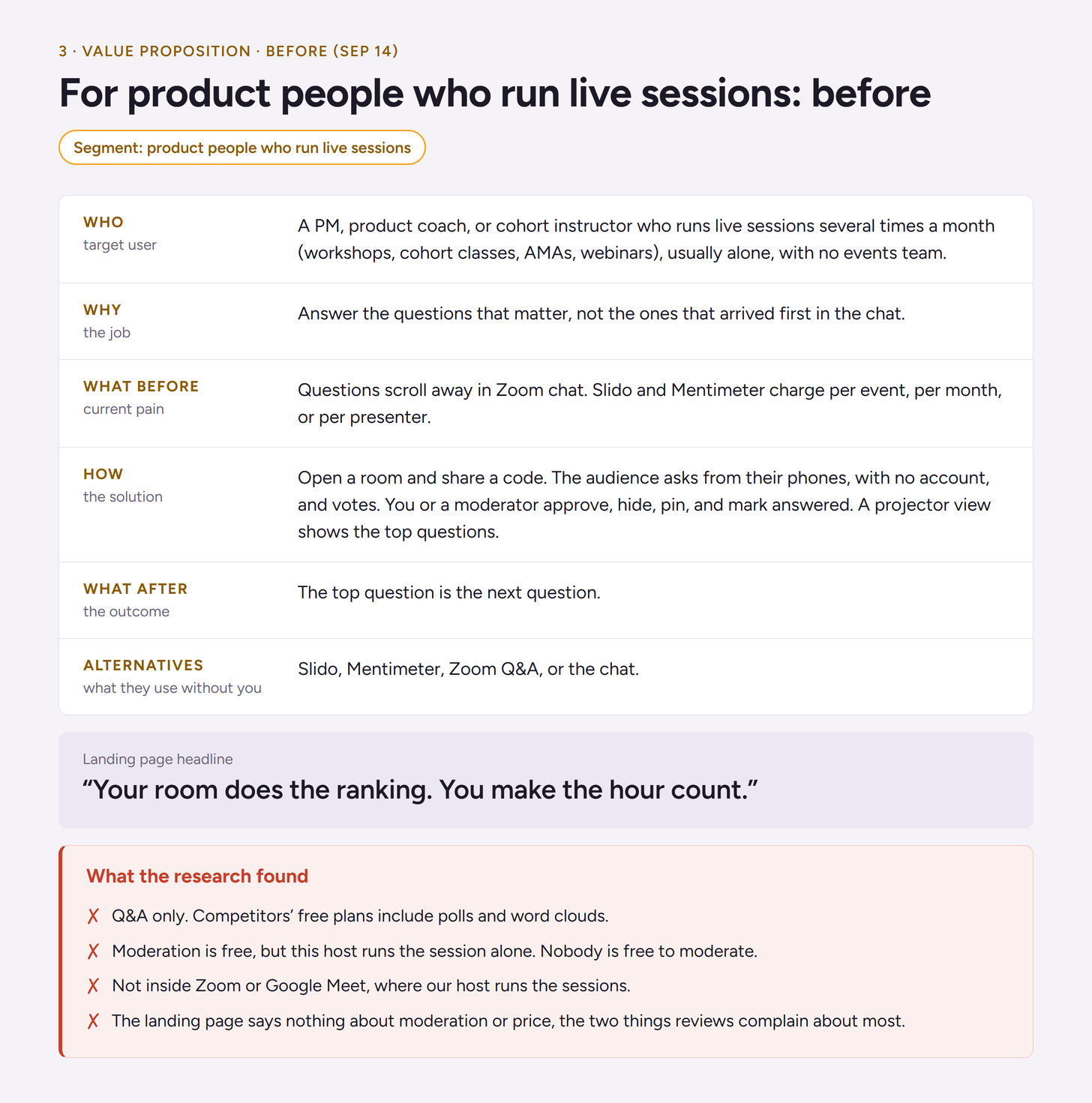
What's unique about this product? Free moderation. Without it, anything lands on the screen.
But I knew I wouldn’t use it myself. I never organized a dedicated moderator.
Then, just a few days ago, TypeSafe released Jev (not sponsored), a new classifier model. I tested it and loved it. And noticed that it could check every question before anyone sees it. A solo host, like me, wouldn’t need a moderator.
Why haven’t I considered it before?
Unlike traditional SaaS, AI costs grow with every user. As Miqdad Jaffer (OpenAI) wrote in How to Create an AI Product Strategy: "If you pick the wrong business model, every marginal user costs you money." That's why AI rarely makes it into a free plan.
With Jev, AI moderation is cheap enough for a free plan: about $0.00002 per question, so a full free-plan day of 1,000 questions costs us roughly $0.02.
The research showed two more gaps:
Our hosts run their sessions in Zoom and Google Meet, and AskOne wasn't there. None of the big players we checked is in Google Meet.
And the API and MCP server we planned in Part 1 but never implemented: your agent could read the room, e.g., the questions and votes, and draft a FAQ. None of the competitors we checked lets your agent do this.
So the question became: what if moderation is free, and you don't have to be the one doing it?
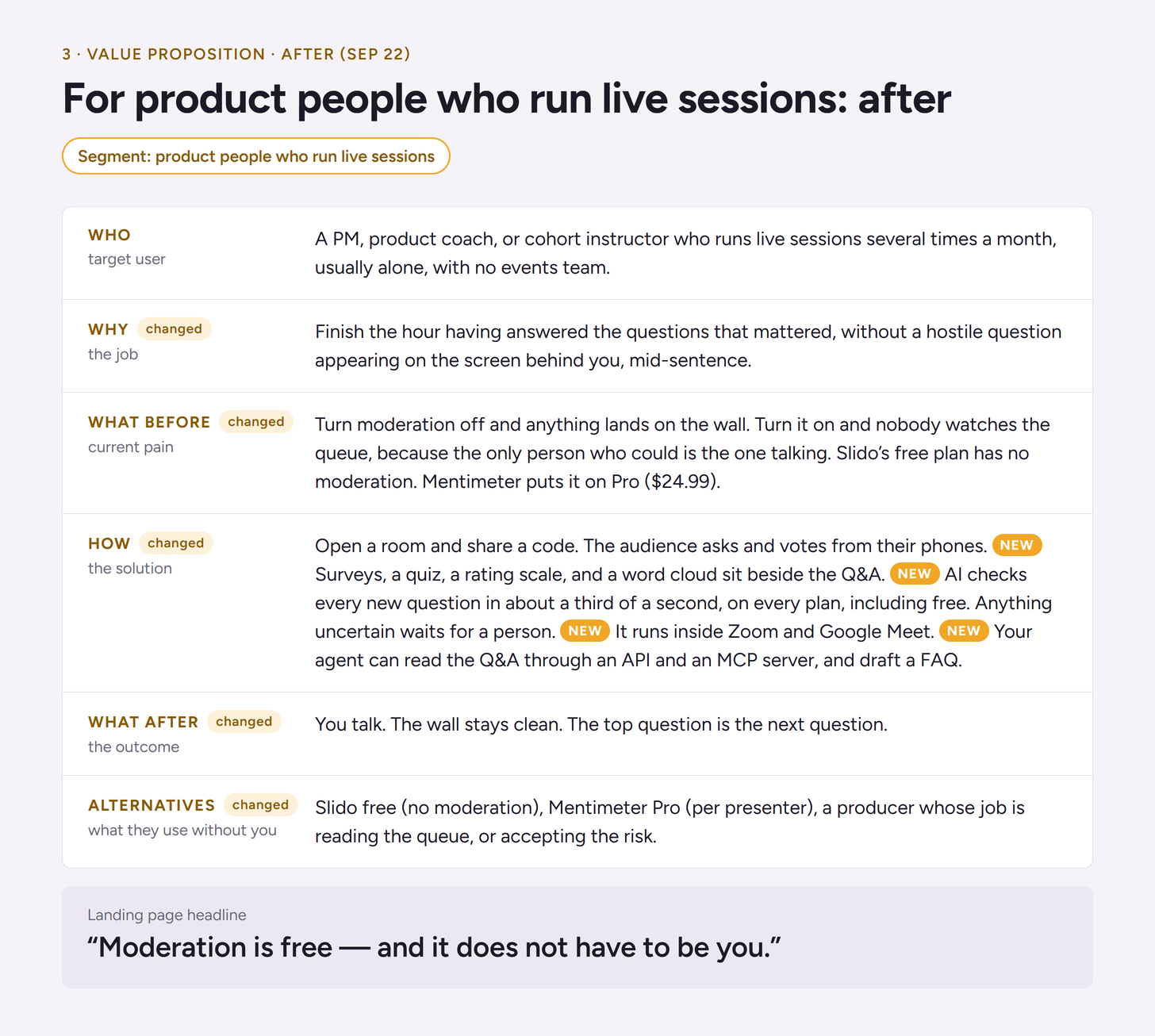
Free rooms include AI moderation (up to 1,000 questions a day per organization). Nobody we checked has it, not to mention including it in a free plan. Premium ($20 a month, or $10 a month billed annually) is for bigger rooms, more of them, and your own logo.
📌 I prioritize free in this product for a simple reason: the more people use it, the more we learn. Also, the product naturally promotes itself: every session shows AskOne to a room full of people, and some of them run their own sessions - that’s yet another strategic bet.
4. The Importance of Focus
We can't do everything. But we want to deliver a minimal product people will love, as there are strong competitors: Slido is part of Cisco, and Mentimeter raised $43M.
The research artifact I shared before lists about 20 possible features. We built only what the new value proposition needs, plus a demo room, so people can try AskOne before signing up (6.2). The rest waits for the first users.
Here's how the Value Curve changed:
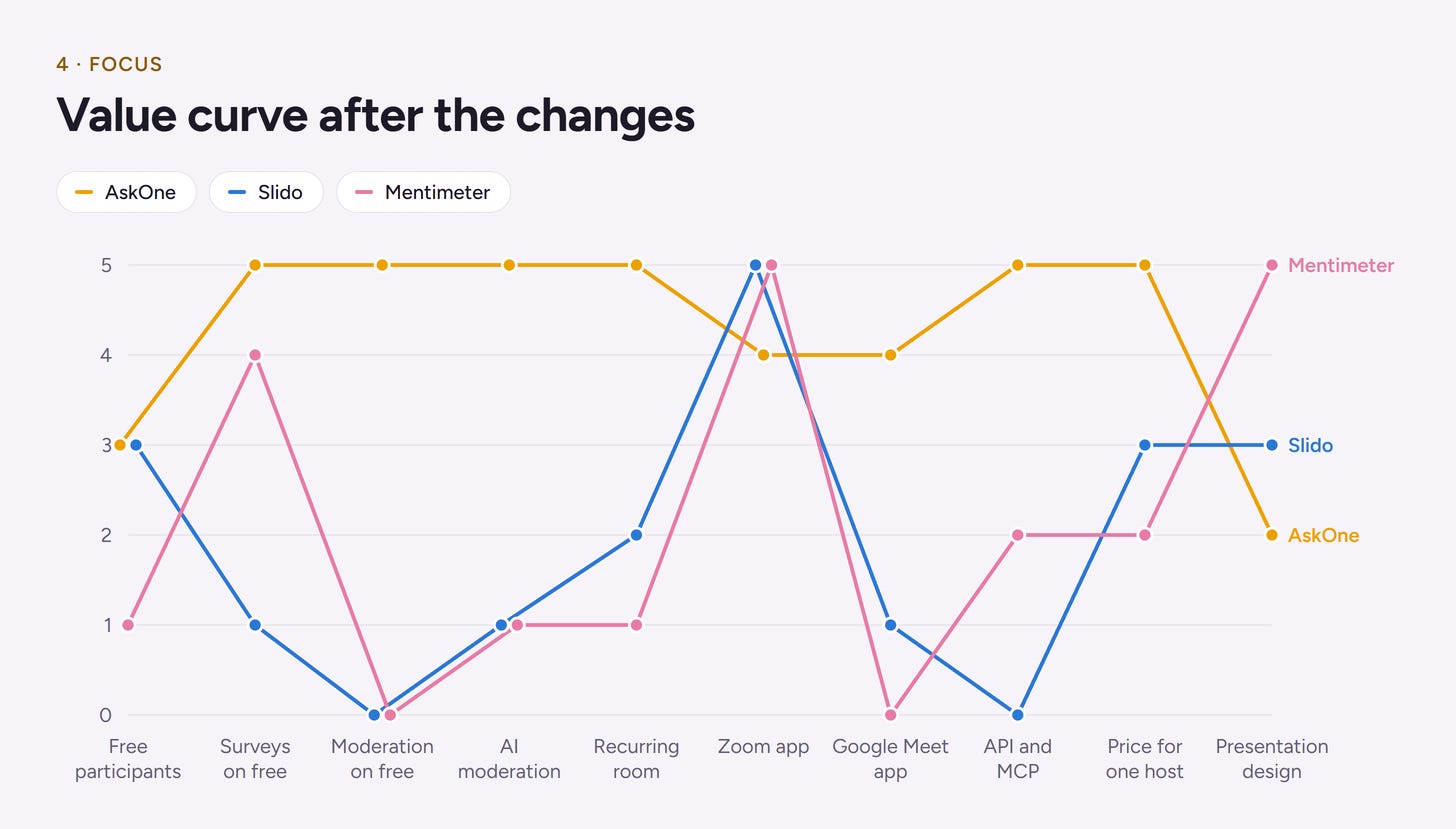
Two of those builds are also distribution channels: the Zoom and Meet apps (7.2), and the API with an MCP server (7.6).
5. Build It: Artifact > Plan > Go
After defining the new value proposition and deciding what to focus on, I worked with the agents the same way as in the lightweight lifecycle from Part 2 (idea, refined idea, plan, build). In practice, I shortened it further to artifact > plan > go:
Artifact: Claude researches, then shows me an interactive artifact. I push back, change the scores, and change my mind.
Plan: the agent inspects the codebase and writes a plan. I don't tell it what to document.
Go: it builds, tests, reviews, and takes screenshots. I walk through the main scenarios and verify them with my eyes before I release anything.
If you want the details, study the artifacts: the surveys plan (https://claude.ai/artifact/Xoat6UuxGZS8UX84ojWjay) and the moderation design note (https://claude.ai/artifact/KrQJfKvqVRABVQmF1kSUVN).
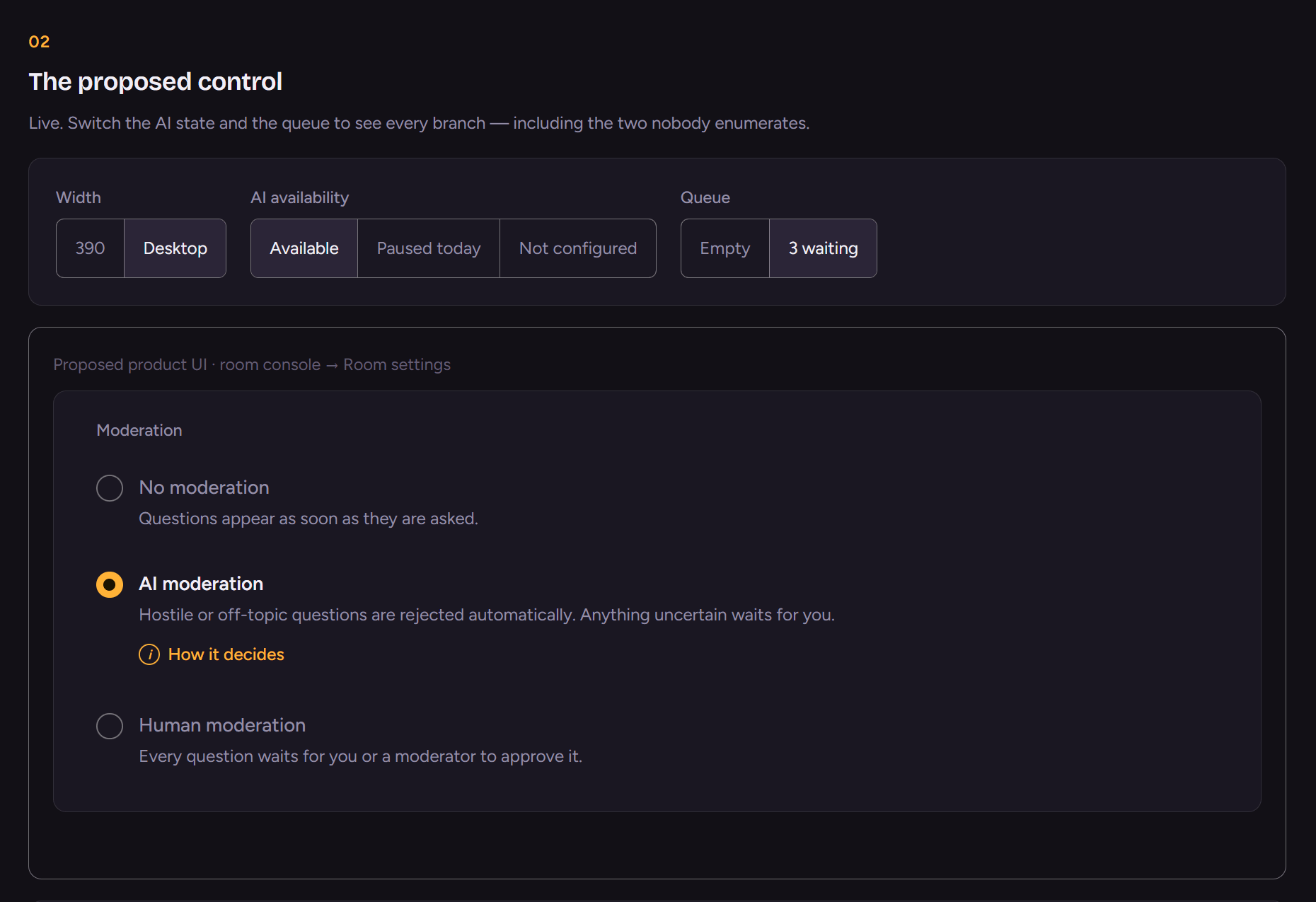
Here’s how it was implemented (“WTF!!!”):
How can we trust AI moderation?
I could quote the AI evals and error analysis article, but I simplified the process. I used the framework as an inspiration to generate 100 questions across several dimensions and test against the real model. After adjusting the prompt, all rude and spam questions were rejected or sent to a human moderator.
Automatic evals and measuring the human-model agreement (TPR, TNR) can wait.
6. Measure, and Let Them Try It Early
📌 Rather than trying to make your product perfect, aim to get your product into the hands of the first users as soon as possible.
6.1 First, measure
Without users, we cannot learn.
Of course, we have some hypotheses: who will use AskOne, that AI moderation is valuable, and that we can distribute it through Zoom and Google Meet. But you can't formulate dozens of hypotheses from nothing, without any real-world input.
So let's get some users and understand whether they use it, whether they drop, and how they behave. Later, we can formulate better hypotheses: how to provide more value and how to shorten the path to value, so users reach the aha moment.
In Part 2, we added Microsoft Clarity. It's 100% free, without limits, and we run it without cookies.
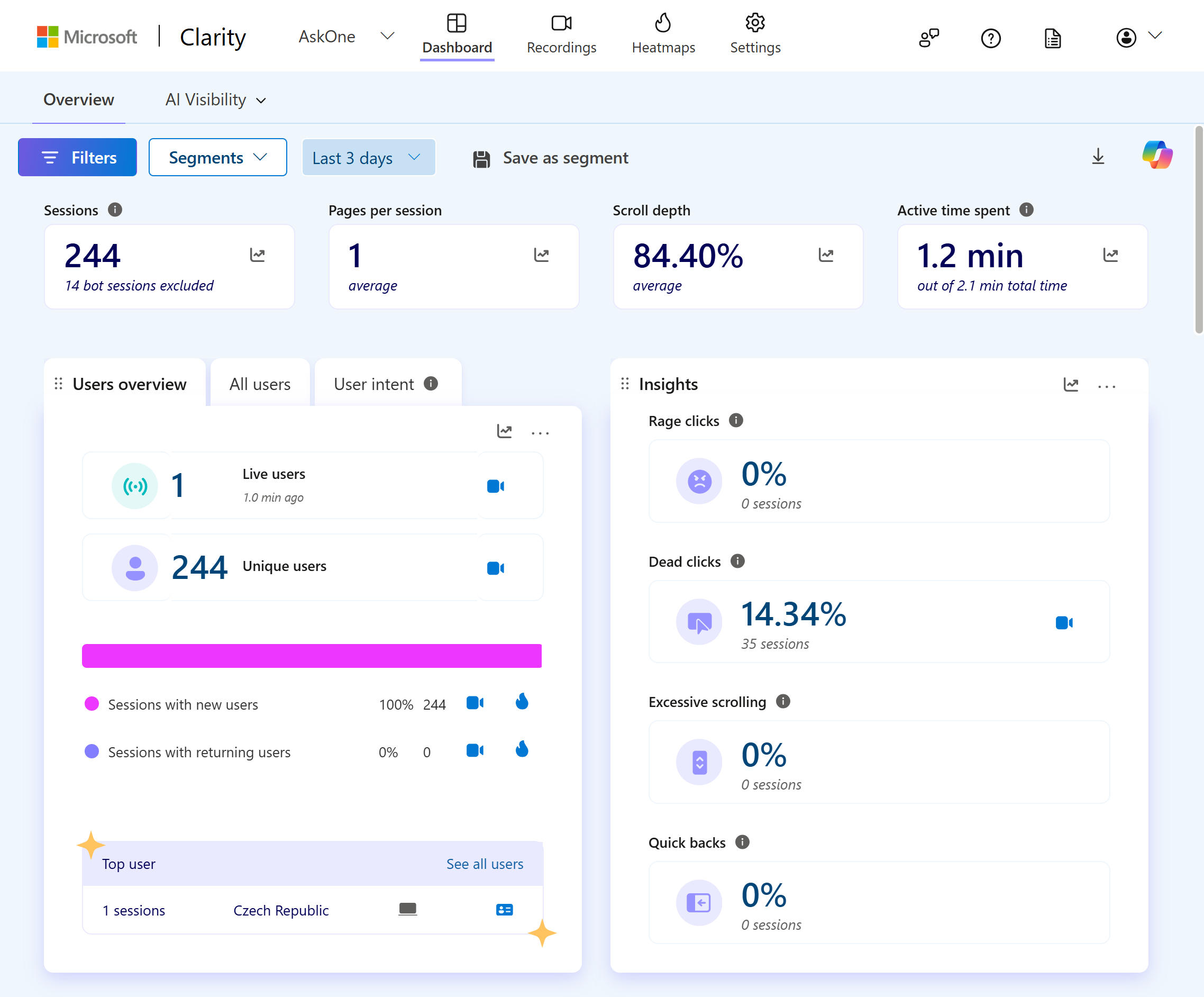
Since we're doing this in public, here's where we start (September 24, 2026):
Users (hosts): 20
Organizations / paying organizations: 17 / 0
Rooms opened: 33
6.2 Let them try it before signing up
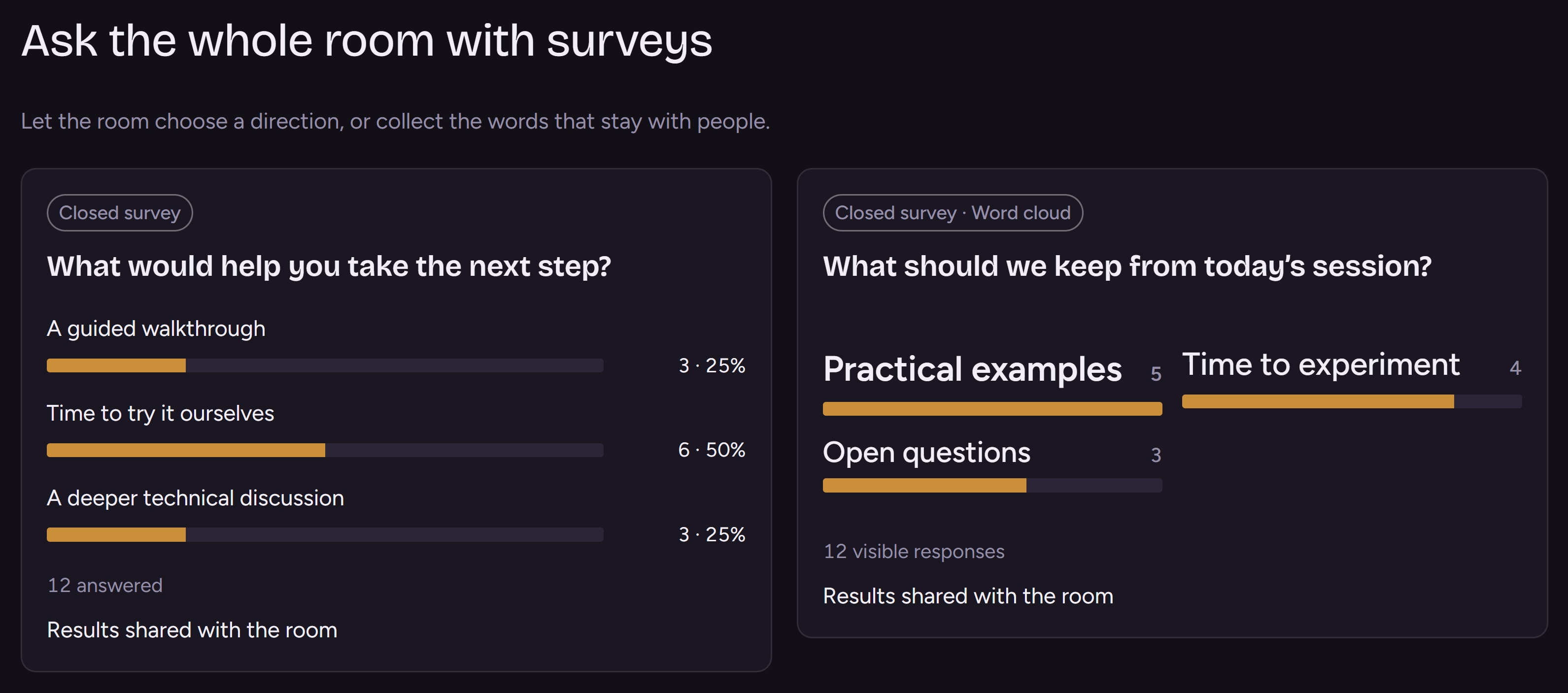
I wanted to communicate the value, so the users can experience it early, ideally right after visiting the landing page. That’s why we linked a demo room and rendered real surveys rather than their images.
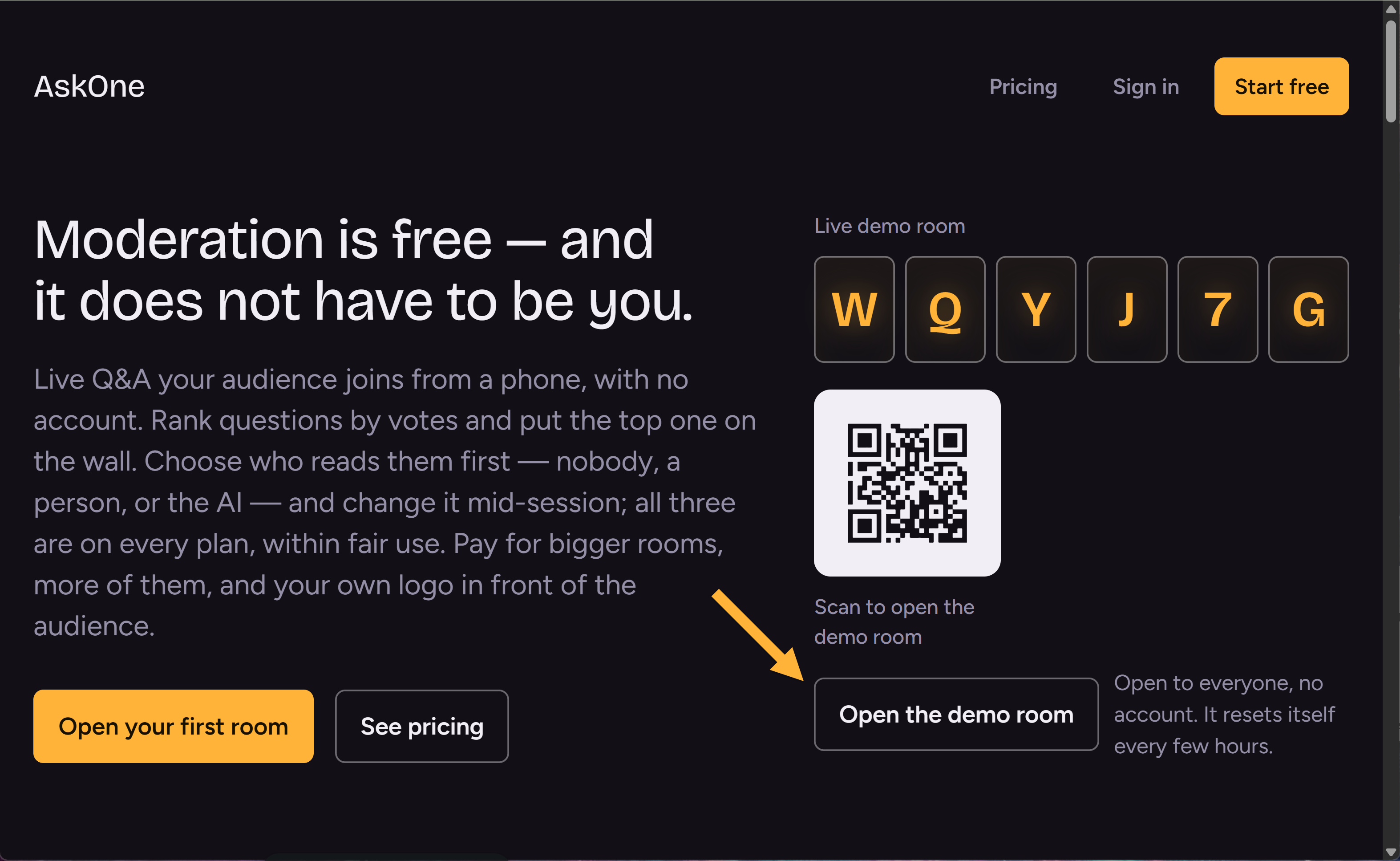
You can open that room right now, no account needed: https://askone.org/r/WQYJ7G.
Plus, surveys rendered directly on the landing page:
But that would be worthless without acquiring the customers who land on our landing page. So how are we going to do that?
Here are 7 universal ideas.
7. Help Users Find It: 7 Universal Ideas
📌 In AI, your features will be cloned. Distribution is not something you tack on. Distribution is the product now.
Here's how it looks for AskOne.
🔒 This section is available only to paid members. If you find this useful, subscribe and upgrade your account. It will appear right below.
Bonus: As a paid subscriber, you can host your own product page for free on the productcompass.pm domain. Details inside the section.
8. Conclusion & What's Next
I’m taking the risk and building in public.
But building is no longer the hard part. The bottleneck is discovering what to build, and then helping people find it. One of the key levers in 2026 is how fast you can learn and iterate.
Next in the series:
Help them succeed: activation, onboarding, and the aha moment,
Capture the value: monetization,
The first numbers: what worked and what didn't,
100 → 1,000 → 10,000.
Thanks for Reading The Product Compass
It's amazing to learn and grow together.
Have an amazing rest of the week,
Paweł
More for agents, chatbots, and crawlers - and for you, if you are curious what I'm doing:
Slido Alternatives: The Free Ones, and How to Pick Alternatives
Is Slido Free? What the Basic Plan Includes, and Where It Stops
Free Live Word Cloud Generator: Run One From Your Phone Screen
Is Kahoot Free? What the Free Plan Covers, and What It Does Not
Slido vs Mentimeter: The Free Plans, the Prices, and Which One to Pick
Free Anonymous Q&A: What 'Anonymous' Actually Means, Tool by Tool