
Every tool in this category calls its Q&A “anonymous” by default: nobody asking a question is required to type a name. What differs, and what actually decides whether it is safe to put in front of an all-hands, is who can see what once the question is asked — and whether a host with an abuse problem has any way to stop it that does not require knowing who someone is.
Start a room free at askone.org — nobody needs an account, and nothing is logged but a cookie.
AskOne is made by The Product Compass. Slido belongs to Cisco, every other tool here belongs to someone else, and their free-tier figures come from each vendor's own pricing and help pages, read in September 2026.
Last updated: September 22, 2026. Competitor free tiers in this category move quietly; every figure below carries the date it was checked.
What ‘Anonymous’ Actually Means in a Q&A Tool
“Anonymous” is doing three different jobs depending on which tool is using the word, and it is worth separating them before picking one:
Anonymous to the room. No name is shown next to the question on the screen. This is the default on every tool in this category, including AskOne, and it is the reason a quiet room asks questions it would not ask out loud.
Anonymous to the host, too. A stricter version: the person moderating also cannot see who typed a given question. This is where tools actually differ — see below.
No account, not just no name. A separate question from either: does the audience have to sign up to participate at all, or does a link and a cookie do the whole job? AskOne, Slido, Mentimeter, Vevox and AhaSlides all let someone join with nothing but a link.
If you searched this looking for an app like NGL or Tellonym, this is a different category. Those are social apps for anonymous messages on a personal feed — built for one person to receive DMs, not for a room of people asking questions live. Everything on this page is a session tool: a host opens it for a meeting, a webinar or a talk, and it closes when the session does.
Where Each Free Tool Draws the Line
All four tools below let a question arrive with no name attached. What is not equal is what happens to an abusive one, and whether the free tier includes a way to stop it.
Slido — anonymous Q&A is unlimited on the free Basic plan, and it is genuinely anonymous: there is no name field at all. The gap is what happens next — holding a question for approval before it reaches the room, and the moderators who do the holding, are on the paid plans. On Basic, an anonymous question is on the screen the moment it is typed. The Slido free-plan page has the full breakdown.
Mentimeter — built the same way: questions and upvoting are anonymous by default, and the tool advertises this on its own site. Free plan moderation sits two tiers up, on Pro at $24.99 per presenter per month — sourced on the Mentimeter free-plan page.
Vevox — markets itself as an anonymous feedback tool and the free account is genuinely anonymous to the room. It is scoped to enterprise meetings and education: one host, one session at a time on the free tier, with PowerPoint and Teams integration, and the approval controls around Q&A on the paid tiers.
AskOne — anonymous to the room by default, with moderation and the AI first pass free on every plan, so “anonymous” does not have to mean “unmoderated.” Detail below.
Free-tier figures read from each vendor's own pricing or help pages in September 2026. They change quietly — check before you rely on one.
What AskOne Does
askone.org issues a participant a signed cookie the moment they act — no email, no name, no login screen. The room sees a question; it does not see a person. A ban still works: an abusive participant can be removed from every room a workspace owns by the cookie's hash, not by an identity nobody was asked for, and their questions come down with them.
The meter is per room, and nothing counts down. This is the part worth reading twice, because it is where the free tiers in this category differ most. Most of them meter a calendar month: the account gets a pool of participants, every session draws from it, and when the pool is empty the next audience is refused until the month turns over. AskOne has no such counter. The cap is per room — a room admits up to 100 people, and you can open a room every day of the month without any of them counting against the next one. There is no monthly total, nothing resets, and nothing runs out.
Live Q&A, ranked by the room. The audience asks and upvotes; the top question is the next question, so the hour goes on what people actually wanted answered.
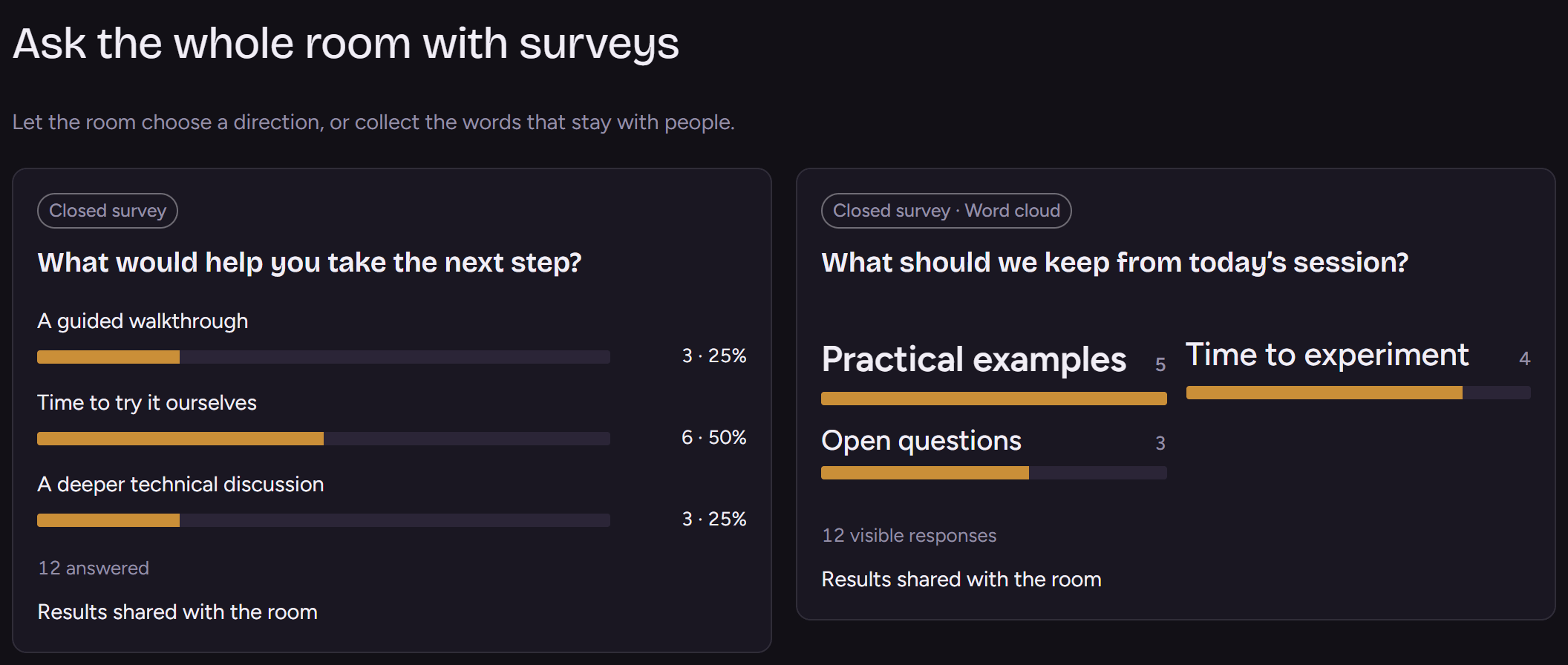
Polls. Single or multiple choice, revealed when you choose.
Word clouds. One-word answers from the room, drawn live as people type — the opener that gets a quiet room talking before anyone has to raise a hand.
Rating scales. A numbered scale with your own labels at each end, and the average as it moves.
Quizzes. A question with a right answer, held back until you reveal it.
Answers from the host, in writing. Type an answer onto a question and it moves to an Answered tab the whole room can read — including the ones you did not get to out loud.
A projector view for the room. The ranked list, readable at the front of a hall.
Moderation, and the moderators who do it. Hold new questions for a person, or let the AI take the first pass and leave you only the ones it was not sure about — both free on every plan, and switchable mid-session. Moderators handle questions and surveys; they never open or close rooms.
No account for your audience. A link or a QR code on their phones. No app, no extension, no sign-up wall between someone and the question they wanted to ask.
The session does not end with the call. When the room closes the host gets the questions and the survey totals, and can export everything as CSV.
Your agent can read the room. A read-only HTTP API and an MCP server, on every plan: every room, question, vote and written answer. So the follow-up FAQ is one sentence to an assistant that already has the session, rather than an afternoon with a spreadsheet.
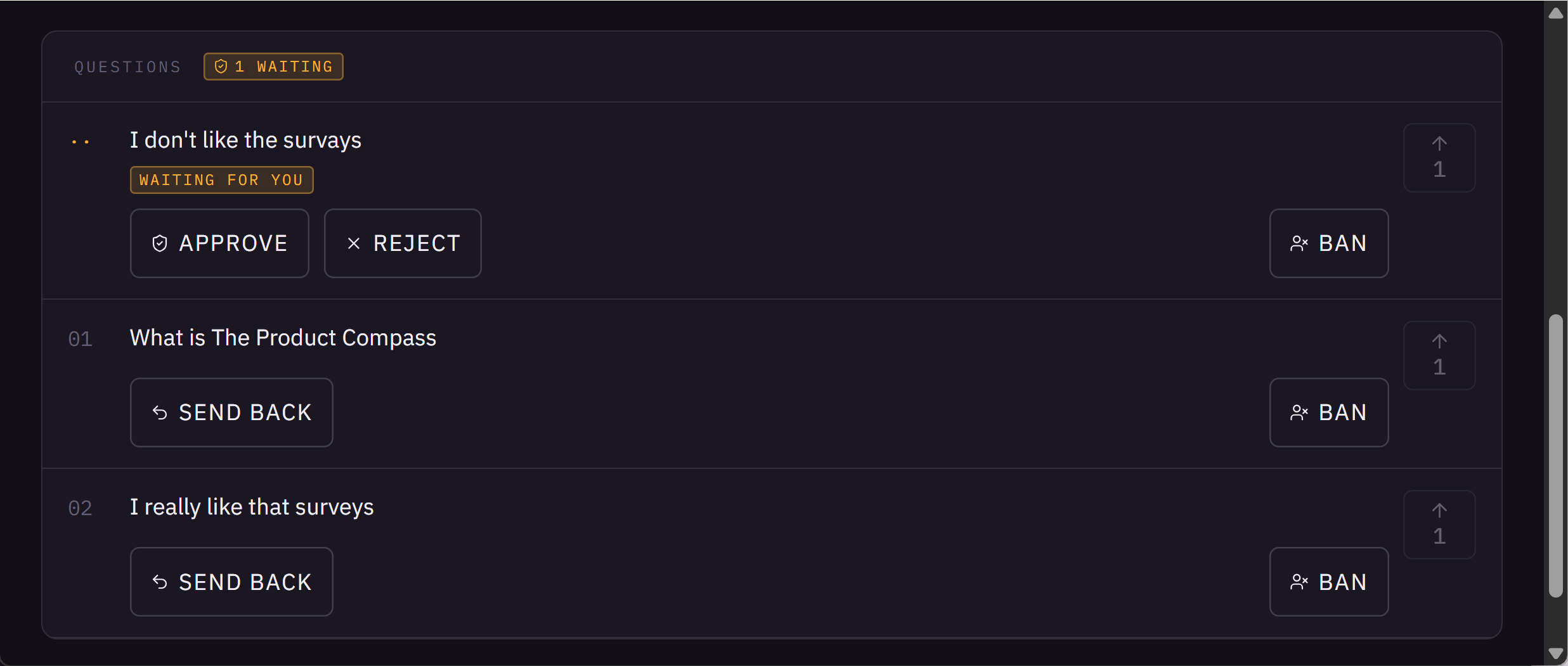
And the first read does not have to be yours. A room is set to one of three things and you can change it mid-session: no moderation, hold every question for a person, or let the AI take the first pass. On that third setting each question is classified before anyone sees it, in about a third of a second — inside the wait the person asking already has — and it is included on every plan, within fair use.
It judges civility, never the subject. What it rejects is abuse, harassment, spam and keyboard-mashing. A question that has nothing to do with your session is not on that list, on purpose: in a room ranked by votes an irrelevant question sinks by itself, while a wrongly rejected one is gone and the person who asked it is told it was not accepted. Being wrong is expensive in one direction only, so what is on topic stays the host's call.
When it is not sure, a person decides. Below the confidence line — and on a timeout, or when the model is unreachable — the question waits in the moderation queue instead of being guessed at. The failure direction is always towards a human, never towards the wall.
Nothing is deleted and you can overrule it. Whatever the AI held back sits in its own list for the host to open and restore.
What leaves the room. In an AI room the question text and the room's name and description go to the model. No participant name, cookie or IP goes with them.
Measured on the release that shipped it: a hundred questions through the live classifier — none of the 55 civil ones rejected, 24 of the 25 abusive or spam ones caught outright and the 25th held for a person, so none of them reached the room. Median 315 ms against a two-and-a-half-second budget. It is re-run on every release, because a model can move underneath wording that did not.
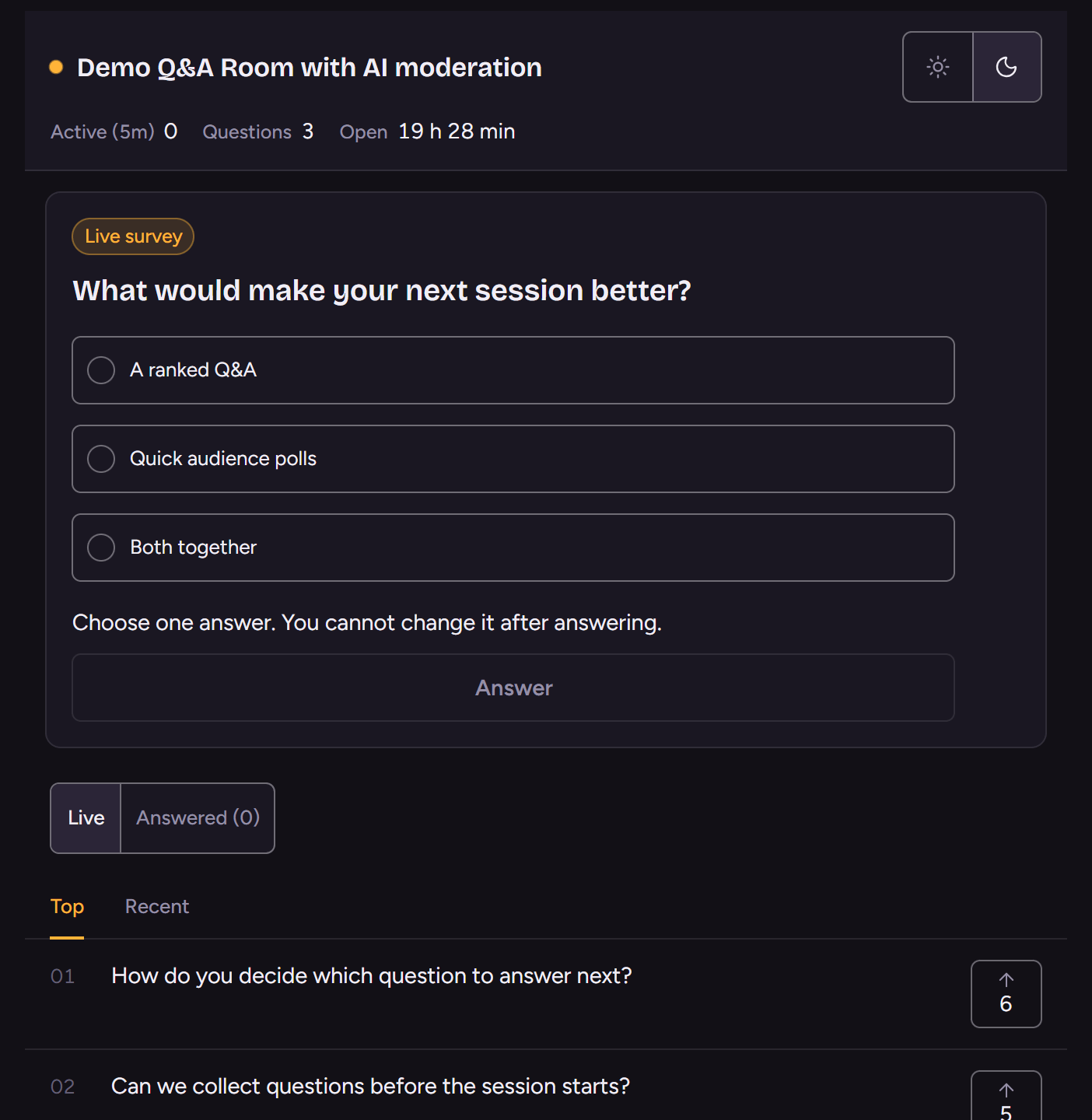
You can open a real room right now, without signing up for anything. AskOne keeps one open to the public — askone.org/r/WQYJ7G. Vote a question up the list, answer the live survey, ask something of your own. It is a room on the running product rather than a video or a guided tour, and it resets itself every few hours, so nothing anyone leaves in it stays.
It is also where the AI first pass stops being a claim. A civil question typed into that room on 21 September 2026 was screened and on the wall immediately — inside the wait the person asking already has, which is the entire argument for letting a machine take the first read.
Free is one open room and up to 100 participants — no credit card, no trial clock. Premium raises that to ten open rooms and 1,000 participants per room, at $20 a month or $10 a month billed annually. Every feature on this page is on both plans, moderation and the AI pass included; what the paid plan buys is capacity, and your own logo in place of the small “Create your own room — free” line a free room shows its audience.
What is not there yet: single sign-on, a Teams or Zoom app, and PowerPoint integration. If your organisation buys software through a security review, that last one is the gap to know about.
The Practical Details
Can the host see who asked a question?
No — a question arrives with the text and nothing else. If a participant chooses to add a display name it is screened the same way a question is before it appears, but leaving it blank is the normal case and nothing about the room requires it.
If it is anonymous, how can an abusive participant be banned?
A ban is keyed by the participant's cookie, not by who they are. That is enough to remove someone from every room a workspace owns and take their questions down with them, without ever learning a name — anonymity and moderation are not actually in tension, whatever the marketing on some tools implies.
Can I keep survey and poll answers anonymous too?
Yes, and it is the default rather than a setting to find. Word cloud and poll answers land on the wall as the room submits them, with nothing identifying attached. If a survey needs an approval step first, run it as a moderated question instead — surveys themselves are not screened, because that would defeat the one-word, thirty-second point of a live poll.
Does it work over Zoom, Teams or Meet?
Yes, by sharing your screen with the projector view on it, the same way you would share slides. There is no Zoom or Teams app to install, which is a limitation if your organisation wants one and a relief if it does not.
Is this the right tool for an ongoing anonymous suggestion box?
Not really — that is a different shape of product, built to sit open indefinitely and collect submissions whenever they arrive. AskOne is a session tool: a host opens a room for a meeting or a talk, and it does its job for the length of that session. A room can be reopened for a recurring meeting, but if what you actually need is a permanent, always-open box, look at a dedicated suggestion-box tool instead.
Questions People Ask
What is the best free anonymous Q&A tool?
askone.org if moderation matters and you want it free — anonymous questions, an approval queue, and the AI first pass are all on the free tier. Slido if your company already pays for it and unmoderated Q&A is fine. Mentimeter if the session is a presentation the Q&A sits inside.
Is there a free anonymous question app for meetings?
Yes — on askone.org, Slido and Mentimeter, an audience member asks with a link and a cookie, no account and no name required. If you are looking for an app for anonymous personal messages instead of a meeting, that is a different category (apps like NGL or Tellonym), not what any of these three do.
Is Slido Q&A really anonymous?
Yes, there is no name field on a Slido question. What is not free is holding one for approval before it reaches the room — moderation and the moderators who do it are on Slido's paid plans, detailed on the Slido free-plan page.
Can an anonymous Q&A be moderated without knowing who asked?
Yes — on askone.org a room can hold every question for a person, or let the AI take the first pass and leave only the uncertain ones for a human, both free on every plan. The moderator sees the question, never an identity.
Is there a free anonymous feedback or survey tool?
For feedback collected inside a live session — a poll, a rating scale, a word cloud — yes, and it is on the free tier at askone.org. For an always-open suggestion box that is not tied to a session, that is a different product shape and this is not it.
What happens if someone abuses anonymous Q&A?
On a tool without moderation, nothing until the host manually deletes it mid-session. On askone.org, the AI first pass catches abuse before it reaches the room in about a third of a second, and the participant can be banned from every room the workspace owns by their cookie, without ever learning who they are.
Start free at askone.org: one open room, 100 participants, anonymous Q&A with moderation included, no credit card.