
Yes, you can run Grok 4.6 inside VS Code today. Grok 4.6 is SpaceXAI’s new flagship model for code, it is the model Grok Build starts on, and the free Grok Build for VS Code (Community) extension puts that agent in a sidebar with diff previews, permission cards, and session history. Setup takes about five minutes.
I also ran it on my own 105-bug benchmark the hour it shipped. Those numbers are below, and they are not SpaceXAI’s.
How to Access Grok 4.6
Grok 4.6 is not a separate install. It is a model, and SpaceXAI shipped it straight into the places you would use it:
In your editor. The free community extension below runs the official Grok Build CLI inside VS Code and Cursor. Grok Build is free to try with usage limits on any X or Grok account, and 4.6 is what a fresh session starts on.
In the terminal. The Grok Build CLI on its own. Same agent, no interface.
In Cursor. SpaceXAI shipped 4.6 to Cursor on day one, natively, alongside Grok Build.
On the API. The model id is grok-4.6, and SpaceXAI points that name at the latest stable version of the model, so it moves with releases. It is on OpenRouter, Vercel, and Cloudflare too.
SpaceXAI is also running 2x included usage inside Grok Build and Cursor for the first week, which makes this the cheapest window there will be to form your own opinion.
What Changed From Grok 4.5
Last verified: August 12, 2026, launch day, against extension v3.6.0.
SpaceXAI’s own framing is long-running agents: Grok 4.6 “stays with complex tasks across many steps.” Their docs call it “the most intelligent and fastest model we’ve built.”
The published numbers put it level with GPT-5.6 Sol on the Artificial Analysis Intelligence Index, 61 to 61, and ahead of Grok 4.5 on every row of the launch table. The gaps are widest exactly where an editor lives, on agentic work: APEX-Agents 57.5% against 47.1%, Terminal-Bench 26% against 15.7%, DeepSWE 65.9% against 54%.
Three things that matter more day to day than a leaderboard does:
The price did not move. Two dollars per million input tokens and six per million output, the same rate card as Grok 4.5. There is a fast variant at twice that.
500,000 tokens of context. This is what makes the long-agent claim mean anything on a real codebase.
A new reasoning tier that 4.5 does not have. It has a spelling trap in it. See below.
Vendor benchmarks are vendor benchmarks. Here is one I ran myself.
What Happened When I Ran It on 105 Real Bugs
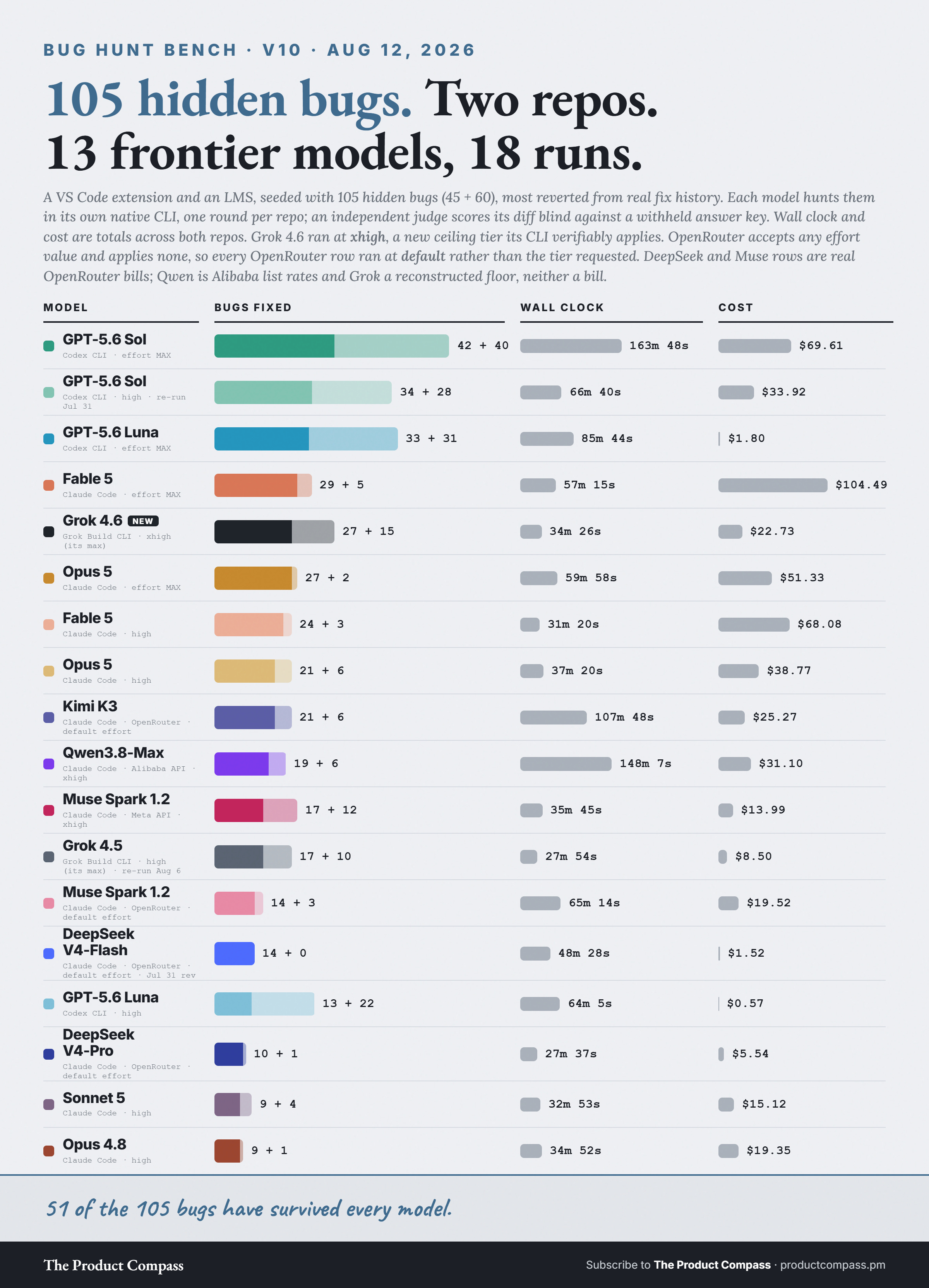
I keep a bench of two real repositories seeded with 105 hidden bugs, 45 in one and 60 in the other, most of them reverted out of real fix history rather than invented. Each model hunts them in its own native CLI, one round per repo, and an independent judge scores the resulting diff blind against an answer key the model never sees.
Grok 4.6, at its top reasoning tier:
27 of 105, plus 15 genuine bugs it found outside the answer key.
Grok 4.5 scored 16, 13, and 17 across three runs at its own ceiling. So this is ten clear of the best 4.5 result, well outside the spread those three runs describe.
On the smaller repo, 4.5 had scored 5 out of 45 three times running, with zero variance. Grok 4.6 doubled it to 10.
It killed a bug no model had ever fixed, across 13 models and 19 scored runs. The all-time survivor count moved from 52 to 51 for the first time in weeks.
Zero claimed-only findings on both repos, meaning it never reported a fix it had not actually made. Only a handful of runs on the whole board manage that.
34 minutes 26 seconds across both repositories, the fastest run among the six highest scores.
The comparison I keep coming back to: Grok 4.6 tied Opus 5 at maximum effort, 27 apiece, while finishing in a little over half the wall clock and finding fifteen unplanted bugs to Opus 5’s two. That is the “fast and cost-effective” claim landing somewhere I can check it.
Two caveats I would want if I were reading this. Grok 4.6 ran at xhigh and Grok 4.5 at high, because those are each model’s ceiling, so it is a fair best-against-best comparison but not a clean isolation of model from tier. And the cost figure for any Grok run here is reconstructed rather than billed, because the CLI reports context occupancy instead of cumulative usage.
Full method, per-run results, and the withheld-key policy: the public benchmark repo.
Turn It On in VS Code
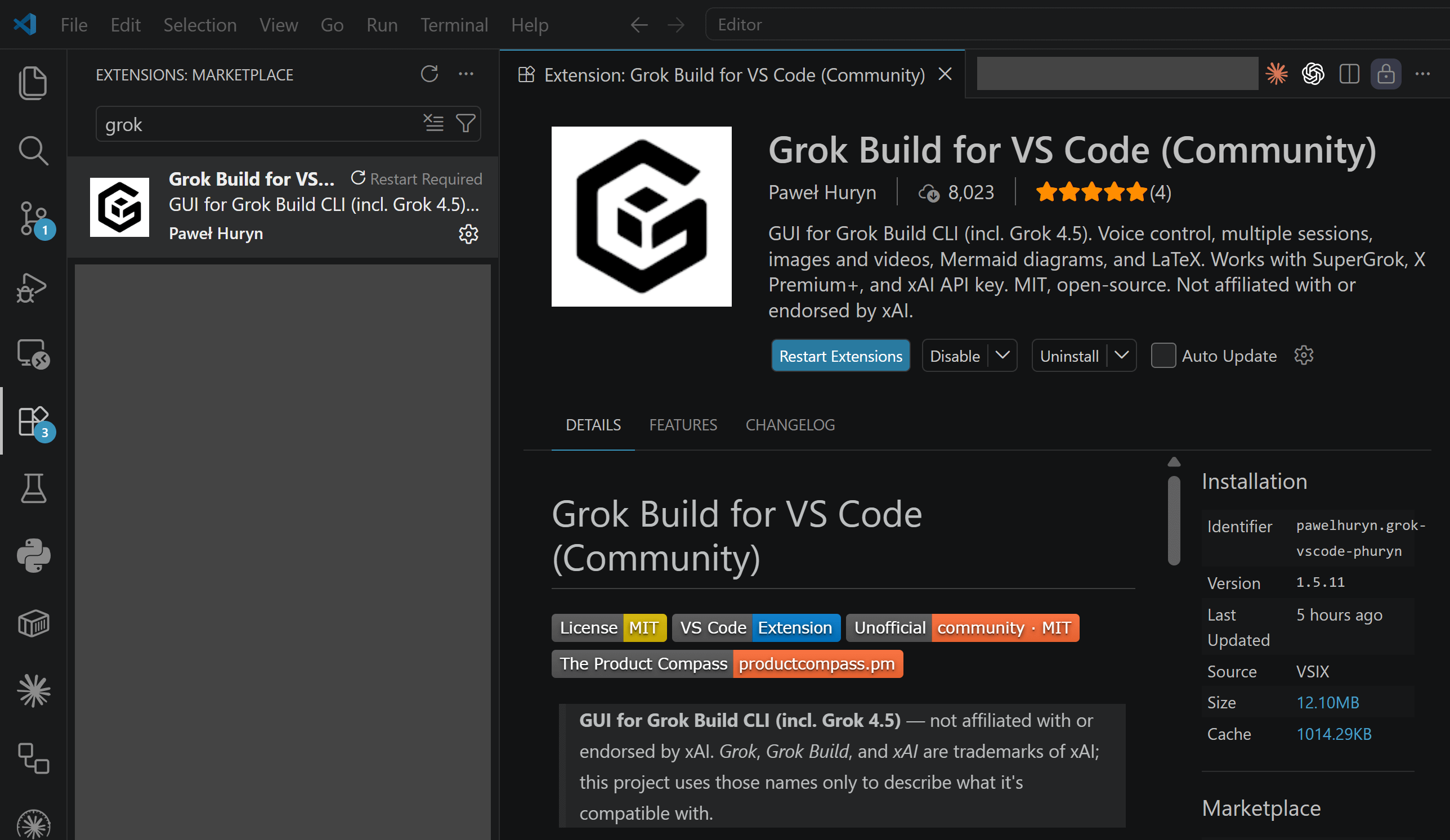
Install the extension. Extensions panel (Ctrl/Cmd+Shift+X), search “Grok Build for VS Code (Community)”, install. VS Code 1.106+ and Cursor 3.x.
Open the sidebar with Ctrl/Cmd+;. The setup wizard installs the grok CLI if it is missing and walks you through sign-in, one click per step.
Check the model. Gear menu, model picker. A current install starts on Grok 4.6, and you can switch models live, mid-session.
Windows runs natively, no WSL required. The full feature breakdown, requirements, and troubleshooting live on the extension’s own page: Grok Build for VS Code (Community). Not in VS Code at all? The same agent runs as a standalone app: Grok Build Desktop (Community). Still choosing an interface: Does Grok Build have a GUI?.
Reasoning Effort: xhigh Is New, and the Spelling Matters
Grok 4.6 adds a reasoning tier Grok 4.5 does not have. Its ladder reads low, medium, high, xhigh, and the model’s own configuration describes xhigh as the “highest effort and reasoning level.” Query Grok 4.5 in the same breath and it still stops at high.
Two things to know before you set it:
The string is xhigh, with no hyphen. I asked the CLI for x-high and it silently gave me high instead. So did max, and so did a deliberately nonsense value. Nothing warns you, so a run you believe is at the ceiling can quietly be sitting one tier below it.
In the extension it is the gear menu, next to the model picker, and it changes live like the model does.
I know this because I read the active effort back out of a zero-token session rather than trusting the flag I had passed. That is a habit worth copying with any model that lets you request a tier.
What It Costs
Free tier first, because it is what people actually type into Google. You can try Grok 4.6 for free. Grok Build is free to try with usage limits on any X or Grok account, 4.6 is what a fresh session lands on, and SpaceXAI is doubling that included usage for the first week after launch. The exact allowance changes often enough that printing a number here would be printing something wrong.
What the free tier is genuinely for is deciding whether you like the model. It is not a working day’s worth of agent. The part I would not have guessed from the pricing page is the other side of that: once you are on a paid plan the allowance mostly stops being something you think about.
On the API it is two dollars per million input tokens and six per million output, with a fast variant at double. One note from my own sessions: a cheap rate card is not automatically a cheap bill, because long agentic runs re-read a lot of context. Watch the context-token donut in the sidebar and use /compact when a session gets heavy.
FAQ
Can I use Grok 4.6 in Visual Studio Code? Yes. Install the Grok Build for VS Code (Community) extension, sign in with any X or Grok account to try it, and a current install starts on Grok 4.6. Sustained use needs SuperGrok, X Premium+, or an xAI API key.
Is Grok 4.6 free? You can try it free. Grok Build is free to try with usage limits on any X or Grok account, Grok 4.6 is the model it starts on, and SpaceXAI doubled that included usage for the first week after launch. The free allowance is sized for evaluating the model rather than working through it; sustained agent use needs a subscription or an API key.
Is Grok 4.6 better than Grok 4.5 at coding? On my own bench, clearly. Grok 4.6 found 27 of 105 hidden bugs against Grok 4.5’s best of 17 across three runs, and doubled 4.5’s frozen score on one of the two repositories. SpaceXAI’s published numbers agree, with the widest margins on agentic benchmarks.
How do I install Grok 4.6? It is not a separate install. It is a model. Install the Grok Build CLI or the extension above, sign in, and you are on Grok 4.6.
How do I switch to Grok 4.6, or back? Gear menu, model picker, click. Switching is live and per-session, and Grok 4.5 is still in the list.
What is Grok 4.6’s context window? 500,000 tokens. SpaceXAI’s knowledge cutoff for the model is February 1, 2026.
Does this work in Cursor? Yes, Cursor 3.x is supported. Cursor also ships Grok 4.6 natively as of launch day. The extension gives you the Grok Build agent workflow, with its diffs, permissions, and sessions, rather than Cursor’s own.
Is there an official xAI extension for VS Code? No first-party standalone extension exists. SpaceXAI officially supports third-party routes, including Kilo Code, and the Community extension drives the official Grok Build CLI through the Agent Client Protocol, so the agent, models, and memory are xAI’s. The interface is the community part.
Can I use Grok 4.6 in other IDEs? This extension covers VS Code, Cursor, and Antigravity. For the full Grok Build agent workflow those are the supported editors. Once a session is running you can also drive it from a phone browser: Grok Remote Control.
Still on Grok 4.5? It has not gone anywhere and it is still in the model picker. The older guide stays up: How to Use Grok 4.5 in VS Code.
Setup is the easy part. What I write about here is what changes for PMs and builders once the agent is running and the building stops being the constraint.
Grok Build for VS Code (Community) is an unofficial community project by Pawel Huryn. Grok, Grok Build, and xAI are trademarks of xAI.