

Updated: 7/3/2026
Fable 5 is the first model that’s made me feel audited.
On day two, mid-task, it read my CLAUDE.md and caught it teaching the exact pattern my own quality gate bans. I hadn’t asked for a review. It hit the contradiction and flagged it on its own.
That file is 320 lines. The knowledge layer behind it is 166 files, around 300k words of rules my agents follow every day. And every one of those rules was written by and for a weaker model.
This guide is what I did about that, plus everything else from 7 experiments and 1,000+ timed runs in Fable 5’s first four days.
One honest note before we start. I published my launch-day numbers on day two, then retested everything at 20 rounds per cell on a single build. Two headline claims didn’t survive. They’re corrected below with the old numbers named, not quietly replaced.
We’ll cover:
What changed, what it costs, and the migration gotchas that bite first
The effort dial and the “Fable is slow” complaint at 20 rounds per cell, including what flipped
What a real finding costs: Fable bills 2x per token and still wins the audit math
When your model silently swaps mid-conversation, and why the swap sticks
The audit prompt to run before giving Fable real work, and the migration workflow behind the paywall
Objectives, not tasks:
/goalpatterns (paid)My depth-10 nesting experiments, the real cost multiplier, the decision rule (paid)
We won’t cover: API migration fine print, benchmark-by-benchmark analysis, or anything I haven’t run myself.
1. What Actually Changed
According to Anthropic, Fable 5 is “a Mythos-class model that we’ve made safe for general use. Its capabilities exceed those of any model we’ve ever made generally available.”
They built a model they don’t fully release. Mythos 5 stays limited-access, available to trusted partners. Fable 5 is the version of it you’re allowed to have.
That framing matters more than any spec row, and we’ll come back to it in Section 3.
Fable plugs in wherever Opus 4.7/4.8 did, with a few breaks that will bite you if you migrate blind:
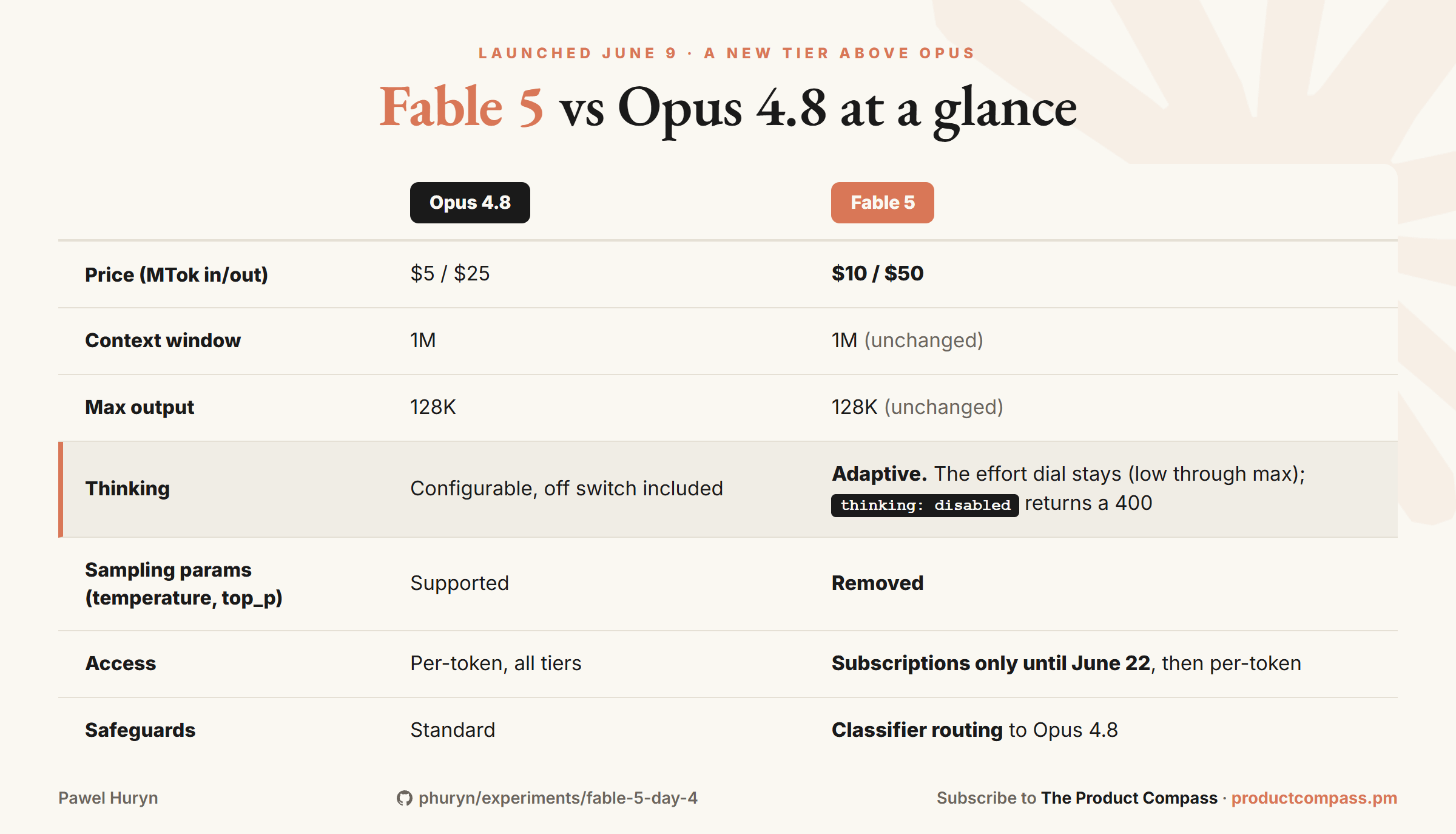
Three migration gotchas hiding in that table:
You can’t turn thinking off. Pipelines that set
thinking: disabledfor speed get a 400 error. The effort dial survives. Zero doesn’t.Temperature is gone. If your eval suite sweeps sampling settings, those configs fail on Fable.
Until June 22, your API keys can’t reach it. Subscription surfaces only (Claude Code, Cowork, the apps). Plan your team’s testing window accordingly.
1.1 Fable 5 effort dial, measured
Instead of taking the docs' word for it, I measured. First at 5 rounds on launch day, then at 20 rounds per cell on day four:
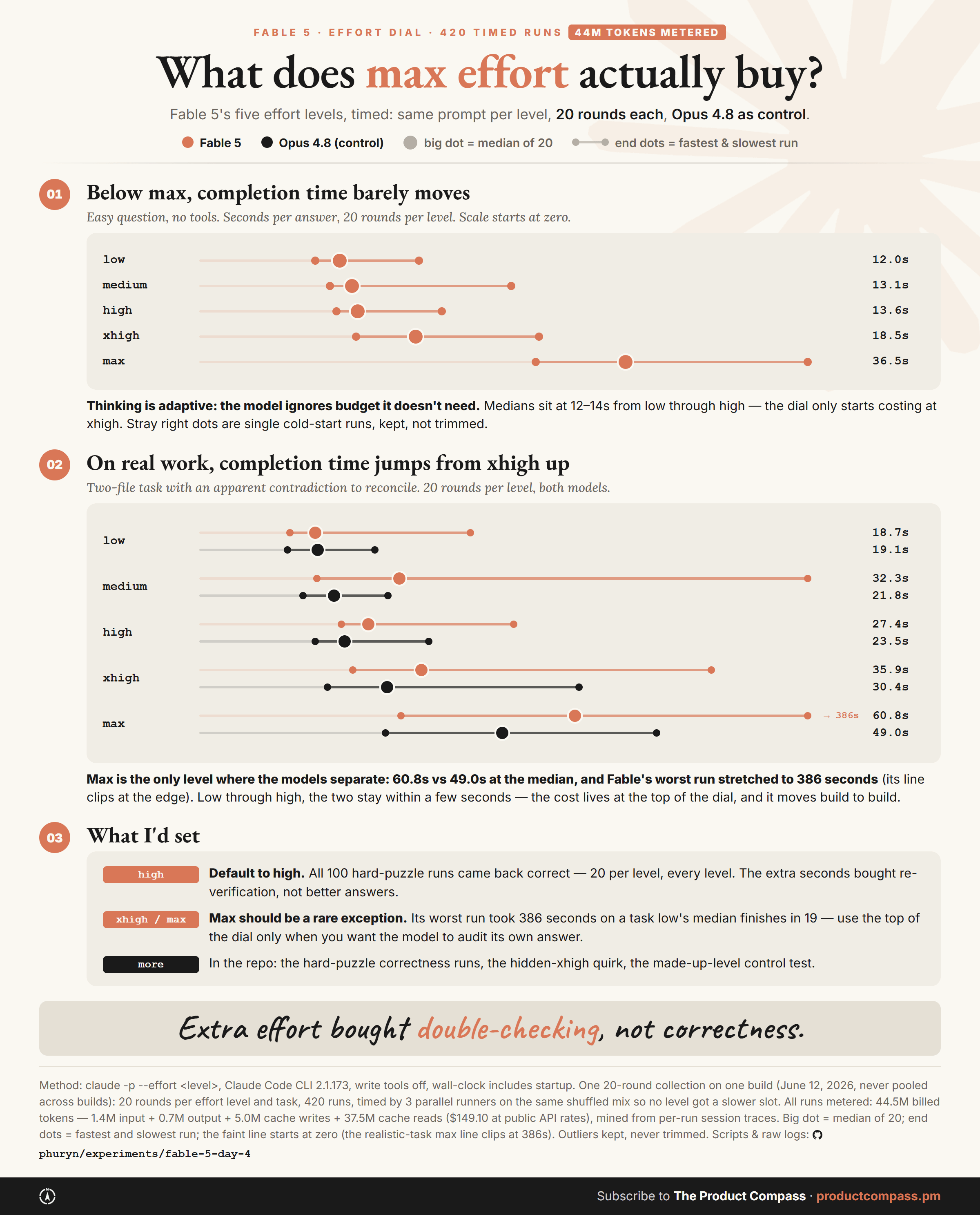
What held from launch day:
Below max, the dial barely moves. Thinking is adaptive. The model ignores budget it doesn’t need.
Correctness never moved. On a hard math puzzle with a checkable answer, every effort level got it right, with the same method. The extra seconds bought re-verification and caveats, not better answers.
What’s new at n=20: max is where Fable and Opus separate the most, 60.8 vs 49.0 seconds at the median. And that gap moved between builds. The top of the dial is the unstable part.
One gotcha worth this whole section. Pass a typo to --effort and the CLI silently falls back to your configured level, not the model default. I ran --effort xyz 20 times as a control: median 17.6 seconds, right on top of xhigh (18.5s), nowhere near high (13.6s).
So check your settings before you benchmark anything. My machine had xhigh persisted, which means every flag-less run I timed ran both models at xhigh. Matched, so the ratios stand. But the honest label on my charts is “matched effort,” not “out-of-box default.” The documented default is high on both Fable 5 and Opus 4.8.
The practical setting hasn’t changed: default to
high. Dialing down buys back a few seconds, not different answers. Max should stay a rare exception. It’s now the least stable level, too.
1.2 Fable 5 speed question, retested
The loudest day-one complaint after the classifiers: “Fable is slow.” One widely shared review called it a crawl, “even on simple tasks.”
I couldn’t find numbers, so I made my own. 320 timed runs, both models at matched effort, stream-level timestamps, exact token counts, outliers kept:
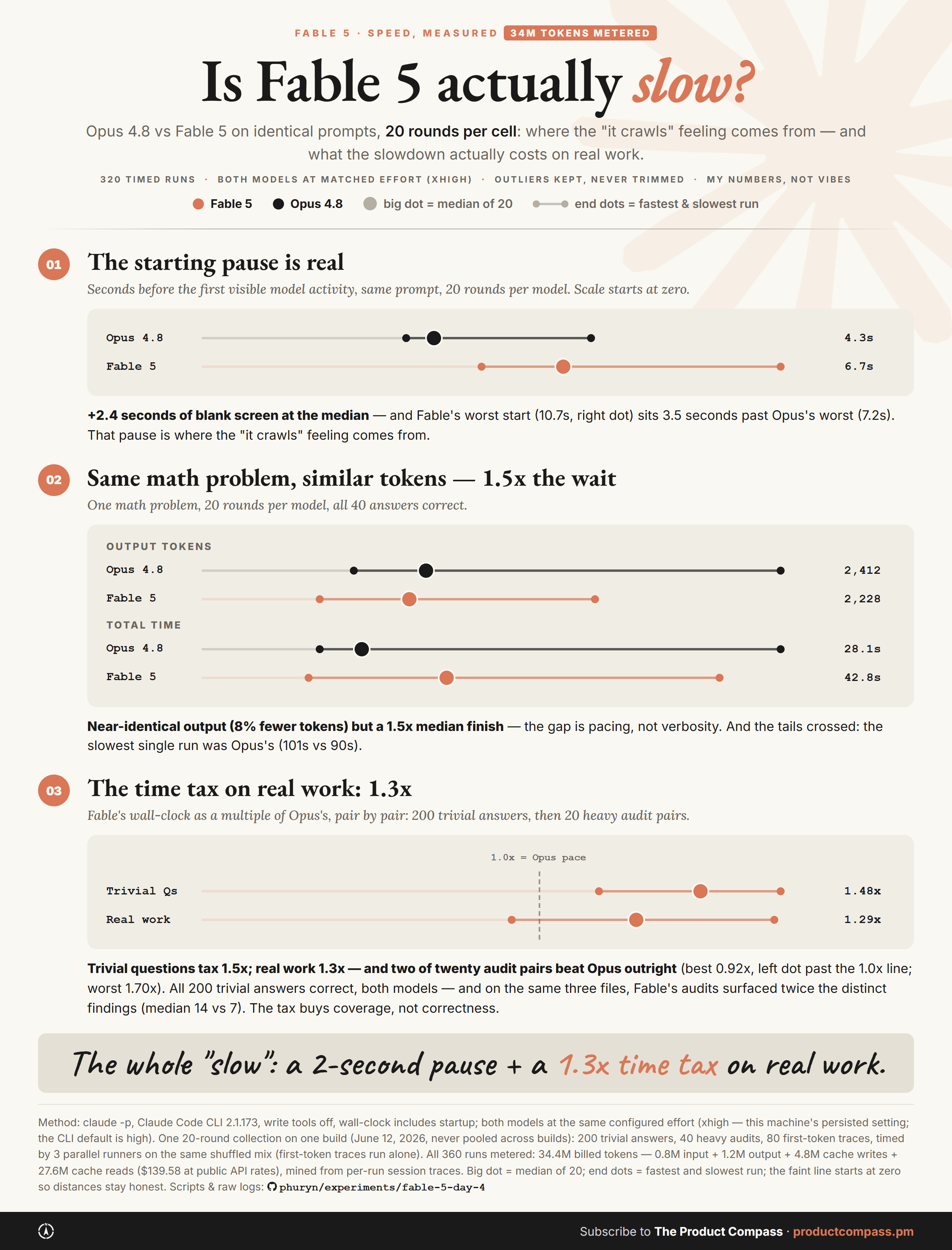
What held:
The starting pause is real. First visible activity at a median 6.7 seconds vs 4.3 for Opus. That 2.4-second blank screen is my bet for where the “it crawls” feeling comes from.
The trivial tax is modest. On one-shot questions, Fable averaged 1.48x Opus wall-clock. Every answer correct from both models.
What flipped on the retest:
“Denser, not slower” didn’t survive. On launch day, Fable used about 40% fewer output tokens on the same math problem and finished sooner. At n=20 the token gap shrank to 8%, and Fable finishes 1.5x behind.
Neither did “the gap vanishes on real work.” Across 20 heavy multi-file audits, the median tax is 1.29x (best pair 0.92x, worst 1.70x). Two of twenty beat Opus outright. The tax flattens with task size. It doesn’t vanish.
What didn’t move: correctness. All 240 graded answers correct, from both models.
So the verdict is narrower than the discourse: budget a short pause at the start of every exchange, accept a 1.3 to 1.5x time tax, and ask what the extra time buys. Section 2 prices exactly that.
1.3 The benchmarks
Anthropic’s official chart covers these better than any table I’d retype:
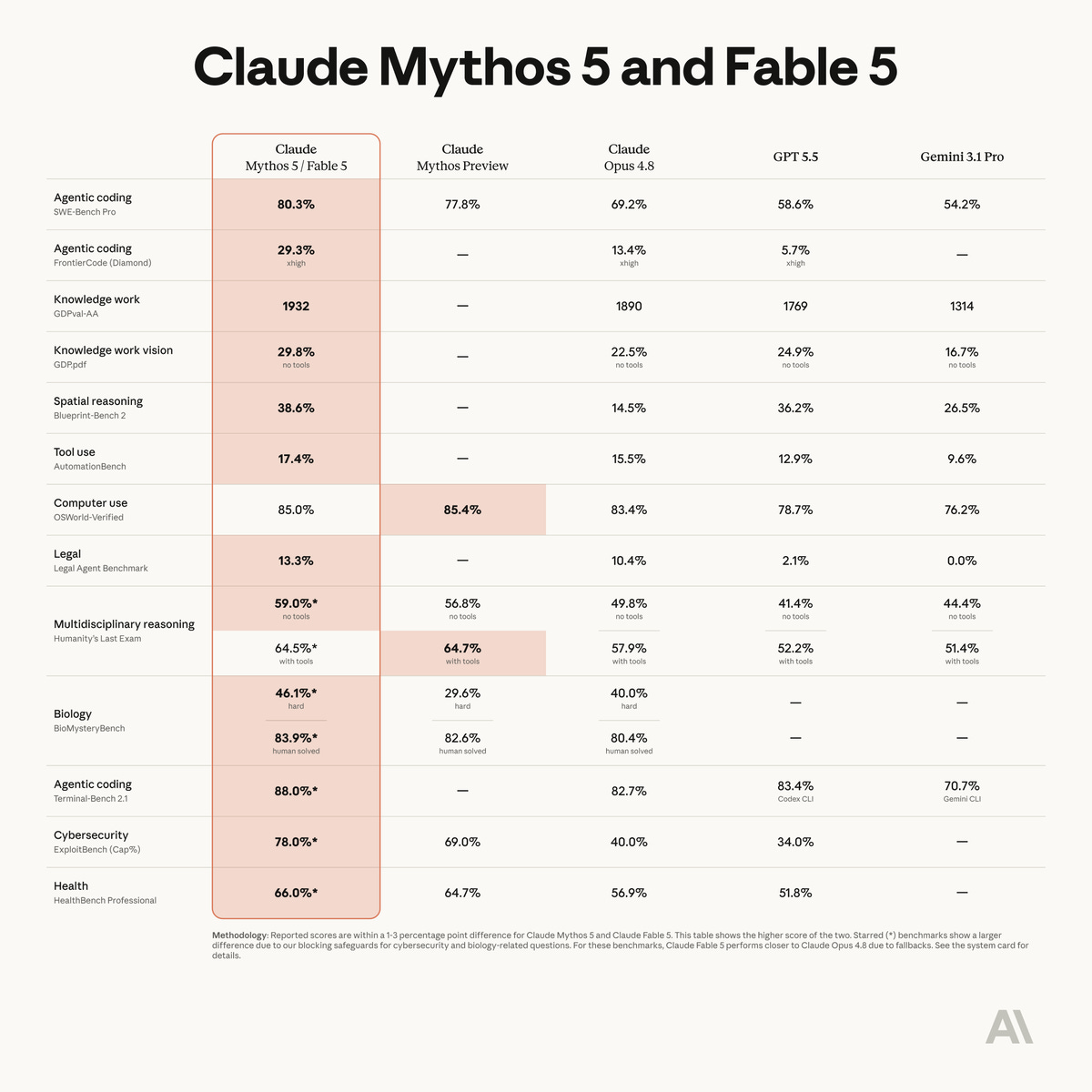
Two things the official chart won’t tell you:
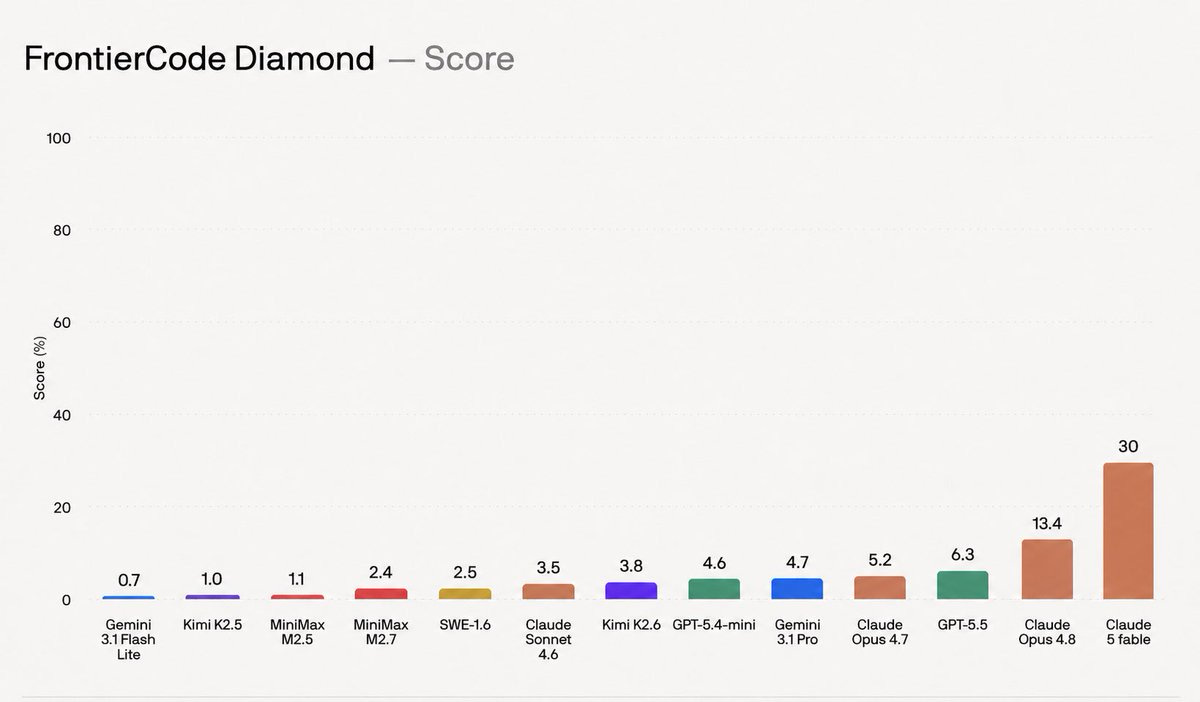
The row that tells you what tier this is: FrontierCode Diamond, the hardest unseen problems in the set, where Fable more than doubles Opus 4.8 (29.3 vs 13.4) and runs 5x GPT-5.5:
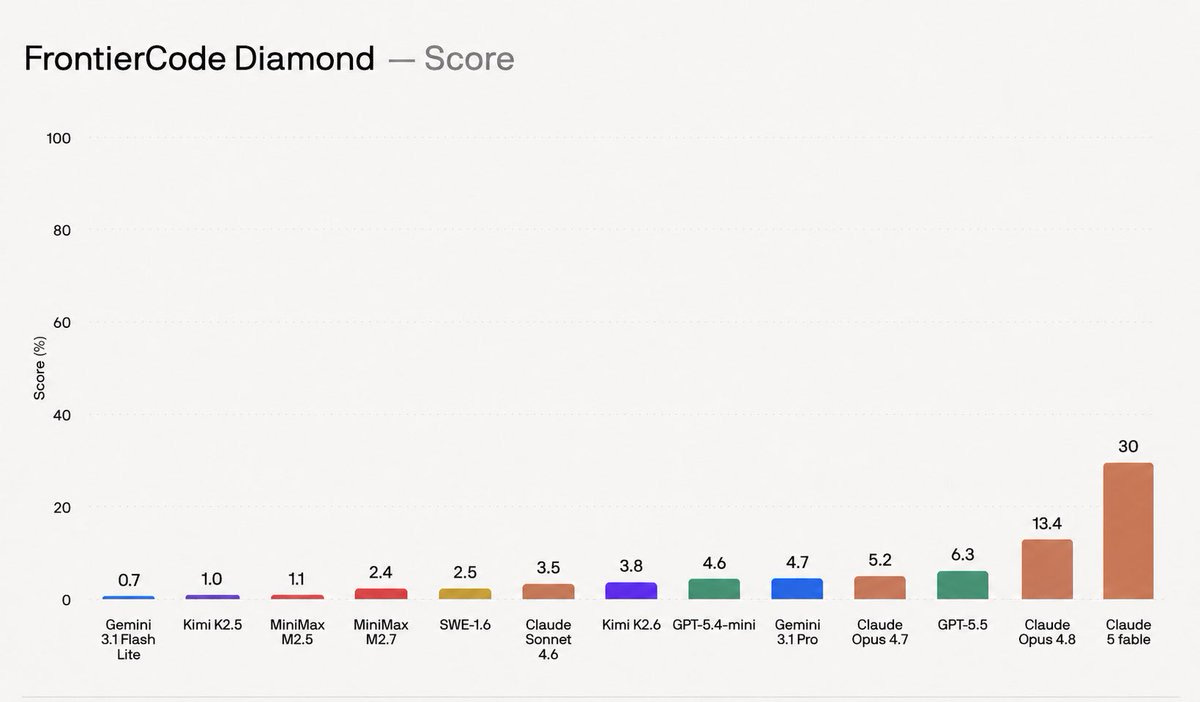
Source: @ChrissGPT on X
And one honest footnote from the system card: Fable’s published scores already include its production safeguards, which is why some rows run slightly below Mythos.
2. What a Real Finding Costs
Fable bills 2x per token. Here’s what that turns into when the task is finding problems, not answering questions.
I ran 60 audits of the same three style-guide files, 30 per model. Every run was metered from session traces and validated to the cent against the CLI’s own billing:
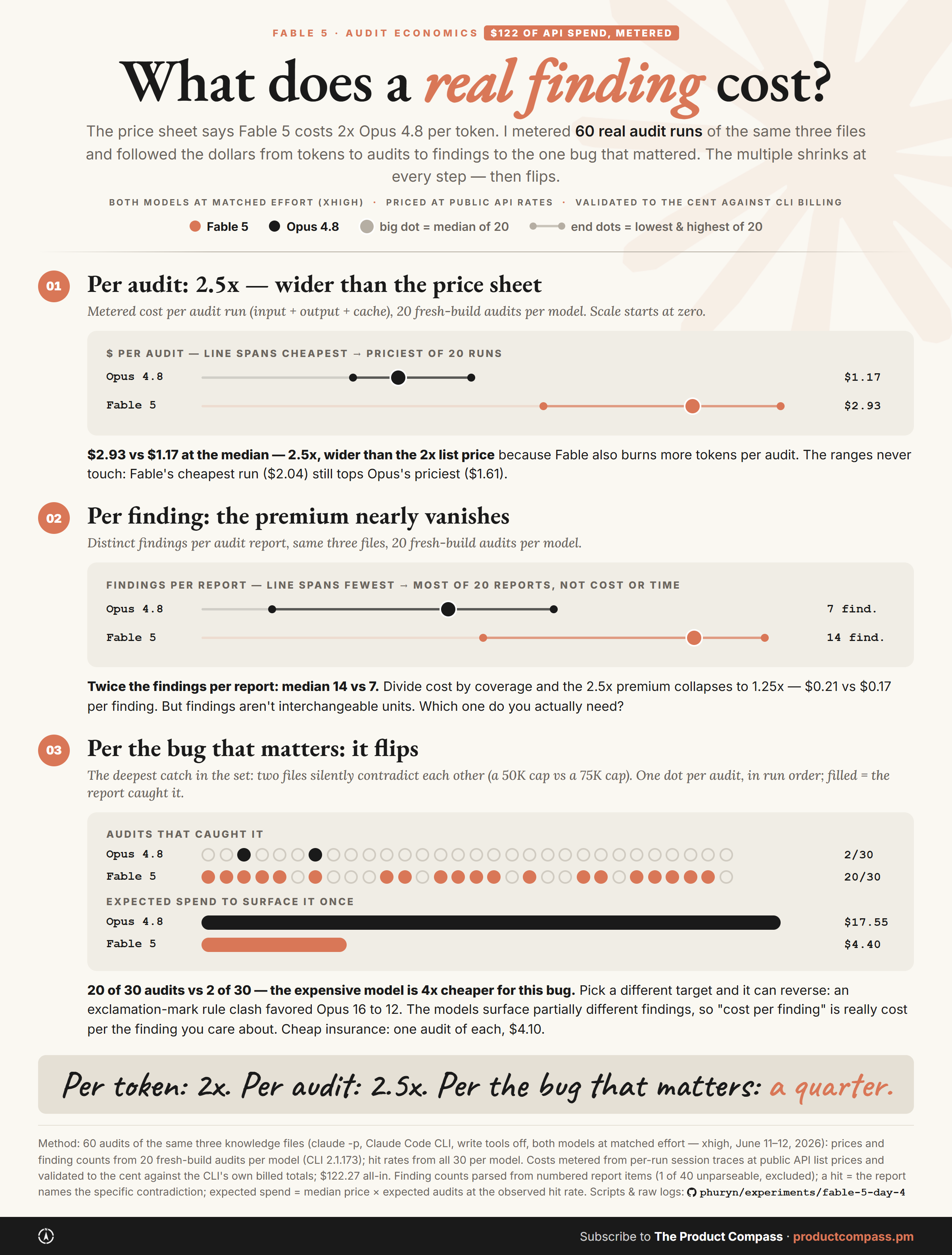
Three prices for the same work:
Per audit: 2.5x. $2.93 vs $1.17 at the median. Wider than the price sheet, because Fable also writes more.
Per finding: 1.25x. Fable surfaces a median 14 distinct findings per report vs Opus’s 7. So $0.21 vs $0.17 each.
Per the bug that matters: 0.25x. One planted issue required reading two files against each other. Fable caught it in 20 of 30 audits. Opus caught it in 2.
That last row is the one your invoice feels. Expected spend per deep catch: $4.40 with Fable, $17.55 with Opus. The expensive model is 4x cheaper!
It’s not “Fable finds everything,” though. A same-file style clash got caught more often by Opus, 16/30 vs 12/30. Depth and breadth are different axes.
For PMs: price the outcome, not the tokens. Per token, Fable costs 2x. Per deep finding, a quarter. Whoever frames the unit wins the budget conversation, and that’s as true for your product’s pricing page as it is for your AI bill.
3. The Safeguard Layer Most Coverage Missed
3.1 The visible layer: routing
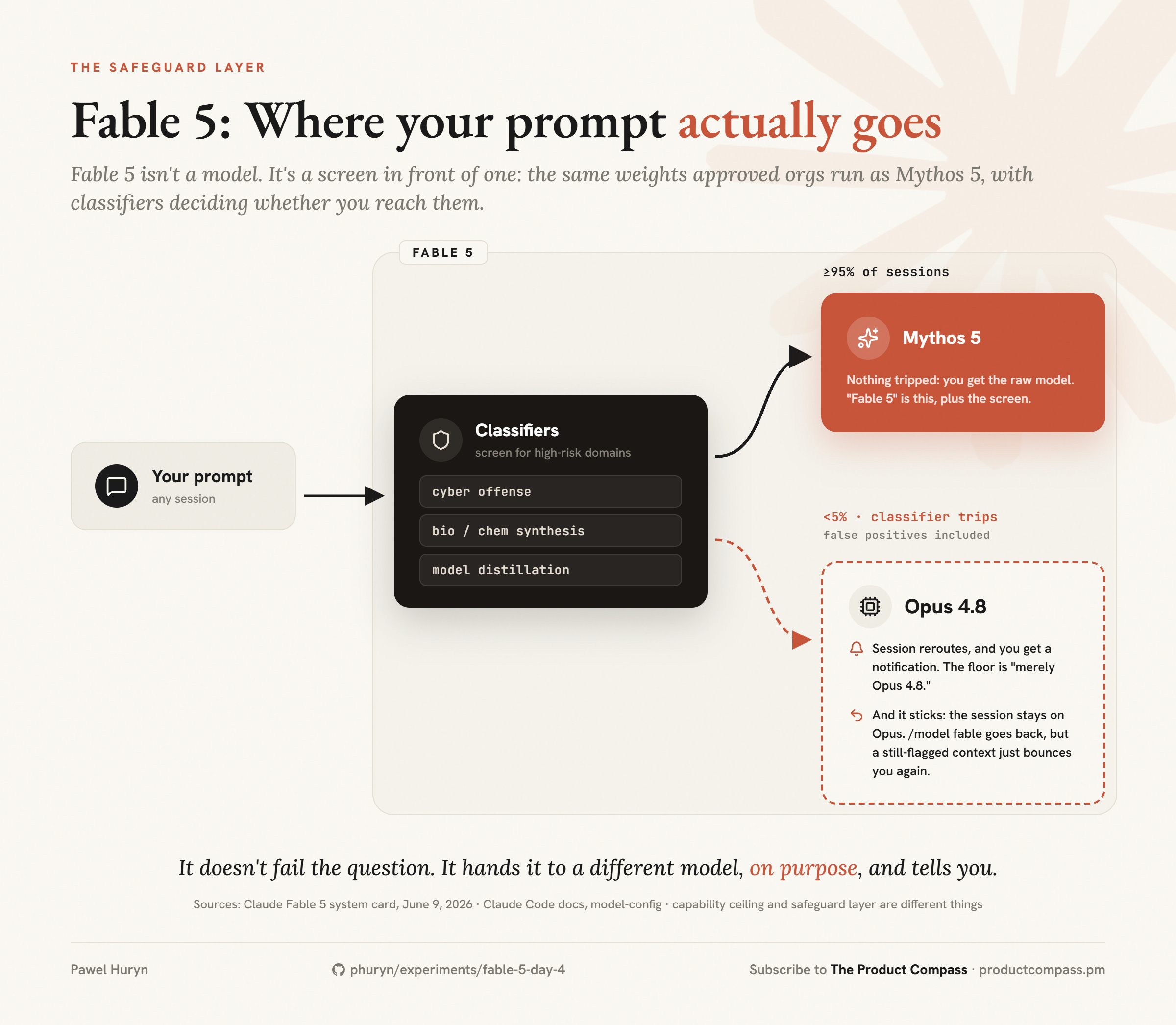
Fable 5 ships with classifiers that screen for high-risk domains. When a query trips one, the session is routed to Opus 4.8 instead, and you get a notification. Anthropic puts it at ~5% of sessions.
My own experiments with subagents got capped, too:

It doesn’t fail the query. It hands it to a different model, on purpose, and tells you. The capability ceiling and the safeguard layer are different things, and knowing which one you hit changes what you do next.
And the reroute sticks. Per the Claude Code docs, the session continues on Opus after a flag. /model fable takes you back, but if the trigger is still in your context, the next request just bounces you again. I learned that one live. My first read was “you can’t switch back.” The docs’ version is more precise: you can switch back, you just can’t stay.
The classifier reads your workspace, too. CLAUDE.md content and git status ride along on the first request. So a repo full of security or biology material can reroute a session before you’ve typed anything unusual.
Why does the screen exist at all? According to Anthropic, “Mythos-class models have reached a threshold where they present significant risks.“ The example they give: these models “excel at discovering and exploiting software vulnerabilities,” enough to make cyberattacks “substantially easier and cheaper to commit.”
There’s also a second, invisible layer. Per the system card’s Section 1.5, requests targeting frontier LLM development itself don’t reroute. They get quietly degraded, with no notification, on ~0.03% of traffic. Unless your team pretrains models, you’ll never hit it. Researchers are furious anyway (Elie Bakouch’s “very very sad for the research community“), and the precedent stands: the model you bought can be tuned down by topic, silently.
3.2 What this means for your team
Four practical notes from the first four days:
Expect occasional routing, especially if your work touches security, healthcare, or biotech. Anthropic admits it (Claude Code’s Boris Cherny: “We know the classifiers are trigger-happy, and are working on improving it“). The notification is your signal: you did nothing wrong, and the floor is “merely Opus 4.8.” For security audits, the supported path is the built-in
/security-reviewcommand. Also see my /security-review-static, which inspects the full solution, not just the diff.Two diagnostics worth knowing. For example,
claude --safe-modestarts a session without your customizations, so you can check whether your own files are the trigger. And/confighas a toggle that asks before switching instead of switching silently.Once flagged, decide fast. Treat the session as an Opus session or start clean. Don’t fight the classifier mid-context.
The API behaves differently. When per-token access opens June 22, a tripped classifier blocks the request and returns a structured refusal category. There’s no automatic fallback by default. Server-side fallback to Opus is opt-in. The same applies to
claude -pscripts today: non-interactive runs get a refusal, not a reroute.
The safeguard is worth copying: it swaps your model mid-session for safety. We can swap on purpose, for cost. Keep a cheaper model as your default and bring in Fable 5 only for the one call that needs it. Section 8 has what that costs.
Side Note: On September 1 we’re launching the 3rd edition of Claudathon. It’s a hands-on program to learn by building and shipping production-ready apps with embedded agents.
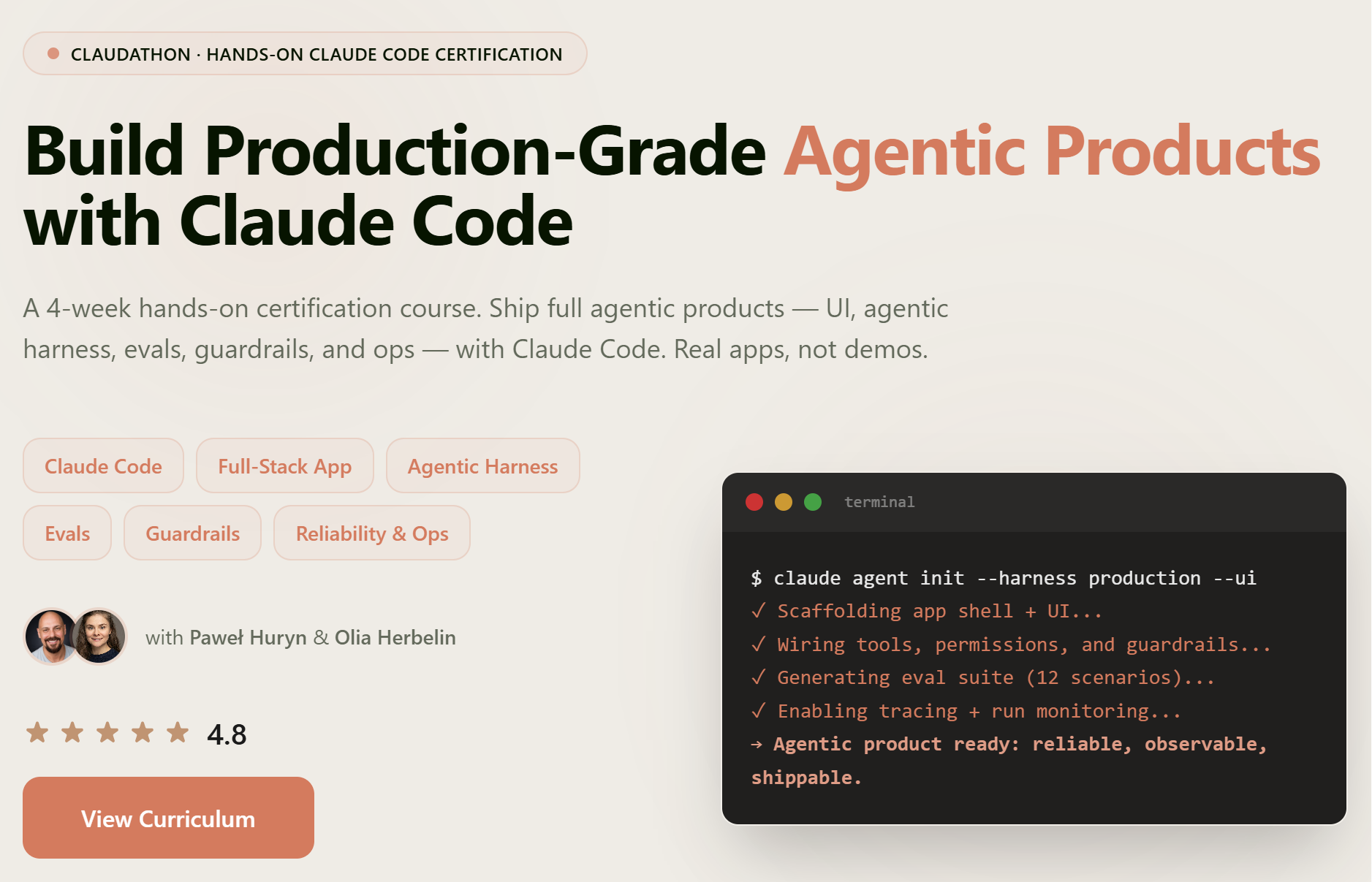
Before the cohort you should get familiar with the basics: VS Code, CLAUDE.md, skills (we provide the materials).
Early bid discount: https://go.productcompass.pm/claudathon
Paid annual subscribers who enroll get a refund for the current billing period.
4. Judgment Is the Feature
The benchmarks got their chart in Section 1. The interesting part of this launch is a behavior change.
One disclosure before the quotes: every voice quoted in praise here works at Anthropic. Read them as insider testimony, not independent validation, then check them against my receipts.
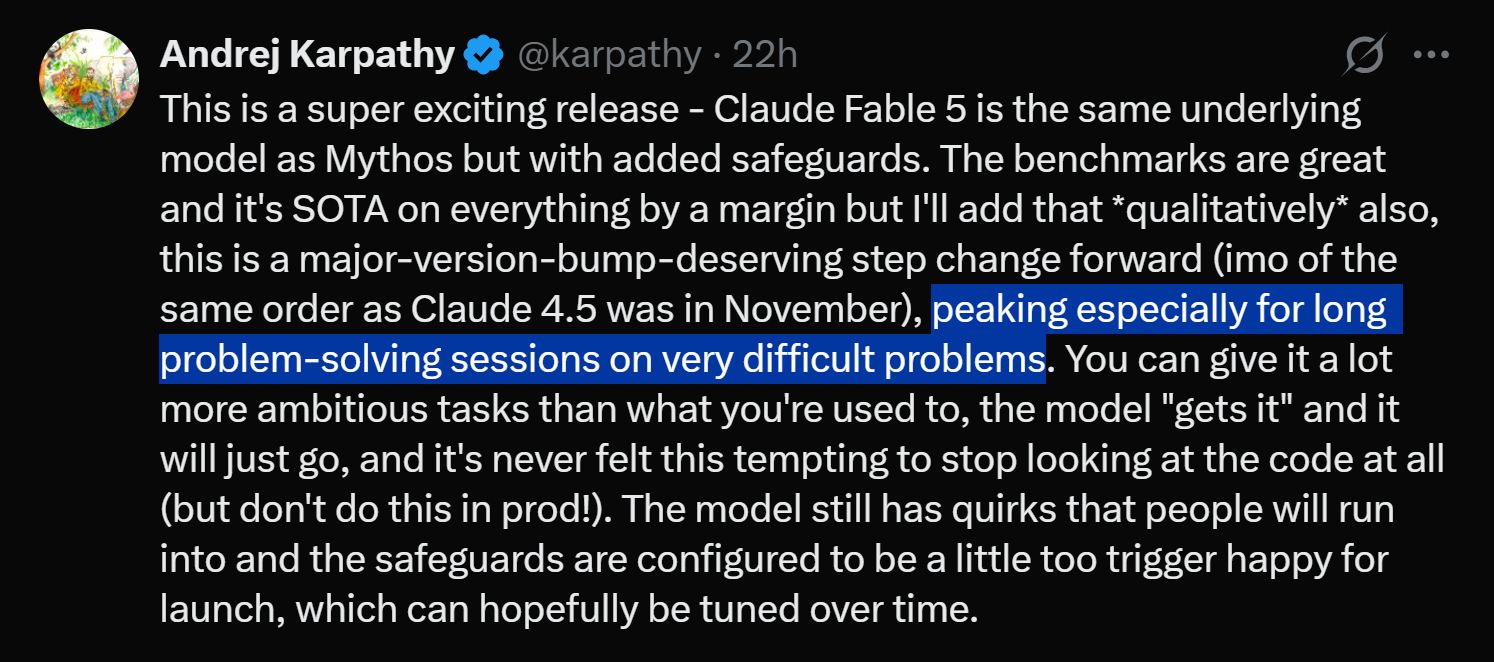
Karpathy called it “a major-version-bump-deserving step change forward,” strongest “for long problem-solving sessions on very difficult problems:”
The people building Claude Code describe the same thing. Cherny, from his launch post: Fable "has judgement, taste, and dimensionality in a way that previous models didn't:"
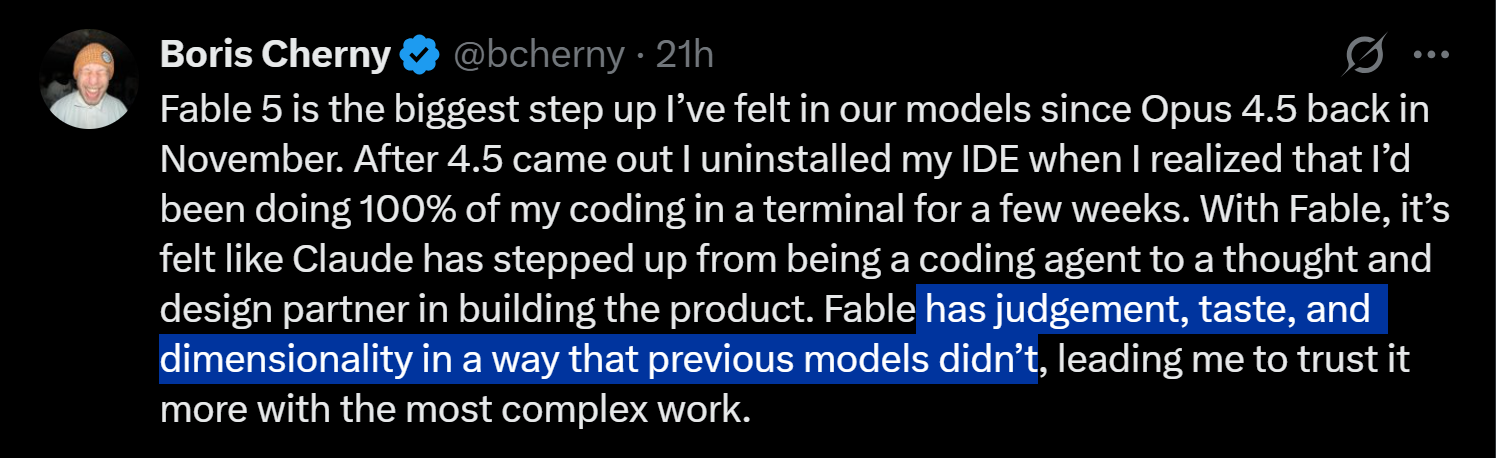
He asked it to debug something, and it took measurements, added logs, and verified the fix before declaring victory. Then the line that stuck with me: "There's nothing in claude code's prompting telling the model to do that, it's just part of its personality."
Thariq Shihipar compressed it to six words: "it's time to be more ambitious:"

The closest thing to an outside read, four days in, is the shape of the criticism. Researchers are angry about the invisible safeguards (Section 3). Dylan Patel of SemiAnalysis reports power users defecting to Codex after “refusals for nonsensical reasons.” Both complaints are about access to the capability. Neither questions the capability.
My version of that moment is the one this guide opened with. Fable read my instruction files and started surfacing contradictions instead of executing them. Previous models followed my rules. This one evaluated them.
That shift is part of a larger question: Will We Lose Our Jobs to AI? Cutting Through the Hype.
5. Your Knowledge Layer Was Built for a Weaker Model
Fable flagged the first contradiction on its own, mid-task, before I’d read anyone’s tips. So I gave it the full job: read everything my agents follow and report what’s wrong.
That conclusion is consistent with voices inside Anthropic. Alex Albert’s launch tips name the same mechanism: instructions written for old models keep Fable behaving like those old models. Rework your skills and CLAUDE.md files. Let the model use its own judgment first.
5.1 What Fable found in my repo
My agents maintain those files, not me. I trusted Opus to keep them clean enough. Still, five finds:
A hardcoded date telling the model what day it is. One strategy file contains “(today is 2026-05-24)“, written during a May session and never noticed again. Every session since has been told the wrong date by its own instructions.
A rule documented with the pattern it bans. My writing system bans em dashes in published content. The file that documents the ban is written with em dashes. Instructions teach by example as much as by rule.
Calibration constants that drifted. An X voice rule still gates on an audience under 50K followers. That number was true when the rule was written. It isn’t two months later (75K).
Guardrails for failure modes the new model doesn’t have. Rules like “never delegate judgment-heavy work to cheaper models“ and complex self-check procedures exist because earlier models needed them. Each one now eats context and pulls the model toward old habits.
The same rule stated in three files. Three maintenance surfaces, three chances to drift apart.
Some were plain mistakes. The rest were right for the model they were written for. That’s exactly the problem. The better your system was for the last model, the more it holds back this one.
5.2 Written by a weaker model
The pushback I got within hours of posting my first thoughts on X: if your files contradict each other, isn’t that just sloppy housekeeping?
Fair question, wrong model of the system.
This knowledge layer isn’t a config file a human writes once. It’s self-improving: agents file evidence as they work, turn evidence into working rules, and edit their own CLAUDE.md (the system from Three CLAUDE.md Blocks). 166 files, maintained partly by the things that read them.
In a system like that, contradictions aren’t carelessness. They’re drift, the same drift every wiki and every org’s process docs accumulate, except here it accumulates as fast as the agents write.
That creates the real trap: a knowledge layer written by a weaker model has a flaw no amount of review can fix. Every line an agent added passed review by the model that added it, by definition. A system maintained by model N tends to preserve the errors model N can’t see.
I review these files every day and didn’t catch it. Neither did Codex, which reviews my knowledge files as a second pair of eyes.
5.3 The audit prompt
So the first prompt I ran with Fable 5 wasn’t a task. It’s the prompt I’d now run before giving any new model real work, and it’s yours:
Read your own instruction files (CLAUDE.md, skills, rules, memory files) end to end.

1. Where do they contradict each other? Quote both sides.
2. Which rules exist to manage a weaker model: guardrails for failure
   modes you don't have, recipes for things you no longer need spelled
   out, hardcoded facts that have drifted? List them with file:line.
3. Which rules teach by bad example: documents that violate the
   patterns they prescribe?
4. What would you delete? What would you keep exactly as is, and why?

Don't fix anything yet. Report first. I decide what gets cut.
The audit is the model's judgment; the deletions are yours. What you do with the report, and how I turned mine into a repeatable migration workflow, is where we go next.
Behind the paywall:
The migration workflow → the three-bucket rule classification (constraint, calibration, scaffolding) so you cut anchors without cutting your actual taste
Objectives, not tasks → the
/goalpatterns that let Fable run long PM work unattended + 2 prompt templatesHow deep agents and workflows stack now → my depth-10 experiments, the 2.54x cost multiplier
Delegating and escalating work with Fable → my CLAUDE.md snippet
What doesn’t work (yet) → the honest list, so you spend your first week on the parts that do
The week-one plan → day by day, copy-paste ready