
Short answer: Staygreen. Its free plan has 50 monitors for one app, checked every 3 minutes instead of every 5, and includes what UptimeRobot keeps for its paid plans: SSL and domain expiry, cron heartbeats, DNS checks, Slack, Telegram and webhook alerts, and a status page on your own domain. Keeping 50 monitors with SSL checks on UptimeRobot takes Solo, at €22 a month.
Start free at staygreen.io: no card, and commercial use is allowed.
Staygreen is made by The Product Compass. UptimeRobot, Better Stack, Hyperping, Instatus, StatusCake and OpenStatus belong to other companies, and Uptime Kuma is an open-source project. Every figure for them comes from the vendor's own pricing page, terms or docs, read on October 25, 2026.
Last updated: October 25, 2026. Free plans in this category change quietly, so check the vendor's page before you rely on a figure.
Staygreen: SSL, Heartbeats and Your Own Status Page Domain, Free
staygreen.io watches your app from the outside, and its free plan covers one app:
50 monitors for one app, checked every 3 minutes, taking turns from Toronto and San Francisco. At most 5 can share one host name, like api.yourapp.com.
SSL certificate and domain expiry for every host, set up automatically.
5 cron heartbeats, so a job that quietly stops running gets noticed.
DNS record and TCP port checks, your mail server included.
Checks that read the answer: up to 3 assertions per monitor on a JSON body, like
$.db.ok == true.Alerts by email, Telegram, Slack, Discord and signed webhook.
A status page on your own domain, with HTTPS, your logo and your color.
Failed Stripe webhook deliveries and a paused Supabase project, each as its own check.
An MCP server and REST API, so Claude Code or Codex can see what broke and set up monitoring for a new app.
Commercial use, no card, and 30 days of history.
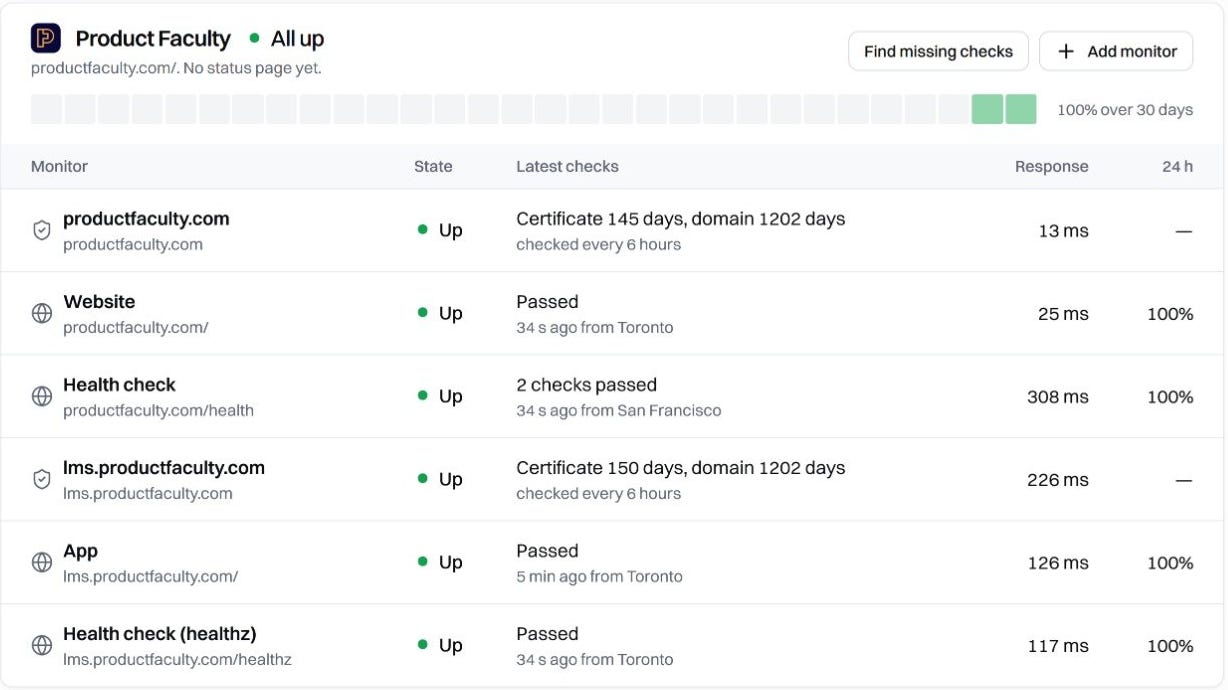
A health route can return 200 while the database behind it is gone, so Staygreen reads the body and checks what it says, on every plan. When something fails, the alert shows the request and what came back.
Free is one app, 50 monitors, 5 heartbeats and a status page on your own domain, with no card. Builder is $9 a month, or $7.50 a month billed yearly: 10 apps, 100 monitors, 50 heartbeats, checks every minute, a third location in Frankfurt, no “Powered by Staygreen” on your status pages, members-only status pages and 1 year of history.
What Staygreen doesn't do yet: monitoring your own MCP server, alert delays and repeats while something is down, maintenance windows, CSV export, and email subscribers on status pages.
Staygreen, UptimeRobot and Three Alternatives Compared
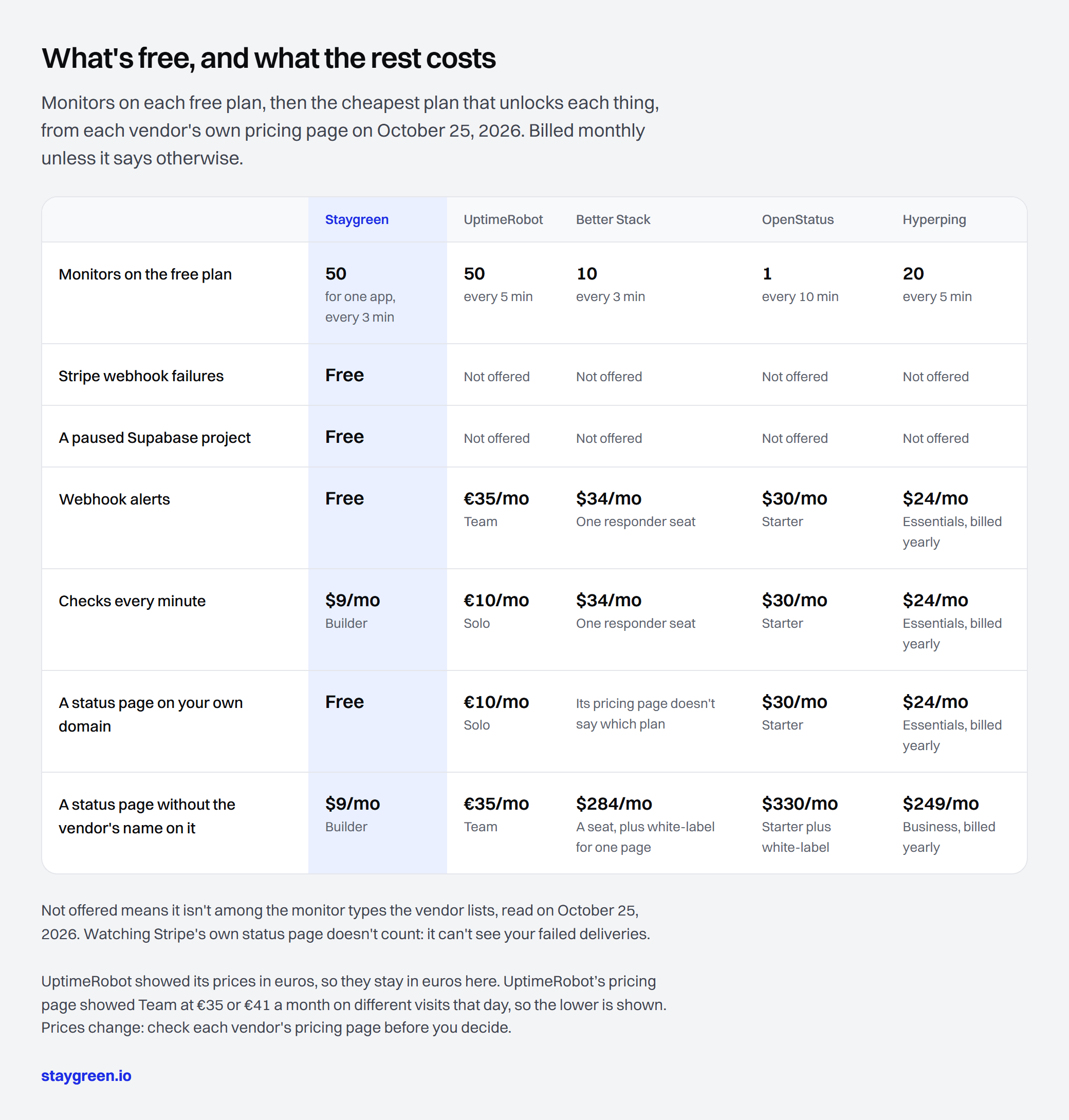
The table in words:
Monitors on the free plan: Staygreen 50 monitors for one app, every 3 minutes. UptimeRobot 50 monitors, every 5 minutes. Better Stack 10 monitors, every 3 minutes. OpenStatus 1 monitor, every 10 minutes. Hyperping 20 monitors, every 5 minutes.
Stripe webhook failures: Staygreen free. None of UptimeRobot, Better Stack, OpenStatus or Hyperping lists it as a monitor type.
A paused Supabase project: Staygreen free. None of UptimeRobot, Better Stack, OpenStatus or Hyperping lists it as a monitor type.
Webhook alerts: Staygreen free. UptimeRobot €35 a month on Team. Better Stack $34 a month for one responder seat. OpenStatus $30 a month on Starter. Hyperping $24 a month on Essentials, billed yearly.
Checks every minute: Staygreen $9 a month on Builder. UptimeRobot €10 a month on Solo. Better Stack $34 a month for one responder seat. OpenStatus $30 a month on Starter. Hyperping $24 a month on Essentials, billed yearly.
A status page on your own domain: Staygreen free. UptimeRobot €10 a month on Solo. Better Stack: its pricing page doesn't say which plan. OpenStatus $30 a month on Starter. Hyperping $24 a month on Essentials, billed yearly.
A status page without the vendor's name on it: Staygreen $9 a month on Builder. UptimeRobot €35 a month on Team. Better Stack $284 a month: a $34 seat plus $250 to white-label one page. OpenStatus $330 a month: Starter at $30 plus $300 for white label. Hyperping $249 a month on Business, billed yearly.
Moving Over From UptimeRobot
There's no importer yet. Setup takes your app's name and address, and Staygreen suggests the monitors: what answered comes ticked, like the website, its certificate, a health route with checks its response already passes and a Supabase project, while a mail server or nameserver check waits for you to tick it. The app's status page then starts with its HTTP checks, logo and brand color.
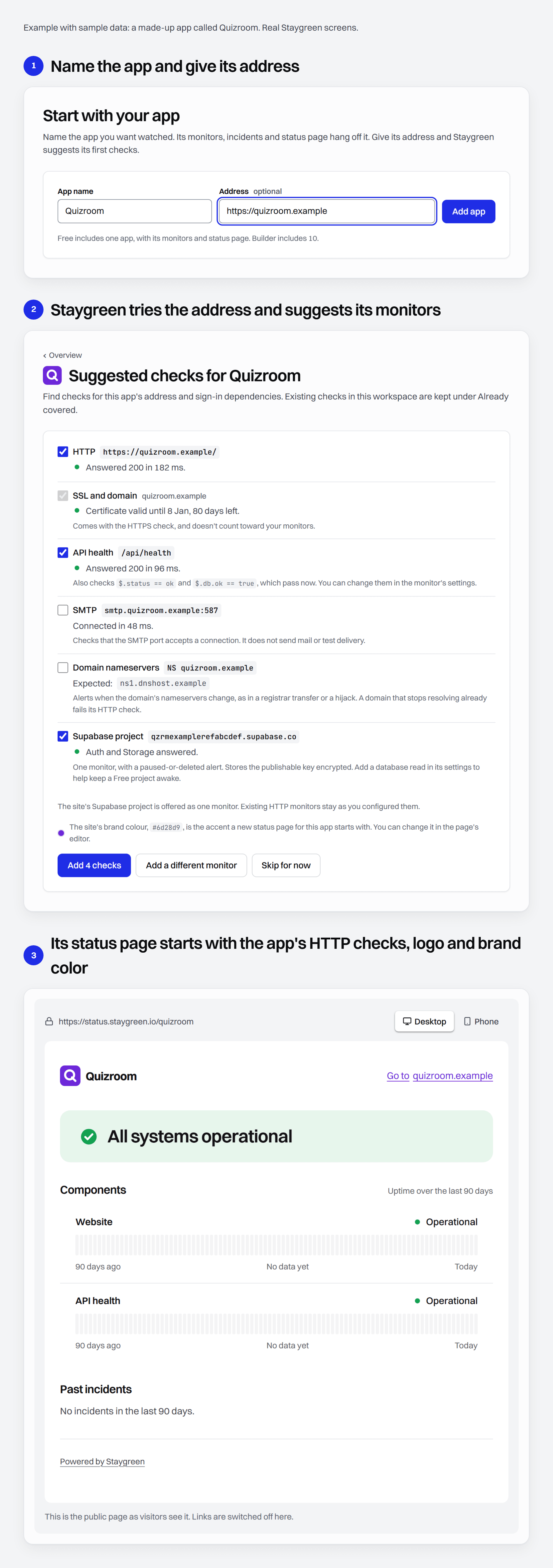
Or your coding agent sets it up over MCP: from the app's address it adds a website check, the certificate and domain check and a status page, and a Supabase monitor when you give it the project's key. You can keep UptimeRobot running while you try it. If the status page is the reason you're moving, the free status page comparison shows what each tool charges for one on your own domain.
What UptimeRobot's Free Plan Includes Today
If you're looking for an alternative, you've probably hit one of its free-plan limits. On the Free plan, as of October 25, 2026:
50 monitors, checked every 5 minutes. HTTP, port, ping and keyword checks.
No SSL or domain expiry, heartbeats, DNS or API monitoring. Its pricing page: “SSL monitoring is included only in paid plans.”
Five alert integrations, Google Chat, Discord, Pushover, Pushbullet and Splunk, besides email. Slack and Telegram start on Solo, webhooks on Team.
One status page, on an UptimeRobot address. Its terms: “Free plan includes 1 status page with a unique UptimeRobot URL only.” Your own domain starts on Solo.
3 months of history. Solo keeps 12 months.
Commercial use is allowed. The Free card on the pricing page calls it “Good for hobby and non-profit projects”, but the terms say “UptimeRobot is available for any use, including commercial and business use.” The terms are the contract.
Solo is €10 a month (€9 billed yearly) for 10 monitors, or €22 (€19 billed yearly) to keep all 50. It adds checks every 60 seconds, SSL, heartbeats, DNS, Slack and Telegram, and your own domain on the status page.
Webhook alerts and a status page without UptimeRobot's name take Team: €35 a month on some visits to its pricing page and €41 on others on October 25, 2026, which looks like a price test. UptimeRobot shows prices by region, and these are the euro prices it served that day. Sources: its pricing page and its terms.
If your monitors are plain HTTP checks every five minutes and email is enough, UptimeRobot's free plan may be all you need.
The Other Free Alternatives, and What Each Is Built For
Better Stack: incident management and on-call
The free plan is “Free for personal projects”: 10 monitors and 10 heartbeats, one status page, and Slack and email alerts, with checks every 3 minutes. Paid starts with a responder seat at $34 a month ($29 billed yearly), which brings unlimited phone and SMS alerts. Source: Better Stack pricing.
Hyperping: 20 free monitors, SSL included
20 monitors free, checked every 5 minutes, with SSL monitoring, cron healthchecks, and email, Slack and Teams alerts. The free status page is on a Hyperping address. Source: Hyperping pricing.
Instatus: the status page first
Built around the status page. The free Starter plan has 15 monitors checked every 2 minutes, email alerts, and a public status page with 200 subscribers but no custom domain. Pro, from $20 a month, adds a custom domain and 30-second checks. Source: Instatus pricing.
StatusCake: uptime plus page speed
The free plan has 10 uptime monitors checked every 5 minutes, plus one SSL check and one page speed test a day and one domain check a week. Superior, at $24.49 a month ($20.41 billed yearly), raises that to 100 monitors checked every minute. Source: StatusCake pricing.
OpenStatus: open source, hosted or self-hosted
Open source under AGPL-3.0, and you can run it yourself. The hosted free Hobby plan has one monitor and one status page with three components. Source: OpenStatus pricing.
Uptime Kuma: you run it
Open source under the MIT license and, in its own words, “an easy-to-use self-hosted monitoring tool”. It costs nothing but the server, and you set the limits. If it runs on the same machine as your app and that machine goes down, nothing is left to tell you. Source: the Uptime Kuma repository.
When UptimeRobot Is Still the Right Answer
It does several things Staygreen doesn't. If one of these decides it for you, stay with UptimeRobot:
You need checks more often than every minute. UptimeRobot goes down to every 30 seconds on Team and every 15 on Scale. Staygreen's fastest is every minute, on Builder.
You want SMS or phone-call alerts, or a mobile app. UptimeRobot sells SMS and voice credits on every plan and has iOS and Android apps. Staygreen alerts by email, Telegram, Slack, Discord and webhook, and has no app.
You watch many unrelated sites from one free account. UptimeRobot's 50 free monitors can point anywhere. Staygreen's free plan is one app, with at most 5 monitors on one host name.
You want longer free history: 3 months on UptimeRobot, 30 days on Staygreen.
You need ping or UDP checks. Staygreen checks HTTP, TCP, DNS and certificates, not ping or UDP.
If none of those is true, the free plan you want is at staygreen.io.
Questions People Ask
Is UptimeRobot free?
Yes. The Free plan has 50 monitors checked every 5 minutes, and its terms allow commercial use. What it leaves out is SSL and domain expiry, heartbeats, DNS, Slack, Telegram and webhook alerts, and a status page on your own domain.
What is the best free UptimeRobot alternative?
staygreen.io if you want SSL, heartbeats, Slack or webhook alerts and your own status page domain without paying. Hyperping if 20 monitors with SSL checks are enough and the status page can stay on its address. Uptime Kuma if you'd rather run it yourself.
Is there a free uptime monitor with SSL monitoring?
Yes. Staygreen checks the certificate and domain of every host on its free plan, Hyperping's free plan includes SSL monitoring, and StatusCake's free plan has one SSL check. On UptimeRobot it starts on Solo: €10 a month for 10 monitors, €22 for 50.
Can I put a status page on my own domain for free?
On Staygreen, yes, with HTTPS. On UptimeRobot the free page lives on an UptimeRobot address and your own domain starts on Solo. The free status page comparison covers the other tools.
Can an uptime monitor watch Stripe webhooks or a Supabase project?
Staygreen can: failed Stripe webhook deliveries, read from Stripe's own record, and a Supabase project that paused itself. Neither is among the monitor types in UptimeRobot's API. Its dependency monitor watches Stripe's public status page, not your deliveries. How the Supabase check works.
Where do Staygreen's checks come from?
Free checks take turns from Toronto and San Francisco, and Builder adds Frankfurt. A failed HTTP or TCP check is run again from a second location before anyone is alerted. StaygreenBot says what each check sends.
Is Staygreen open source?
Not yet. Its code opens in November 2026 under the Apache 2.0 license, and from then on anyone can host it, commercial use included. Hosting it means running probes in several cities, the status page server and the alerts, and watching all of it, which the hosted version does for you, free for one app.
Start free at staygreen.io: one app, 50 monitors, SSL, heartbeats and a status page on your own domain, no card.
This page is part of The Product Compass, a newsletter for PMs and builders who ship products with AI. Subscribe for the guides and tool tests.