
Short answer: Staygreen. Point status.yourapp.com at it and your users get a status page in your colors that updates itself from Staygreen's checks on your app, with an HTTPS certificate Staygreen gets and renews. It's on the free plan, commercial use allowed.
Four of the six other tools below keep their free page on their own address and put your domain on their first paid plan: from €10 a month on UptimeRobot to $30 on OpenStatus.
Start free at staygreen.io: one app, its status page on your domain, no card.
Staygreen is made by The Product Compass. UptimeRobot, Better Stack, OpenStatus, Hyperping, Instatus and Atlassian Statuspage belong to other companies. Every figure for them comes from the vendor's own pricing page, terms or docs, read on October 25, 2026.
Last updated: October 25, 2026. Free plans in this category change quietly, so check the vendor's page before you rely on a figure.
Staygreen: Your Own Domain on the Free Plan
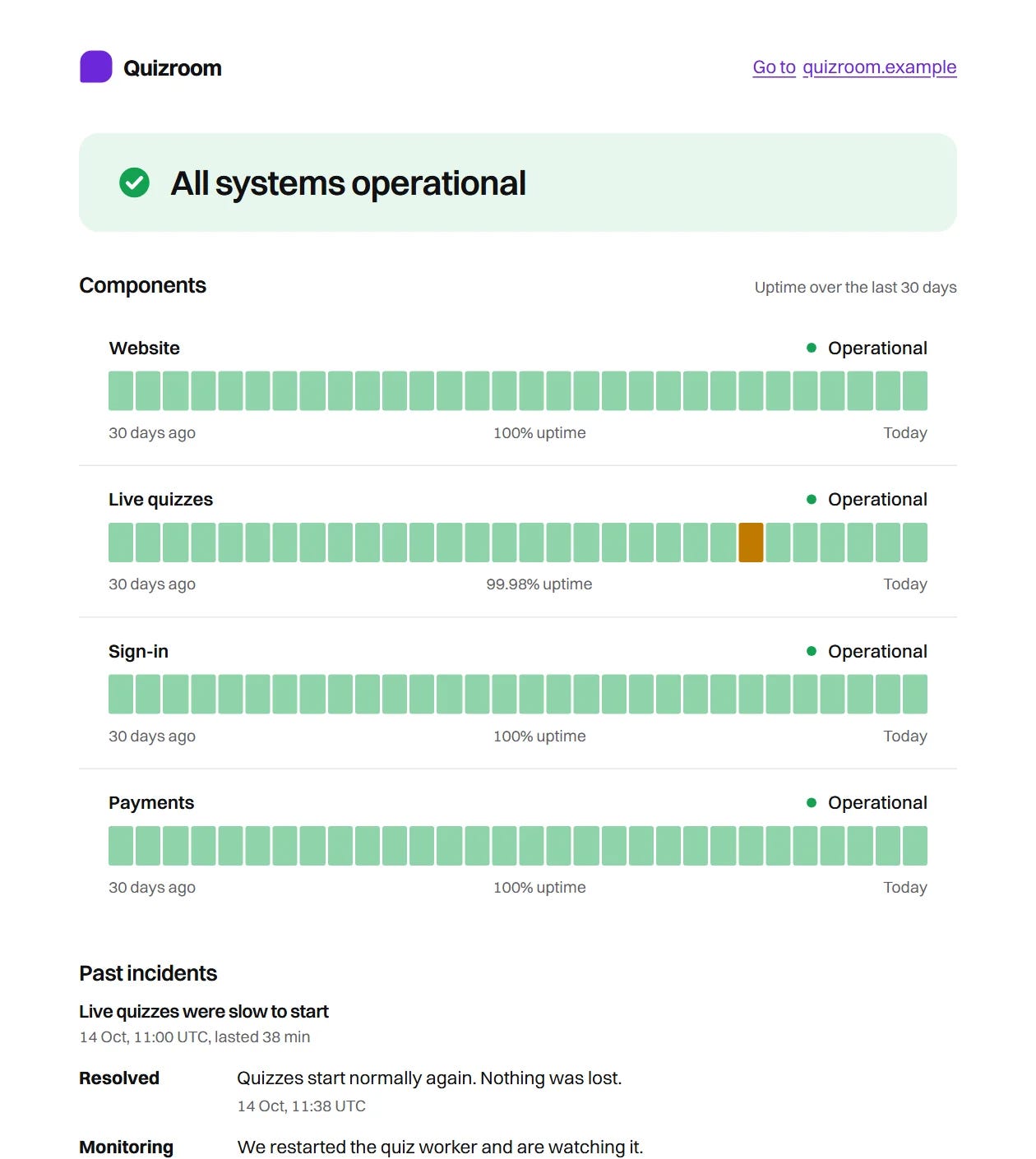
Your own domain, HTTPS included.
Your logo, favicon and accent color, in light, dark or the visitor's choice.
Components that follow your monitors, with daily uptime bars.
Incidents and the updates you publish. Your coding agent can draft an update over MCP, and it stays a draft until you publish it.
A banner in your app while something is wrong, a status pill in your footer from the same script, and a README badge.
It stays up when your app doesn't. Pages are served by their own server, separate from your app and from Staygreen's dashboard. If that server can't refresh, the page keeps the last state and says how old it is.
A free page says “Powered by Staygreen” in its footer. Builder ($9 a month, or $7.50 a month billed yearly) takes it off your pages and the Staygreen name off the widget and the badge, adds members-only pages and pages hidden from search engines, and allows up to 10 pages, one for each app.
Setting Up Takes a Name and an Address
Give Staygreen your app's name and address, and it tries the address and suggests monitors from what answers there: the website, its certificate and domain, health routes, a mail server and, when the site uses one, a Supabase project. A new status page for the app then starts with a component for each of its HTTP checks, the site's icon as its logo and the site's brand color as its accent. You change any of it in the page's editor.
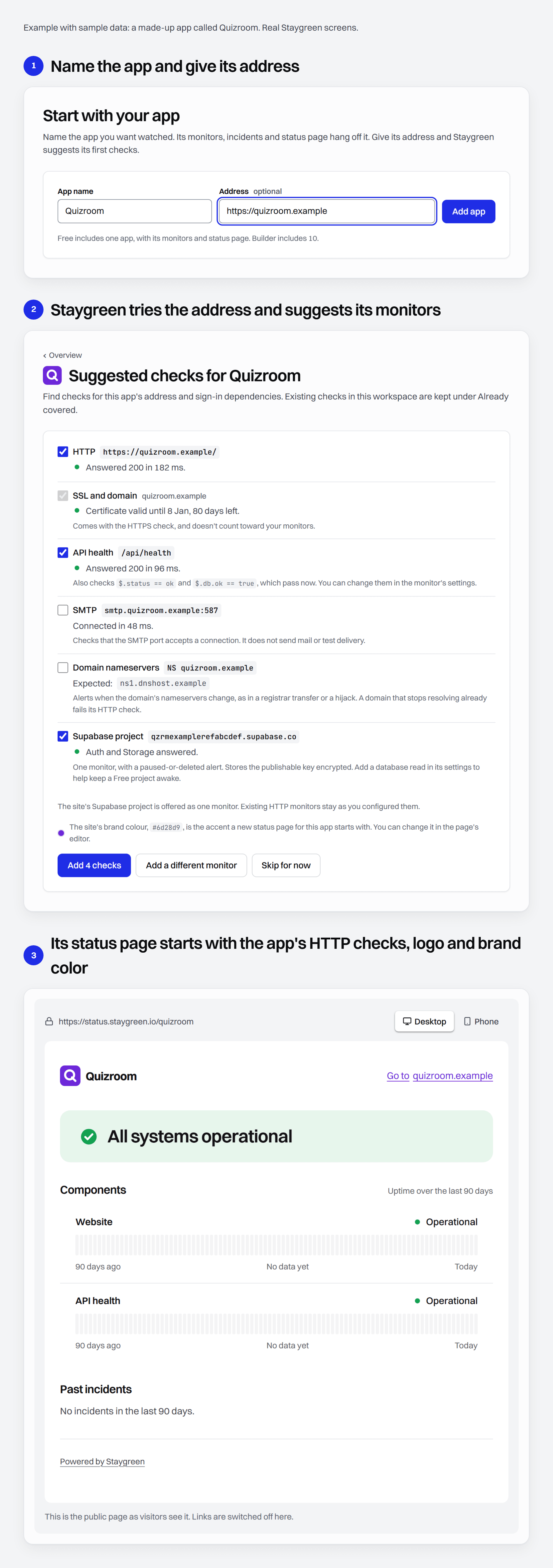
The free plan has 50 monitors to feed it, with HTTP checks every 3 minutes. How that monitoring compares with UptimeRobot's.
Your Domain in Four Steps
Type the domain, like status.yourapp.com, in the page's settings.
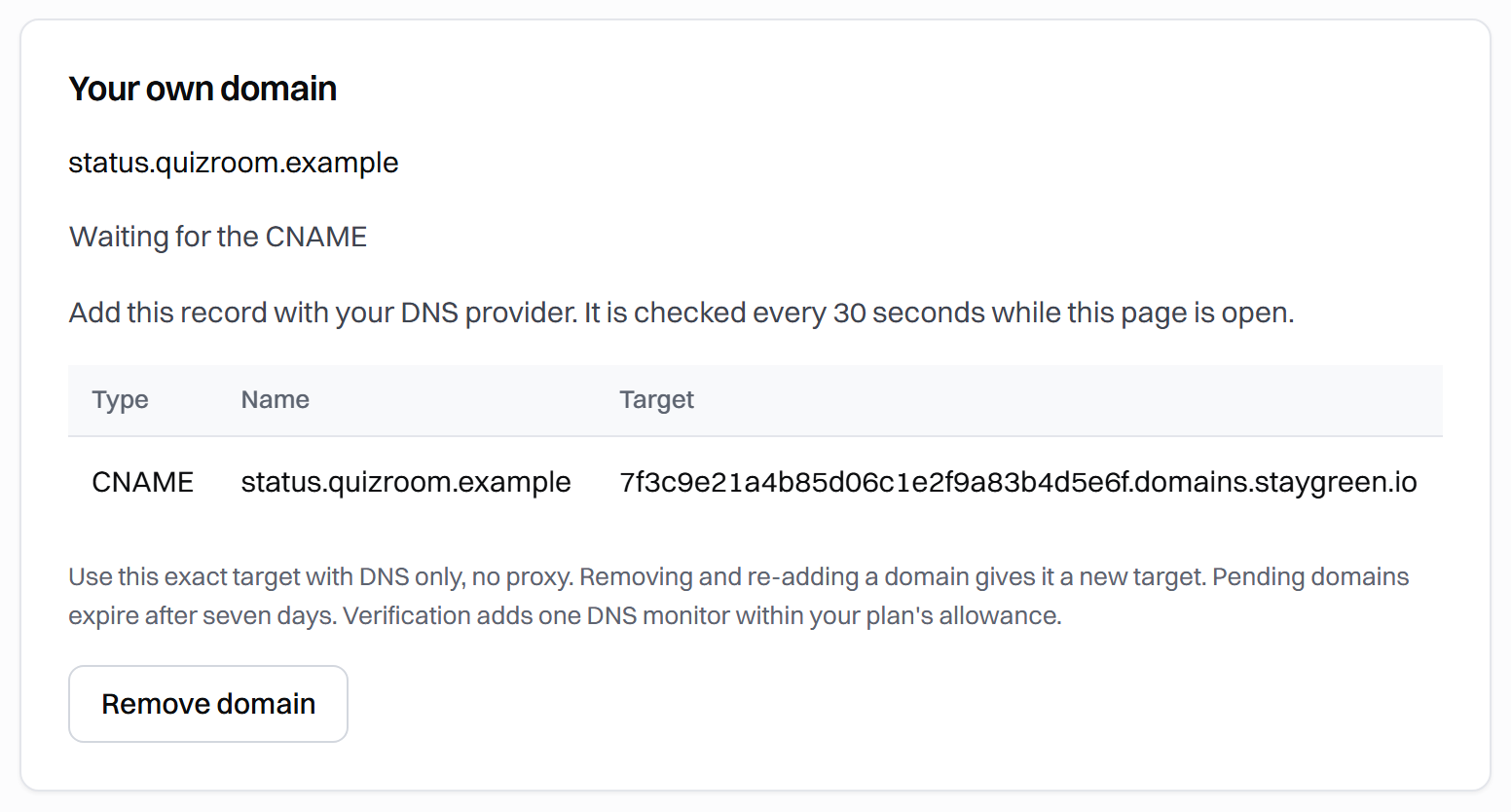
Add the one CNAME record the screen shows you, with any proxy switched off (DNS only, in Cloudflare). While that screen is open, it checks DNS every 30 seconds. A pending domain expires after seven days.
When the record matches, the domain turns green, and Staygreen adds a DNS monitor that watches it, as one of your plan's monitors.
The first HTTPS visit gets the domain its certificate: Staygreen's status server checks that the domain is verified, gets a Let's Encrypt certificate and renews it from then on. You never upload or renew one.
What the Same Page Costs Elsewhere
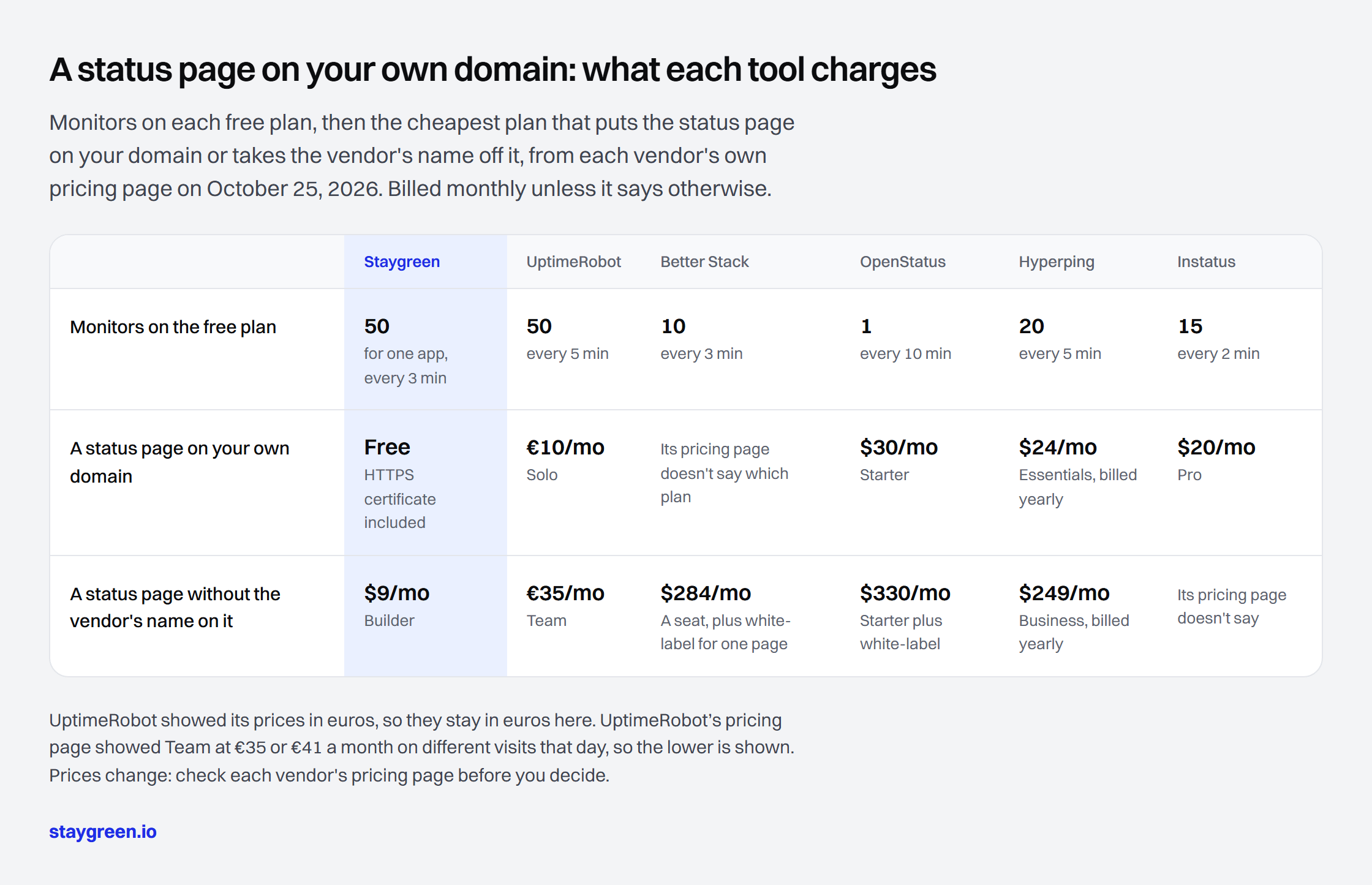
The table in words:
Monitors on the free plan: Staygreen 50 monitors for one app, every 3 minutes. UptimeRobot 50 monitors, every 5 minutes. Better Stack 10 monitors, every 3 minutes. OpenStatus 1 monitor, every 10 minutes. Hyperping 20 monitors, every 5 minutes. Instatus 15 monitors, every 2 minutes.
A status page on your own domain: Staygreen free, HTTPS certificate included. UptimeRobot €10 a month on Solo. Better Stack: its pricing page doesn't say which plan. OpenStatus $30 a month on Starter. Hyperping $24 a month on Essentials, billed yearly. Instatus from $20 a month on Pro.
A status page without the vendor's name on it: Staygreen $9 a month on Builder. UptimeRobot €35 a month on Team. Better Stack $284 a month: a $34 seat plus $250 to white-label one page. OpenStatus $330 a month: Starter at $30 plus $300 for white label. Hyperping $249 a month on Business, billed yearly. Instatus: its pricing page doesn't say.
UptimeRobot's terms say “Free plan includes 1 status page with a unique UptimeRobot URL only.” Its Solo plan is €10 a month for 10 monitors, or €22 to keep all 50.
Atlassian Statuspage's free plan gives 100 subscribers, 25 components, two team members and two metrics, with email, Slack and Teams notifications. Hobby is $29 a month, and its pricing page doesn't say which plan carries a custom domain. Moving to Staygreen, you get the monitoring behind the page and your own domain on the free plan, and give up email subscribers for now.
UptimeRobot showed its prices in euros, and Team at €35 a month on some visits and €41 on others that day, which looks like a price test. Sources: UptimeRobot and its terms, Better Stack, OpenStatus, Hyperping, Instatus and Statuspage.
When Another Tool Is the Better Choice
Your visitors need to subscribe to updates by email. Staygreen doesn't offer that yet. Instatus's free plan includes 200 subscribers and Statuspage's 100.
You want to host it yourself today. OpenStatus is open source under AGPL-3.0 and can run on your own server. Staygreen's code opens in November 2026.
You're keeping the monitoring you have. Staygreen's page shows only Staygreen's monitors. If you stay on UptimeRobot, its Solo plan puts its status page on your domain: €10 a month for 10 monitors, €22 for 50.
What Staygreen doesn't do yet: monitoring your own MCP server, alert delays and repeats while something is down, maintenance windows, and CSV export. What it isn't built for: SMS or phone-call alerts, a mobile app, ping and UDP checks, and checks more often than every minute. UptimeRobot covers the second list, and the UptimeRobot alternatives page compares it with the rest.
If none of those is you, the free page on your own domain is at staygreen.io.
Questions People Ask
Is there a free status page with a custom domain?
Yes: Staygreen puts it on your own domain with HTTPS on the free plan, commercial use allowed. UptimeRobot, OpenStatus, Hyperping and Instatus all charge for a custom domain.
Is Staygreen's status page really free?
Yes, with no card. The free plan covers one app and its status page, with 50 monitors to feed it. The page says “Powered by Staygreen” in its footer, and Builder removes it.
Can visitors subscribe to status updates by email?
Not yet. For now, the in-app banner tells people while they're using your app, and the status pill sits in your footer.
Who holds the certificate for my domain?
Staygreen does. Its status server requests the certificate from Let's Encrypt the first time someone opens your page over HTTPS, once Staygreen has verified the domain, and keeps renewing it. Your part is one CNAME record with the proxy off. There's no certificate to upload or renew.
What's a good free alternative to Atlassian Statuspage?
Staygreen if you also want the monitoring behind the page and your own domain free. Instatus if email subscribers matter more than the domain. OpenStatus if you'd rather host it yourself.
Does the status page need Staygreen to monitor my app?
Yes. Each component shows the state of the monitors you bind to it, so the page changes when they do. A Supabase monitor can feed a component too, so a Supabase project that paused itself shows on the page.
Is Staygreen open source?
Not yet. Its code opens in November 2026 under the Apache 2.0 license, and from then on anyone can host it, commercial use included. Hosting it means running probes in several cities, the status page server and the alerts, and watching all of it, which the hosted version does for you, free for one app.
Start free at staygreen.io: a status page on your own domain, its HTTPS certificate taken care of, monitoring included, no card.
This page is part of The Product Compass, a newsletter for PMs and builders who ship products with AI. Subscribe for the guides and tool tests.