


Hey Paweł here.
Our guest today is Elena Luneva, a product and business leader who helps PMs translate product work into business impact. She’s led product and GTM at Braintrust, Nextdoor, Nuna, OpenTable, and BlackRock. Today, she’s a fractional CPO, advisor, and executive coach.
If you’ve ever walked into a product roadmap review feeling prepared and walked out feeling… questioned, this one is for you.
There’s a moment most PMs recognize.
You walk into a roadmap review ready to talk product: the user pain, the validation, the demo, the edge cases.
Then the room flips.
A senior leader asks something that sounds simple, but kills the momentum:
“How does this move the business?”
“When do we see impact?”
“What’s the tradeoff if we don’t do this?”
And suddenly you’re no longer discussing a product. You’re defending a bet.
For a long time, I thought this meant execs “didn’t get product.” The real answer is more useful, and more uncomfortable:
I was speaking in product. They were listening in business.
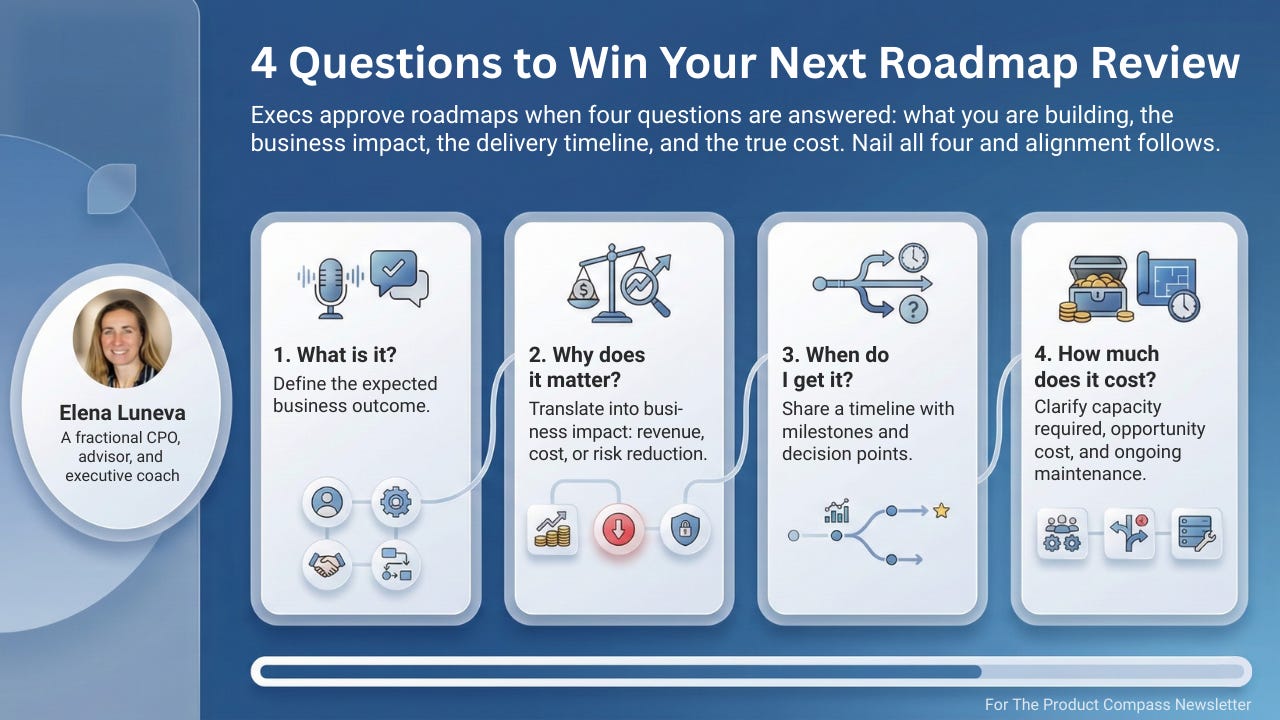
TLDR: In roadmap reviews, execs evaluate four things: what is it, why it matters, when we get it, and how much it costs me (including tradeoffs). If you can answer all four clearly, approval gets easier.
1. The Invisible Scorecard Behind Every Product Roadmap Review
Across companies and stages, leaders pressure-test initiatives with the same four questions:
Q1: What is it?
Q2: Why does it matter?
Q3: When do I get it?
Q4: How much does it cost me?
They may not ask them in that order. They may not ask them directly.
But if you can’t answer all four, your initiative becomes “interesting” instead of “approved.”
Let’s make each one land clearly.
Q1: “What is it?”
Executives are asking: Can I repeat this back accurately in one line?
Most PMs are strong here. We can explain the workflow, show mocks, and demo prototypes.
But “what” is table stakes at senior leaders. It earns you a seat. It does not win the decision.
Make “what” land in one sentence:
“This is [name]. It helps [who] do [job] by [mechanism], so [observable business outcome].”
Example (AI PM):
“This is Auto-Triage for support agents. It routes tickets by intent and risk, so urgent cases hit the right queue on first pass reducing OPEX by 1%.
Key assumptions:
In scope: [capabilities / languages / channels]
Not in scope: [edge cases we will ignore in v0]
Success looks like: [observable outcome] + [one metric]”
Q2: “Why does it matter?”
Executives are asking: Which business lever moves, and what is the mechanism?
PMs often answer in product language:
“It improves engagement.”
“It reduces friction.”
“Users asked for it.”
Execs are listening for business outcomes:
Does it grow revenue?
Does it reduce cost?
Does it protect margin?
Does it reduce risk?
Does it change trajectory?
Early in my career, I learned this the hard way. I was working on a mapping interface and kept defending it with engagement metrics. The project almost got killed.
What changed the outcome was not a better demo. It was translating the feature into the revenue system it supported (to learn more about the example and turnaround read through or watch From Feature Factory to Finance Fluency: How I Learned to Speak CFO).
Here’s the key: “Why does it matter?” is not philosophical. It’s resource allocation. Your job is not to become a CFO. Your job is to translate.
Make “why” land in one sentence:
“This matters because it moves [business lever] via [mechanism], measurable by [metric] in [time].”
Example (AI PM):
“This matters because it reduces cost by x% resulting in y revenue retention via faster triage, which shows up as lower cost per ticket within a quarter.
What makes this credible:
Lever: cost (and second-order retention protection)
Mechanism: fewer misroutes and less agent back-and-forth
Metric: cost per ticket + time-to-resolution (already in ops dashboards)
Assumption we’re testing: [X must be true] + early validation results”
If you want the template for this step, it’s in the downloads section below.
Q3: “When do I get it?”
Executives are asking: When do we learn, and when can we change course?
Roadmaps don’t fail because timelines slip. They fail because leaders stop believing them.
When someone asks “when do I get it,” they are usually asking:
When does this start to matter?
When do we learn if it works?
When can we stop or pivot if it doesn’t?
When do we get value?
In AI products, this gets sharper. Quality is probabilistic. Drift is real. Integrations surprise you. If you sell certainty, you burn trust.
Instead, give them a learning timeline and a decision point.
Make “when” land in one sentence:
“We get the first signal by [date], confidence by [date], and a scale-or-stop decision by [date].”
Example (AI PM):
“First signal in 2 weeks from a 5% pilot, credible read in 6 weeks after expansion, scale-or-stop by week 4.
How we’ll validate it:
v0 signal: [metric that indicates it works at all]
v1 proof: [metric tied to business outcome]
Decision rule: ‘If [threshold], we stop or narrow scope’
Top risk: [data quality / eval gap / integration dependency]”
This is the part that prevents “faster” pressure from turning into impossible dates and constant apology loops.
Q4: “How much does it cost me?”
Executives are asking: What are we spending, what are we not doing, and what burden are we creating?
This question makes many PMs uncomfortable because it sounds like finance.
But “cost” is not just money. Cost is:
engineering capacity
opportunity cost
cognitive load
maintenance ownership
AI run costs (model usage, infra, evals, human review)
risk carried forward
You do not need perfect numbers. You do need to show you are not ignoring reality.
What mature cost talk includes:
one-time build cost vs ongoing run cost
who owns maintenance
what gets delayed as a result
what happens if costs scale faster than expected
Make “cost” land in one sentence:
“This costs [build effort] plus [ongoing run and maintenance], with the tradeoff that we delay [other work].”
Example (AI PM):
“This costs 2 engineers for 6 weeks plus labeling, then ongoing model spend and weekly eval maintenance. Tradeoff: onboarding improvements slip by 4 weeks this quarter.
Tradeoffs and costs:
Build: [eng weeks] + [data work]
Run: [model cost drivers] + [monitoring / eval cadence]
Ownership: [who maintains prompts/evals/incidents]
Risk carried forward: [what becomes permanent load if we ship]”
If you want the template for this step, it’s in the downloads section below.
2. The Reframe That Changes Everything
You are not being evaluated on how good your feature is.
You are being evaluated on whether you understand the system it lives in:
the business model
the constraints
the portfolio tradeoffs
the decision-makers and what they need to say “yes”
When you translate well, the tone of the conversation changes. You stop reporting work. You start owning a business decision.
If you want to learn more about how to get better at understanding your audience take a look at Elevate Your Executive Presence with AI.
3. Where Financial Translation Fits in Your Career
If you’re a PM or AI PM reading this and thinking, “I was never taught this but I’m expected to know it,” you’re not wrong.
This translation skill between product, finance, and executive judgment is what separates:
PM → Senior PM
Senior PM → Director
Director → VP / CPO
It’s also why I built Develop CPO-Level Skills Course the way I did. To help PMs start thinking in a business context early, so the jump from shipping features to running the business is not as abrupt later.
You don’t need the title to practice the skill. But you do need the skill before the title shows up.
The next promotion boosting cohort starts Jan 15th.
Note From Paweł
Hey, Pawel here, again.
Elena’s post reminded me of an older piece I wrote, How to Elevate Your Status at Work (2023), where I said:
“90% of business outcomes top executives care about are related to costs, savings, revenue, business risk, and churn. Learn to talk their language.”
Future CPOs should consider her course. It goes much deeper, especially into the language of finance.
Find this helpful? You could also benefit from:
5 Phases To Build, Deploy, And Scale Your AI Product Strategy (OpenAI)
3-Layer Distribution Framework To Win Mind & Market Share (OpenAI)
Your Complete Roadmap to Earning a $180K–$569K AI PM Role (OpenAI)
Step-by-step Course to Craft a Killer PM Resume That Stands Out
The Ultimate List of 147 Product Manager Interview Questions
Downloads: Elena’s Templates (Subscribers Only)
Elena’s templates with proven tactics, metrics, sources of data, language to use, and copy-paste AI prompts:
Feature to P&L Translation Worksheet (5 pages)
The 4-Question Product Narrative (4 pages)
Get them below 👇