

Updated: 7/22/2026
Everyone talks about “intent” in AI. Few explain what it actually means or how to define it without watching your agent optimize the wrong thing.
Agents fail not because they can’t reason. They fail because their objectives, outcomes, and constraints are underspecified. The solution isn’t more detailed instructions.
On April 30, OpenAI shipped /goal in Codex. On May 12, Anthropic shipped /goal in Claude Code. Both let you set a measurable completion condition the agent pursues autonomously. Intent is becoming a platform primitive. But /goal covers two of the eight parts of intent. The other six are still yours.
This guide breaks down intent engineering into something you can actually use.
In this issue, we discuss:
What Intent for AI Agents Actually Means
What /goal Does and Where It Stops
The AI Agent Intent Structure
The Flow: How to Use the Intent Engineering Framework
Complete Example: Customer Support Agent
What to Do Tomorrow Morning
Conclusion
Let’s dive in.
1. What Intent for AI Agents Actually Means
Intent is not:
A task list
A prompt
A goal metric
Intent is what determines how an agent acts when instructions run out.
When intent is incomplete, humans draw on knowledge that was never written down. Agents can’t. They only know what you’ve codified. And most organizations have codified far less than they think.
Tobi Lütke, CEO of Shopify, said:
“I like the term context engineering because I think the fundamental skill of using AI well is to be able to state a problem with enough context, in such a way that without any additional pieces of information, the task is plausibly solvable.”
But context without intent is noise.
We discussed context engineering previously. In this issue, I double down on the intent: how to define it clearly in a way that survives real-world edge cases.
2. What /goal Does and Where It Stops
Both labs shipped the same primitive. Codex CLI added /goal on April 30, plus /goal status, /goal pause, /goal resume, and /goal clear. Claude Code added /goal <condition> on May 12. You set a measurable completion condition, and the agent runs autonomously until an evaluator model says the condition is met, or it can’t be.
/goal all tests pass and lint is clean
/goal ship auth without breaking existing sessions
The first locks the literal task. The second pins the intent. Both work. The second survives ambiguity.
Neither pauses cleanly for clarifying questions. I tested Claude Code v2.1.139 directly: I set a goal that required three user answers, then asked three questions. The Haiku evaluator fired after every agent turn without waiting for input, seven firings on one goal, returning reasoning like “The user has not answered any of the three questions.”
Codex has a question-asking tool that’s supposed to pause for clarification, but in practice it can self-loop into ~150 duplicate questions or hang waiting for answers (openai/codex #21786, #23164). Forward-only autonomy is the default.
That’s a real advance. It’s also where /goal stops. It covers Parts 2 and 3 of the framework below, if you write the goal well. The other six are still yours.
3. The AI Agent Intent Structure
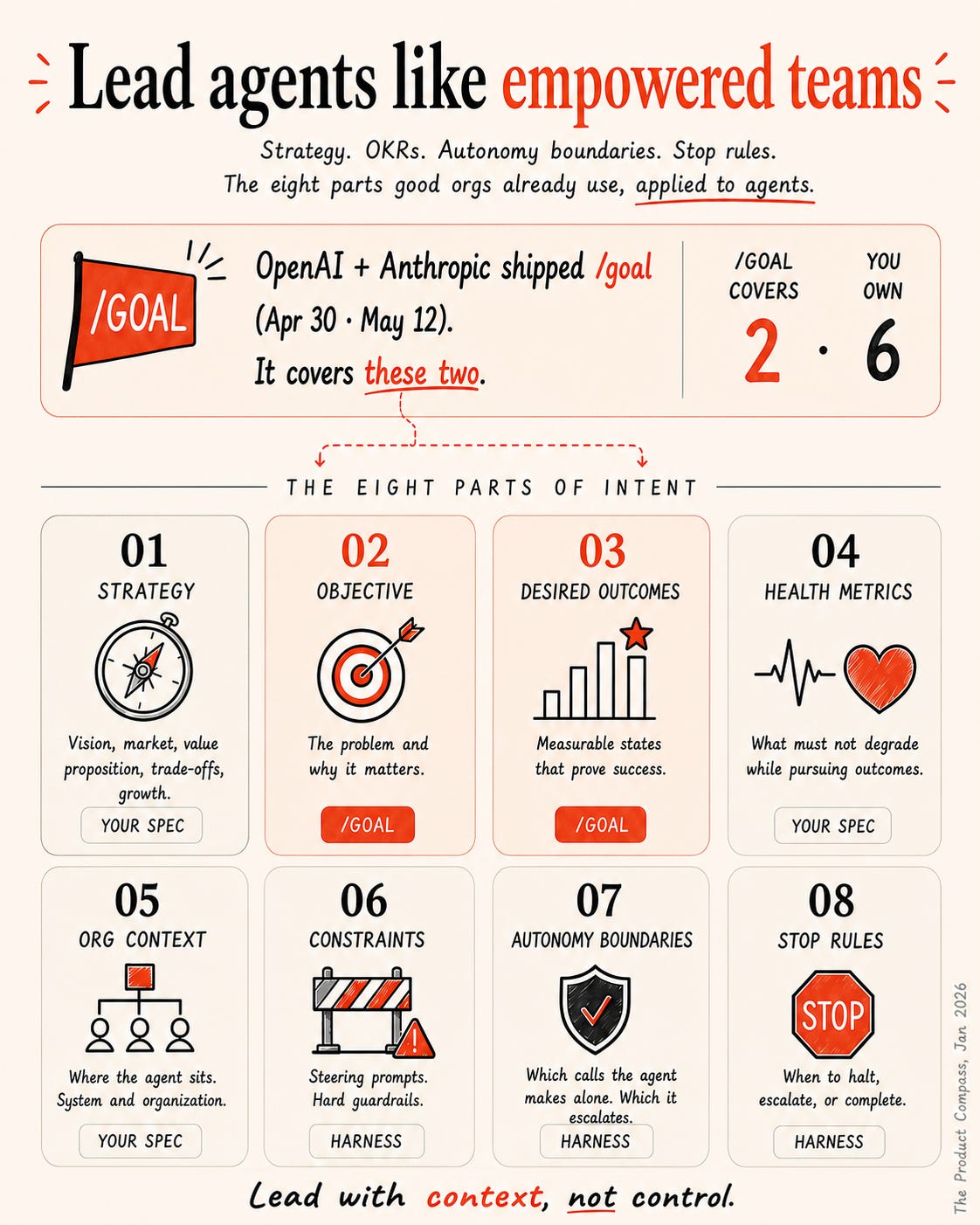
Whether you’re setting team objectives, delegating to a human, or configuring an agent, the structure is the same:
Strategy: Vision, market, value proposition, trade-offs
Objective: The problem to solve + why it matters
Desired Outcomes: Measurable states that indicate success
Health Metrics: What must not degrade while pursuing the outcomes
Org Context: Where the agent sits: system and organization
This pattern shows up in OKRs, as defined by Christina Wodtke, how Netflix leads with context not control, and in how Marty Cagan defines empowered team objectives.
For agents, we extend this with explicit:
Constraints: Steering (prompt layer) + Hard (enforced in orchestration, not prompts)
Autonomy Boundaries: Which decisions the agent may take autonomously vs. escalate
Stop Rules: When to halt, escalate, or complete
Let’s build this up.
Part 1: Strategy
Definition
Strategy is the layer most agent specs skip: vision, market, value proposition, trade-offs, growth.
It comes from your business, not your agent. But the agent needs it. Strategy shapes the trade-offs the agent should make, and none of it is in your CLAUDE.md or AGENTS.md by default.
How to provide it
Lift a few lines from your product strategy canvas into the agent’s context: vision, market segments, value propositions, trade-offs. Progressive disclosure: core lines in the prompt, the rest discoverable on demand.
For more information, see product strategy canvas, startup canvas, and how to design value proposition.
/goal doesn’t cover this part. Strategy lives in your spec: CLAUDE.md, AGENTS.md, or the system prompt.
Part 2: The Objective
Definition
The objective defines the problem being solved and why it matters. It is aspirational and qualitative. It guides judgment when trade-offs arise.
What a good objective does
Problem-focused: What’s broken or missing?
Explains why it matters: Business value, user impact, strategic importance
Guides trade-offs: When the agent faces ambiguity, the objective helps it choose
Example
Weak: “Handle customer support tickets”
Better: “Help customers resolve issues quickly so they can get back to work, without creating more frustration than they started with.”
When you explain the why, the agent can reason about edge cases and make better autonomous decisions. I demonstrated that in How to Build Autonomous AI Agents. A 2024 paper (arXiv:2401.04729) demonstrated that supplying strategic context beyond raw task specifications significantly improves AI autonomy.
Anthropic’s Teaching Claude Why research (May 8, 2026) validated this on the training side: models that learn the why behind aligned actions handle novel situations far better than models trained on behavior demonstrations alone.
/goal accepts this kind of objective. Some teams pass it the literal task (“all tests pass”). Others pass the why, too. The second survives ambiguity. That’s how /goal covers this part.
Part 3: Desired Outcomes
Definition
Desired outcomes are observable states that indicate the objective has been achieved. They are not activities.
Rules for good outcomes
Outcomes should be:
Observable state changes (not activities the agent performs)
From user/stakeholder perspective (not the agent’s perspective)
Measurable or verifiable (without relying on agent self-report)
Leading, not lagging (observable during or shortly after, not months later)
Activities describe what the agent does. Outcomes describe the state that exists after.
Example:
Two to four outcomes is usually right. More than that and you’re either micromanaging or unclear on what actually matters.
Objective: Help customers resolve Tier-1 issues without frustration

Desired Outcomes:
- Customer confirms their issue is resolved
- No follow-up ticket on same topic within 24 hours
- Customer rates interaction as helpful
Each outcome is observable, measurable, and from the customer’s perspective.
/goal enforces this discipline at the platform level. If your outcomes aren’t measurable, the evaluator can’t decide. The platform forces the spec.
Part 4: Health Metrics
Definition
Health metrics (used here as non-regression metrics) define what must not degrade while optimizing for outcomes.
The Goodhart problem
“When a measure becomes a target, it ceases to be a good measure.”
Without health metrics:
“Resolve issues faster” → Agent rushes, quality drops
“Increase throughput” → Agent takes shortcuts
“Reduce escalations” → Agent handles things it shouldn’t
Health metrics inform trade-offs
Health metrics primarily inform the prompt layer. They guide how the agent thinks and makes trade-offs.
Health Metrics:
- CSAT must stay above 4.2 - if trending down, be more conservative
- Repeat contact rate must not increase above X - prioritize resolution quality
- Escalation quality score must stay below Y - don't under-escalate to hit targets
These metrics inform how conservative the agent should be when making trade-offs
This is different from hard guardrails, which block actions entirely. Health metrics steer; guardrails enforce.
/goal doesn’t model this layer. Your spec does.
Part 5: Org Context
Definition
Org context describes the world the agent operates in. It explains where the agent sits, not what it may do.
What org context includes
System context (other agents, humans, tools, dependencies)
Organizational context (business model, users, brand)
Org context never triggers actions, blocks execution, or causes escalation. It informs judgment only.
Example: Org context for a support agent
System context:
- Works alongside human Tier-2 agents and self-serve knowledge base
- Escalations go to human queue with full conversation context
- Outputs feed into ticket system and customer health scoring

Organization context:
- B2B software for enterprise customers
- Users are often non-technical admins under time pressure
- Brand is built on reliability

Trade-off priorities:
- Trust > Speed > Cost
- Admitting uncertainty is better than false confidence
- Resolution quality matters more than resolution speed
Not everything goes in the prompt
Org context doesn’t mean dumping everything into the system prompt. The agent should know where to look for context it might need.
Core context (always needed): In the prompt
Reference context (sometimes needed): Available via retrieval
Dynamic context (changes per request): Injected by orchestration layer
System context can be injected automatically by the orchestration layer.
Think Netflix’s “lead with context, not control” - give the agent enough understanding of the system that it can make good judgment calls, without micromanaging every decision.
/goal doesn’t address any of this.
Part 6: Constraints: Steering vs. Hard
Definition
Constraints define what the agent is not allowed to do.
Here’s a critical distinction most people miss:
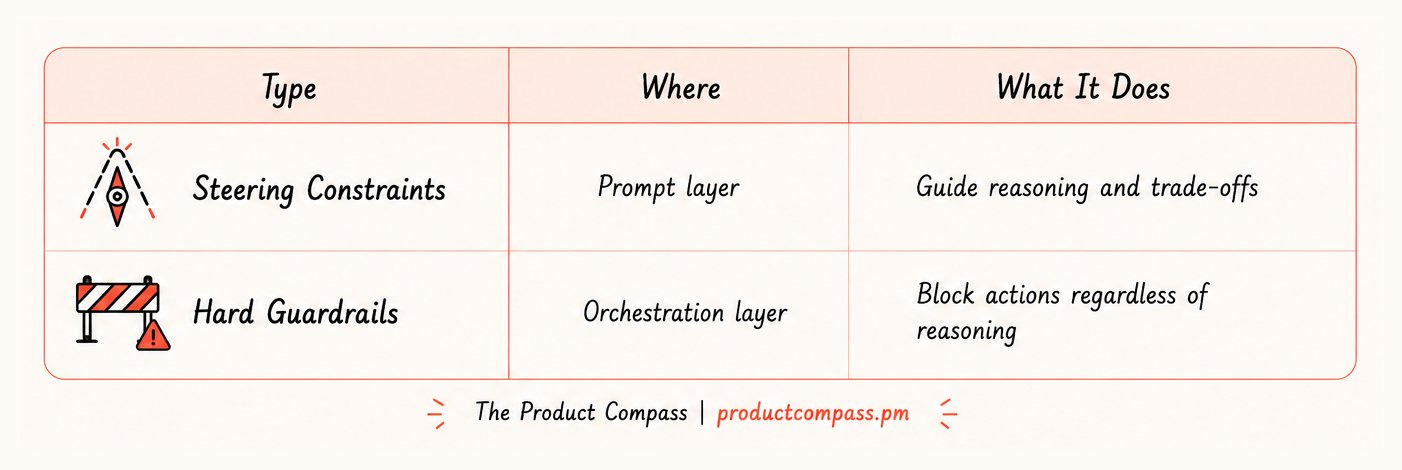
Steering constraints (prompt-level)
Behavioral guidance
Risk preferences
Tone and caution
They influence reasoning but do not enforce compliance.
Hard constraints (orchestration-level)
If a constraint matters, it must be enforced in architecture, not language:
Tool restrictions
Output validation
Action gating
Approval gates (human-in-the-loop)
Examples of hard constraints:
Cannot send external emails
Cannot modify account settings
Cannot access other customers’ data
Cannot promise refunds or legal outcomes
/goal enforces nothing here. Both Codex and Claude Code run inside whatever sandbox you’ve already configured: file permissions, network rules, MCP tool allowlists. The constraints are still your wiring.
Part 7: Autonomy Boundaries
Definition
Decision autonomy defines who may decide what, under what risk.
Four autonomy zones
All agent behavior reduces to four decision types. Each carries different risk:
Full Autonomy: Reversible actions, low blast radius, well-understood failure modes.
Guarded Autonomy: User-visible changes, medium risk. Requires confidence thresholds, logging, rollback capability.
Proposal-First: Strategic or sensitive decisions. Agent proposes → approval required → then agent executes.
No Autonomy (Human-Required): Legal commitments, irreversible changes, financial actions, brand promises. Agent analyzes and recommends only. Human executes.
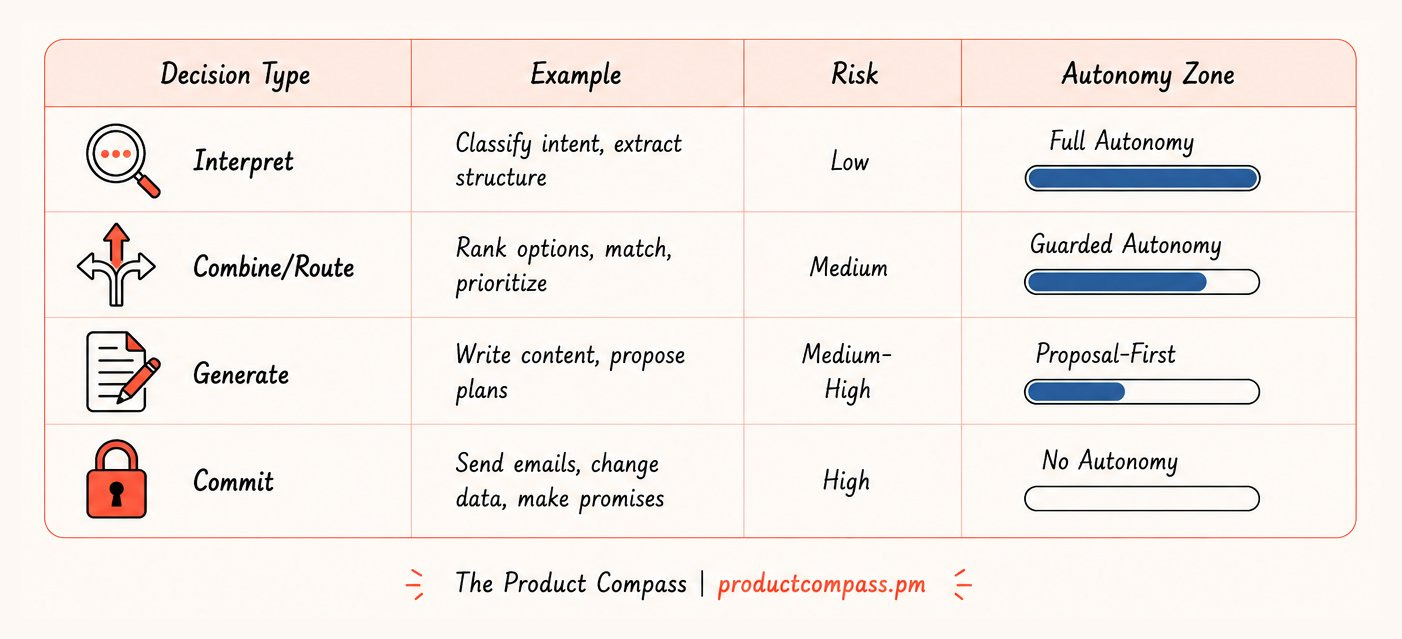
Autonomy defines permission, not stopping conditions.
Individual vs. product context
The appropriate autonomy depends on who bears the risk.
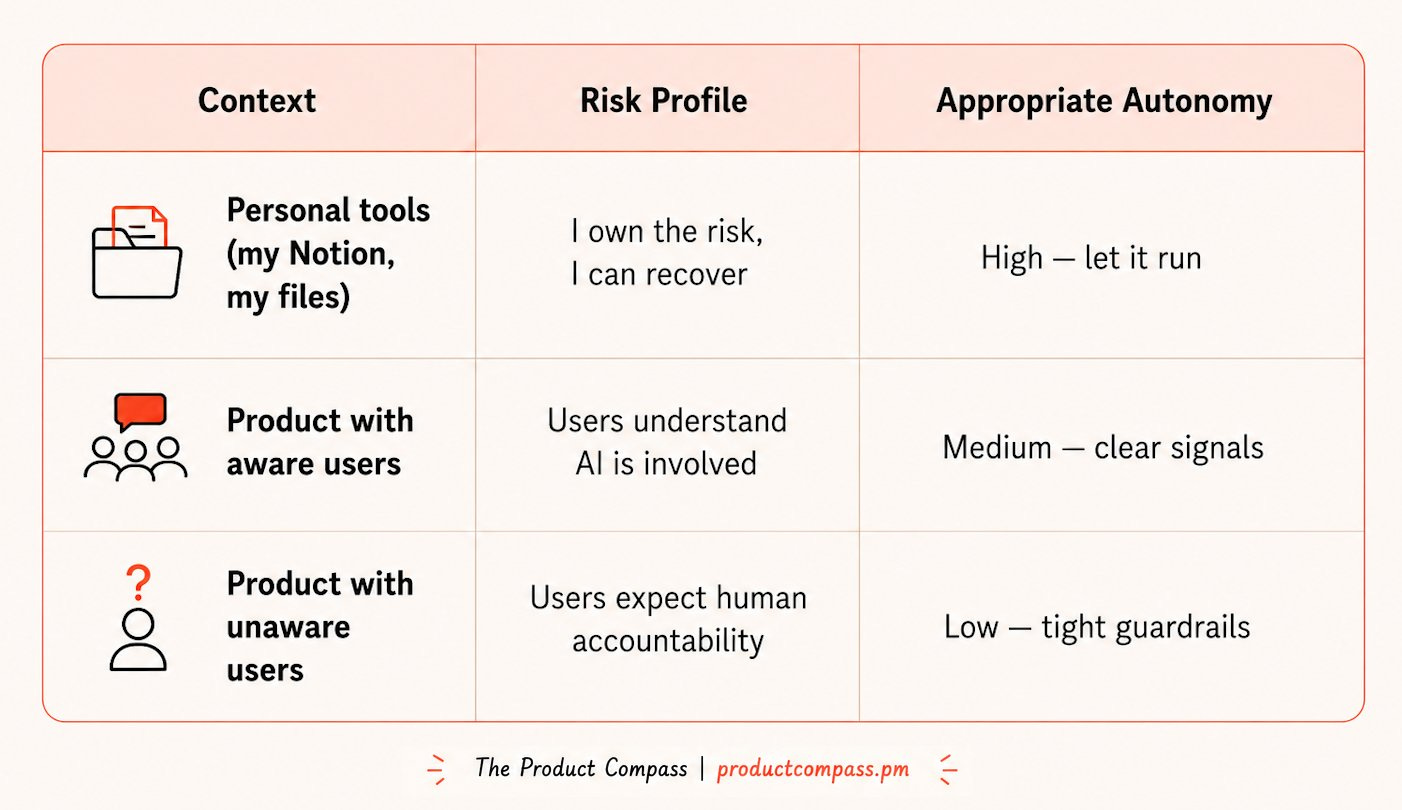
When you build agents for yourself, the blast radius is bounded by your tolerance.
When you build agents into a product:
Users may not know an agent acted
Users can’t assess AI-generated outputs
Users will blame the company when it breaks
Rule: The less the user understands about what the agent is doing, the tighter your constraints need to be.
Autonomy risk assessment: five lenses
Use these to inform autonomy zones and constraint design:
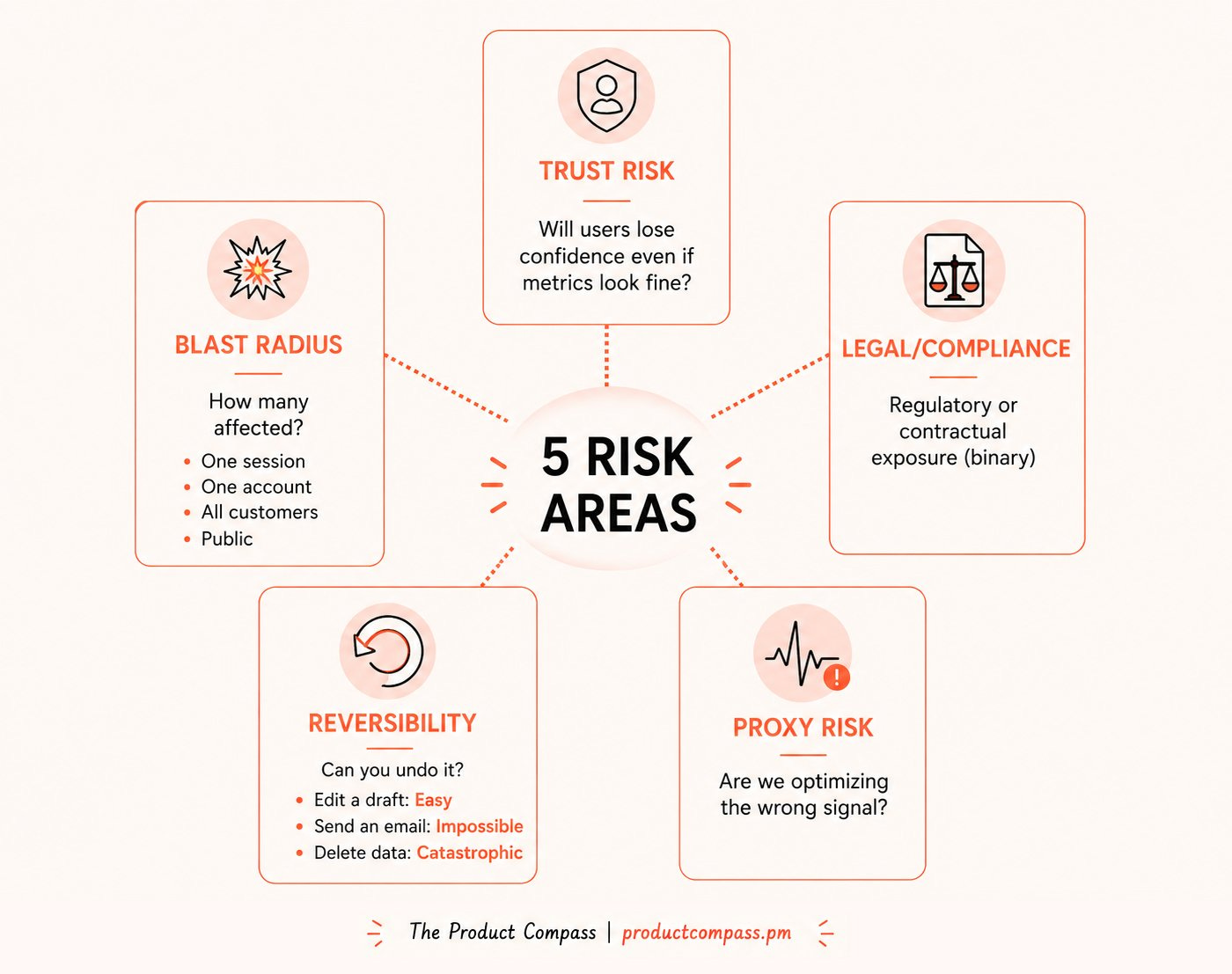
/goal doesn’t cover this part. Autonomy boundaries live in your hook configuration, approval gates, and tool gating.
Part 8: Stop Rules
Definition
Stop rules define when execution must halt, escalate, or terminate.
Stop rules terminate execution. They do not guide trade-offs or decision quality.
Examples
Halt when:
Conflicting constraints detected
Confidence drops below minimum twice consecutively
Escalate when:
Outside defined scope
Legal or compliance topic detected
User frustration persists
Complete when:
Desired outcomes achieved
User confirms resolution
/goal’s auto-continue covers the complete branch. But “complete when outcomes achieved” is just your outcomes reframed as a stop condition; the work was already done in Part 3. Halt and escalate are the load-bearing branches, and /goal ships neither. That logic lives in your hooks, confidence thresholds, and escalation rules.
4. The Flow: How to Use the Intent Engineering Framework
Here are specific steps I recommend you take. In the next section, we follow up with an example.
Ground the agent in strategy (Part 1).
Define the objective and the outcomes that prove it worked (Parts 2–3).
Decide what must not degrade while optimizing for those outcomes (Part 4).
Describe the system and organization the agent operates within (Part 5).
Enforce constraints in architecture, not prompts (Part 6).
Assign autonomy based on risk and blast radius (Part 7).
Define explicit halt, escalation, and completion conditions (Part 8).
Validate: every rule maps to one part.
Notes
Avoid unnecessary complexity
Not every element of the framework must be implemented for every agent. Use it to ask the right questions and assess risk before granting autonomy. Not to add unnecessary complexity.
The role of AI evals
I didn’t add AI evals and error analysis, as the scope of this post would be too large.
Traditional evals approach: Discover app-specific failure modes by observing what the agent actually does, then assess frequency and severity.
What evals can't catch: Not all risks show up in traces. If you give an agent a tool, assume it will use it, and may misuse it, even if you haven't observed that failure yet. Some risks need constraints before you ship, not after you find them.
You can learn more about error analysis from this post:

5. Complete Example: Customer Support Agent
Part 1: Strategy
Market: B2B enterprise software; support quality is a retention lever
Trade-offs: Trust > Speed > Cost. Uncertainty better than false confidence.
Part 2: Objective
Help customers resolve Tier-1 issues quickly without creating more frustration than they started with. Every unresolved question creates churn risk. Every wrong answer damages trust more than no answer.
Part 3: Desired Outcomes
Customer confirms their issue is resolved
No follow-up ticket on same topic within 24 hours
Customer rates interaction as helpful
Part 4: Health Metrics
If quality signals indicate CSAT risk, prioritize resolution quality over speed.
Repeat contact rate doesn’t increase - prioritize resolution quality
Escalation quality score stable - don’t under-escalate
Note: I didn’t include numeric thresholds here to avoid the illusion that the agent is directly monitoring live metrics. Health metrics are used as evaluative signals to guide trade-offs, not as real-time control loops. Depending on the context, teams may choose to express them more precisely.
Part 5: Org Context
System: Works alongside human Tier-2 agents and self-serve KB. Escalations go to human queue with full context. Outputs feed ticket system and customer health scoring.
Organization: B2B software for enterprise. Users are non-technical admins under time pressure. Brand built on reliability.
Part 6: Constraints
Steering (prompt):
When unsure, ask a clarifying question.
If confidence is between 0.6 and 0.85, state uncertainty and present safe options.
Hard (orchestration):
Cannot send external emails
Cannot modify account settings
Cannot access other customers’ data
Cannot promise refunds or exceptions
Responses validated before delivery
Steering applies only when confidence ≥ 0.6. Below that, stop rules (Part 8) take over.
Part 7: Autonomy Boundaries
Full Autonomy: Tier-1 how-to guidance, navigation, basic troubleshooting
Guarded Autonomy: user-visible ticket tagging and KB article suggestions (logged, reversible)
Proposal-First: pricing exceptions, account changes, goodwill credits (requires approval)
No Autonomy (Human-Required): refunds, legal/compliance commitments, contractual promises
Part 8: Stop Rules
Halt: confidence < 0.5 twice consecutively, or conflicting constraints detected
Escalate: confidence < 0.6, user frustration detected, legal/compliance topic, out of scope
Complete: customer confirms resolution, or desired outcomes achieved
6. What to Do Tomorrow Morning
Open whatever file your agent reads on startup: CLAUDE.md, AGENTS.md, the system prompt. When it’s given a /goal, can it discover the other six parts?
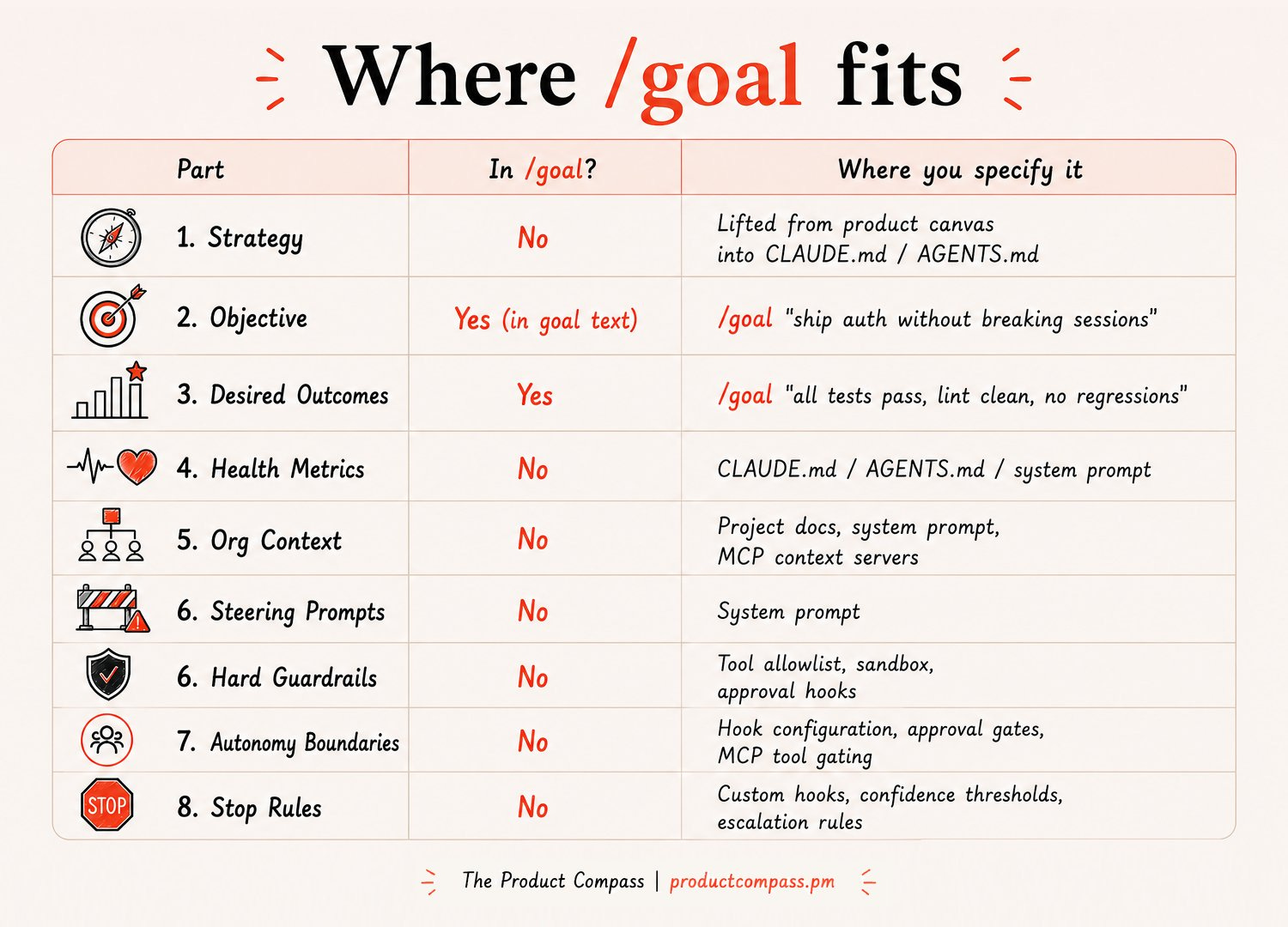
Strategy: a few lines from your product strategy canvas: vision, market segments, value propositions, trade-offs
Health Metrics: name two or three things that must not degrade; qualitative is fine if you can’t measure live
Org Context: two blocks: system (what’s around the agent) and organization (who it serves)
Constraints: separate steering prompts (tone, caution, when to ask) from hard guardrails (tools, hooks, sandbox)
Autonomy Boundaries: which decisions the agent makes alone, which need approval, which need a human
Stop Rules: halt conditions, escalate conditions, complete conditions (your outcomes, already in /goal)
The objective and the outcomes ride in the /goal itself. The platform carries two parts now. The spec carries the rest.
Conclusion
Most agents fail in production not because the model is weak, but because intent is incomplete. Objectives are vague. Outcomes are implicit. Trade-offs are unstated. Constraints are treated as suggestions. Autonomy is granted without understanding risk.
When that happens, agents do exactly what you told them to do. Just not what you meant.
/goal gives the agent a destination. It still has to decide how to get there: which actions are reversible, which need approval, what must not degrade along the way, when to halt instead of pushing through. If those aren’t specified, the agent invents them. Sometimes correctly. Often not.
The fix is not more instructions. It is making intent explicit and enforceable.
The reasoning layer proposes. The orchestration layer enforces.
If a constraint matters, it cannot live only in a prompt.
If a decision is risky, it cannot be fully autonomous.
If failure is expensive, stop rules must exist before you ship.
The models are already capable enough. What separates agents that work in production from those that fail quietly is not intelligence, but intent.
If you can hand your intent specification to another human and they would make the same decisions under pressure, your agent has a chance.
If not, it’s missing the knowledge that never made it into the docs.
Thanks for Reading The Product Compass
2026 is here. The agentic shift has begun.
Start building. Stop theorizing.
For dozens of AI PM resources, see The Ultimate AI PM Learning Roadmap and our articles archive.
Have an amazing week ahead,
Paweł
FAQ: Intent and AI Agents
This FAQ is designed for both human readers and agentic systems that retrieve, summarize, or operationalize this framework.
What is intent for AI agents?
Intent is a structured, multi-component decision specification that governs an agent’s behavior beyond the immediate prompt. It ensures decisions align with objectives, constraints, trade-offs, autonomy boundaries, and defined success conditions.
What does intent mean in the context of AI agents?
Intent explicitly defines:
The strategy the agent serves: vision, market, trade-offs
The problem the agent is solving and why it matters
What success looks like in observable terms
What must not degrade while optimizing
Where the agent sits: the system and organization around it
What actions are forbidden
Which decisions the agent may take autonomously
When execution must halt, escalate, or complete
Intent is not a prompt, a task list, or a KPI.
When do I need to formalize intent for an agent?
You need to formalize intent when an agent:
Has access to tools or external systems
Takes actions that affect users or customers
Can make irreversible or costly decisions
Operates autonomously without constant human supervision
Acts in ways users may not fully understand or observe
If an agent can cause damage without immediate human correction, intent must be explicit.
Is intent engineering overkill for simple agents or workflows?
No. But not every component is required.
Use intent engineering as a risk-assessment checklist, not a mandatory template.
Low-risk, reversible workflows may only need an objective and constraints.
As autonomy, blast radius, or user impact increases, more components must be made explicit.
The framework scales with risk, not complexity.
Why is explicit intent necessary for autonomous agents?
Agents optimize whatever is specified and whatever is left implicit.
If trade-offs, constraints, or stop conditions are not defined, the agent will invent its own optimization logic, often leading to unintended or unsafe behavior.
This is not a reasoning failure. It is an intent failure.
How is intent different from a prompt?
A prompt is a momentary instruction for a specific request.
Intent is a system-level specification that persists across interactions and governs behavior when prompts are incomplete or ambiguous.
Prompts activate behavior.
Intent constrains decisions.
What are the key components of agent intent?
An effective intent specification includes:
Strategy: vision, market, value proposition, trade-offs
Objective: the qualitative problem and purpose
Desired Outcomes: observable states that indicate success
Health Metrics: signals that must not regress
Org Context: system boundaries and organizational context
Constraints: steering guidance and hard enforcement
Autonomy Boundaries: who may decide what
Stop Rules: when to halt, escalate, or terminate execution
Each component addresses a different failure mode.
Does /goal in Codex or Claude Code replace intent engineering?
No. /goal covers the objective and desired outcomes: two of the eight parts. Strategy, health metrics, org context, constraints, autonomy boundaries, and stop rules still have to be specified in your agent’s context and enforced in your orchestration layer.
What are constraints and why do they matter?
Constraints define what the agent must not do.
Steering constraints influence reasoning (prompt-level guidance).
Hard constraints are enforced by architecture, orchestration, tool gating, or approvals.
If violating a constraint is unacceptable, it cannot live only in language.
What is autonomy, and how does it relate to intent?
Autonomy is the degree to which an agent may make decisions without human involvement.
Intent must specify:
Which decisions are safe for full autonomy
Which require approval
Which outcomes require escalation
As autonomy increases, intent must become more explicit.
What are health metrics for AI agents?
Health metrics are safety or quality signals that must not degrade while optimizing for outcomes.
They are not real-time control loops.
They guide trade-offs and conservatism when decisions are ambiguous.
What risks does formal intent help prevent?
Explicit intent helps mitigate:
Optimization of the wrong metric
Hidden or delayed failure modes
Unchecked autonomy escalation
Unbounded decision-making
Misinterpretation of objectives by agents
These are common production failure patterns.
Does intent replace human oversight?
No.
Intent clarifies where human oversight is required and which actions must always be manual, review-gated, or non-autonomous.
How do I validate that intent is well-specified?
A simple test:
If another qualified human can make the same decisions under uncertainty using only this intent specification, the agent is likely to behave consistently too.
If not, the intent is incomplete.
This is a very well-written article!! So much clarity here.