

Hey, Paweł here. Welcome to The Product Compass Newsletter.
Every week, I share actionable tips to help you become a (better) PM.
Consider subscribing and upgrading your account for a full experience:
The North Star Framework 101
Growing your product can often feel overwhelming.
Every day, you and your teams - engineering, design, marketing, sales, growth, or success - must make dozens of small decisions, experiment, measure the outcomes, and adapt. If they are not perfectly aligned, it's like a body with each limb moving independently - you can't even take a step forward.
You might wonder:
“How do we know where to go?”
“How can we measure our progress?”
“Are going to succeed?”
It would be great to have a compass that always points in the right direction. It would help empower your teams to make better, autonomous decisions.
A true North Star.
In this issue, you will learn:
What is the North Star Metric?
North Star Metric - common misconceptions
North Star Metric - recommended classification
🔒 The North Star Framework
🔒 North Star Metric vs. One Metric That Matters (OMTM)
🔒 Practical tips and advice
🔒 Recommended content
1. What is the North Star Metric?
The North Star Metric is an extremely simple, powerful concept. But it's largely misunderstood.
The term has been popularized by Sean Ellis. Sean is also known for coining "growth hacking" while being a growth marketer at Dropbox. In his talks, Sean often points out a recurring issue in product management:
It’s common for a product's revenue to continue growing rapidly while the value provided to customers doesn't follow the same trajectory. Over time, this can lead to a sudden crash in revenue.
Let's imagine you have a Substack newsletter, and you are solely focused on acquiring new subscribers. You get 50 new paid subscribers every month, which seems promising. As a result, you decide to quit your job to become a full-time content creator.
On the surface, everything seems promising as your MRR (Monthly Recurring Revenue) continues to rise. But one day, you discover that only 10% of paid subscribers read at least one article every month. Your content fails to provide value to users, and there's a significant risk that they will soon cancel their subscriptions.
This is why the most successful product companies select and optimize for a metric that truly reflects the value customers derive from their products.
Let’s take Netflix as an example:
A possible wrong approach would be to focus solely on the number of paid subscribers. The most profitable short-term scenario would be if everyone bought a subscription but didn't watch anything. In that case, Netflix wouldn't even have to scale its infrastructure.
Netflix's actual approach is to focus on the number of weekly viewing hours. They understood that by increasing the viewing hours, let's say, by 50% year after year, they are likely to sustain their revenue growth in the long term.
Now, let's go back to the newsletter we imagined earlier. What can be improved?
Instead of obsessing over acquisition, a better approach might be to focus on the statistics related to reading your content. The more valuable people find it, the more likely they are to continue their subscriptions. Some might even become your ambassadors.
1.1 North Star Metric definition
North Star Metric is a tool to drive your product’s growth. In the Growth Hacking world, North Star Metric:
Is a single metric. The goal is to create focus.
Is easy to understand, enabling everyone to speak the same language.
Is customer-centric. Reflects how customers get value from the product.
Ideally ensures the value is sustainable, typically by forming habits.
Represents your progress toward vision / mission, fostering alignment among your teams and inspiring them to move in the same direction.
Is quantitative. It relies on numbers, not opinions.
Is actionable. Whether it increases or decreases, you will take action based on it. Otherwise, what's the point of tracking it?
Serves as a leading indicator of your long-term business success.
1.2 North Star Metric examples
Let's consider 14 companies. For each company, I have specified a potential misconception and the actual North Star Metric (NSM). Can you justify it?
In particular, ask yourself:
Does this metric truly reflect customer value?
Does this metric help in forming habits?
Does this metric inspire the teams working on the product?
Does this metric indicate long-term business success?

The same examples as text. Each entry names the actual North Star Metric, the company's game (attention, transaction, or productivity — the classification is in section 3), and the vanity metric it replaced:
Facebook: daily active users (attention). Not daily posts.
Spotify: time spent listening to music (attention). Not the number of subscribers.
Amazon: the number of orders per month (transaction). Not monthly revenue.
Uber: the number of rides per week (transaction). Not the number of installs.
Loom: videos with a view (productivity). Not LTV/CAC.
Airbnb: nights booked (transaction). Not time spent using the app.
Tinder: matches made (transaction). Not the number of swipes right.
Fitbit: steps made (productivity). Not the number of products sold.
Dropbox: files saved (productivity). Not the number of paid customers.
Canva: happy, active users (productivity). Not the number of projects created.
YouTube: time spent watching videos (attention). Not the number of videos uploaded.
WhatsApp: messages sent (productivity). Not the number of accounts.
Quora: the number of answers (productivity). Not time spent in the app.
Netflix: weekly viewing hours (attention). Not the number of subscribers.
2. North Star Metric - common misconceptions
The term "North Star Metric" has gained popularity, leading some to use it to label any metric they can track.
However, it is important to clarify what the North Star Metric is not:
A few metrics. While a company may select a few key metrics, referring to them as "North Star Metrics" is a misunderstanding. After all, have you ever seen multiple North Stars in the sky?
A metric focused on business value, like a Monthly Recurring Revenue (MRR) or LTV/CAC. This overlooks the essential aspect of being customer-centric. Besides, can your team truly get excited about solely growing revenue? Even if a company has a valid reason to prioritize MRR as a key metric, it would not qualify as a North Star Metric.
An Objective Key Result (OKR) - OKR is a goal-setting technique. You can use OKR to express an expected mid-term change in the Nort Star Metric or one of the input metrics. However, it is important not to confuse these terms. More: Beware of OKRs. 90% of companies use them wrong.
A strategy - A strategy is a cohesive set of choices, such as a Value Proposition, that reinforce one another and enable you to succeed in your chosen playing field. While your North Star Metric must align with your strategy, it is essential to understand that these are separate concepts. More: Introducing the Product Strategy Canvas.
3. North Star Metric - recommended classification
I've come across various attempts to classify North Star Metrics, but the best one I've found is proposed by Amplitude. The company has done a fantastic job researching products at over 11,000 companies and has identified three games companies are likely to play.
Depending on the game you are playing, you might want to focus on:
⚡ Attention - How much time do your customers want to spend in your product? The time and recurrent use of a product can indicate the value people derive from it.
🎁 Transaction - How many transactions do your customers make in your product? Your goal is to assist customers in finding the right product quickly and easily.
💼 Productivity - How efficiently and effectively can someone do their work? Your goal is to help customers with specific tasks.
Now, let's take another look at the 14 companies including Netflix, Spotify, Airbnb North, YouTube, Facebook, and Uber North Star Metric:

When considering Tinder, one could argue that it plays the transaction game, even though people are not products. Take a moment to reflect on the three categories mentioned earlier and determine which one aligns best with optimizing "Matches made."
Identifying the game you are playing is the first step toward finding your North Star Metric.
🔒 4. The North Star Framework: How to Identify North Star Metric
The framework below takes you from your product's game to a single metric, then breaks it into input metrics your teams can directly influence — with Spotify as the worked example.
5. North Star Metric vs. One Metric That Matters (OMTM)
In his article, Ben Yoskovitz presented a diagram that illustrates how one One Metric That Matters (OMTM) bubbles up to another, eventually leading to a business health indicator:
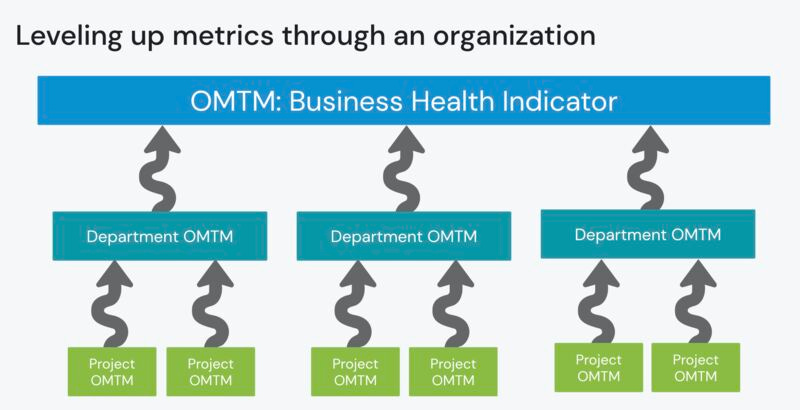
This reminds me of the North Star Metric (NSM) and its Input Metrics.
Many characteristics of a good OMTM, such as being actionable, comparable, easy to understand, and the need to base decisions on leading indicators, are also characteristics of a good North Star Metric.
While OMTM and NSM can be the same, they don't have to be.
OMTM has its roots in the Lean Startup movement. It focuses on navigating through different growth stages, known as "Lean Analytics Stages," in a startup: Empathy, Stickiness, Virality, Revenue, and Scale. The OMTM is the specific metric you focus on for your current stage.
On the other hand, the North Star Metric centers around the core value that customers derive from the product, regardless of the growth stage. According to Sean Ellis's definition, it should not be directly linked to a value created for the business.
I find insights related to both OMTM and NSM to be extremely valuable. For further exploration, I recommend reading Lean Analytics.
6. Practical tips and advice
Here are some practical tips:
The North Star Metric is perfectly aligned with Product-Led Growth. I would argue that using these techniques together is essential. It's not just about creating value for your customers; it's crucial that they can quickly and easily experience the promised value (aka "Aha moment"). You should double down on reducing any friction in the onboarding process.
When building a new product, it’s essential to achieve the product-market fit before focusing on growth. Having a product that provides significant customer value is crucial for sustainable growth. As Dan Olsen defined it in The Lean Product Playbook, “My definition of product-market fit (…) is that you have built a product that creates significant customer value. This means that your product meets real customer needs and does so in a way that is better than the alternatives.”
Having a product that delivers value is not enough. You are much more likely to acquire and retain your customers long-term if you take care of driving usage and building habits. A good example might be Uber, which initially offered incentives to attract and retain customers, eventually making it a part of their everyday lives.
If you want to understand North Star Metric vs OKR or North Star Metric vs KPIs, read OKR vs KPI: What's the Difference. Theoretically, a North Star Metric can be one of the KPIs or Key Results. The latter is unlikely if the team cannot influence it directly - use input metrics instead..
North Star Metric FAQ
Is the North Star Metric the same as a KPI?
A North Star Metric is one of your KPIs — the single one that best captures the value customers get from the product. KPIs track many things: revenue, churn, acquisition. The North Star Metric is the one customer-value KPI the whole product team aligns on, and it should be a leading indicator of business success.
Is there a North Star Metric framework template?
You don't need a dedicated template. Pick your game (attention, transaction, or productivity), define one metric that represents the value customers get, then break it into input metrics teams can directly influence. Section 4 walks through the full process.
Can a company have more than one North Star Metric?
One per product. The metric's job is alignment — several “north stars” defeat it. Companies with multiple products define one per product, each with its own input metrics.
7. Recommended content
More information:
[Article] Are You Tracking the Right Metrics by Ben Yoskovitz: 8 types of metrics every PM needs to understand. 2 case studies. 5 actionable steps to take as a PM.
[Book] Hacking Growth by Sean Ellis and Morgan Brown
[Book] Lean Analytics by Ben Yoskovitz and Alistair Croll
Thanks for reading The Product Compass!
Hope you find value.
What are your thoughts? I'm happy to answer any questions you might have.
If you liked this issue, consider sharing it with others.
It’s fantastic that we learn and grow together 🚀
Take care, Paweł
Pawel, great read. I would be curious how you would apply this framework to an internal enterprise product.