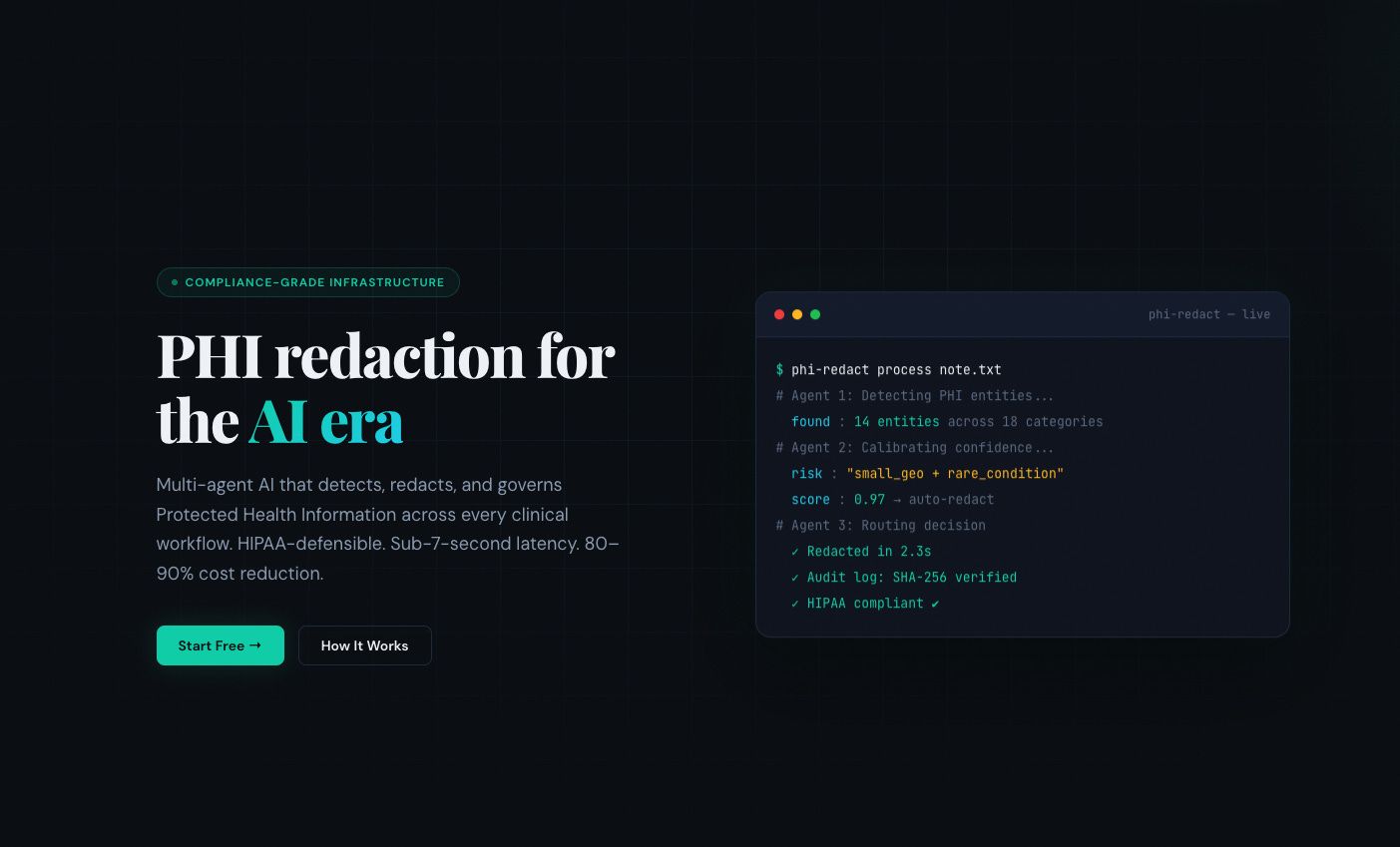
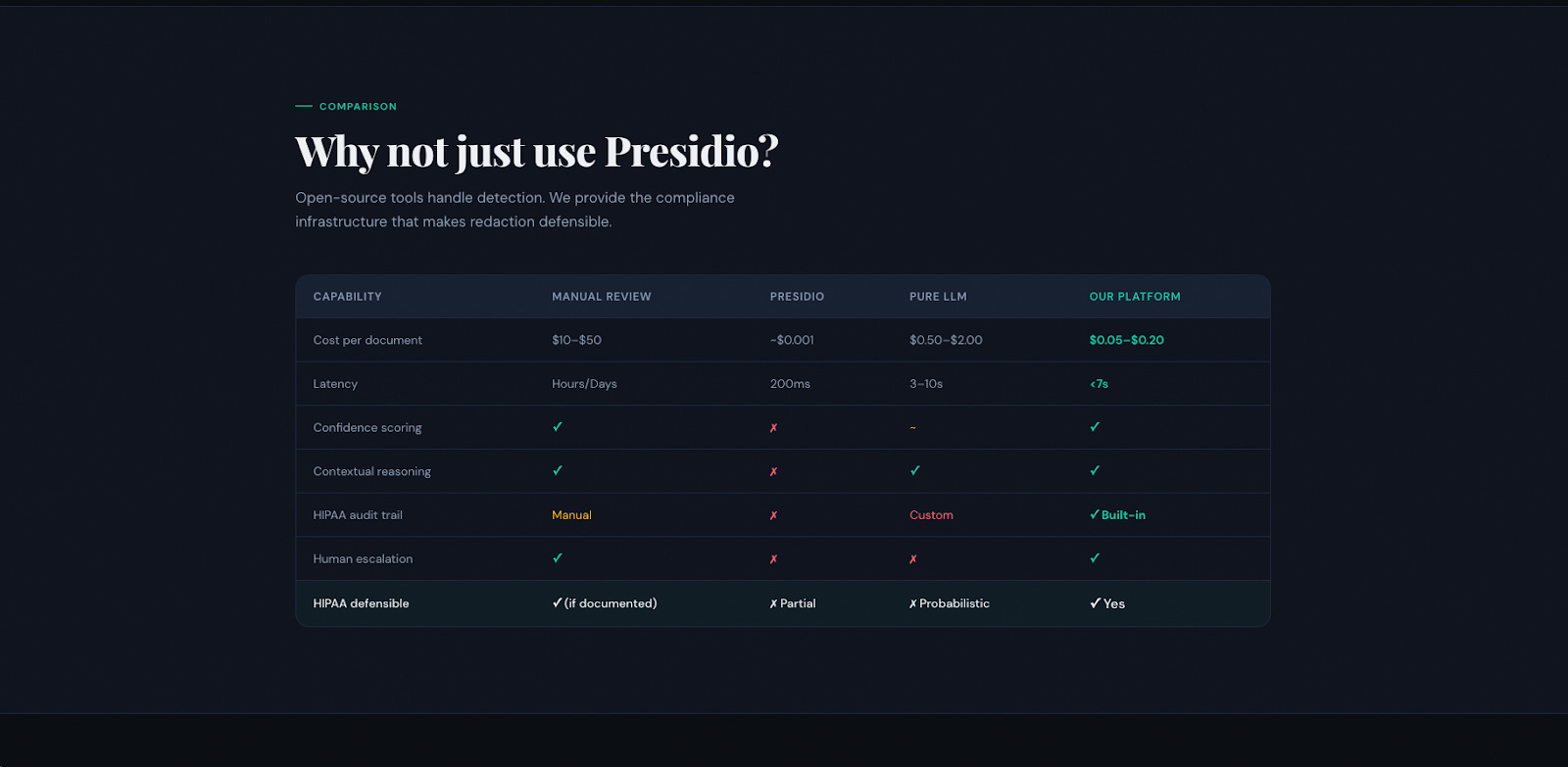
Every healthcare AI project hits the same wall: PHI compliance. Before a single line of clinical text enters your LLM pipeline, RAG system, or analytics platform, it must be stripped of Protected Health Information (PHI). Manual review costs 0-50 per document and takes days. Regex patterns miss contextual identifiers. And pure AI without oversight is not HIPAA-defensible.
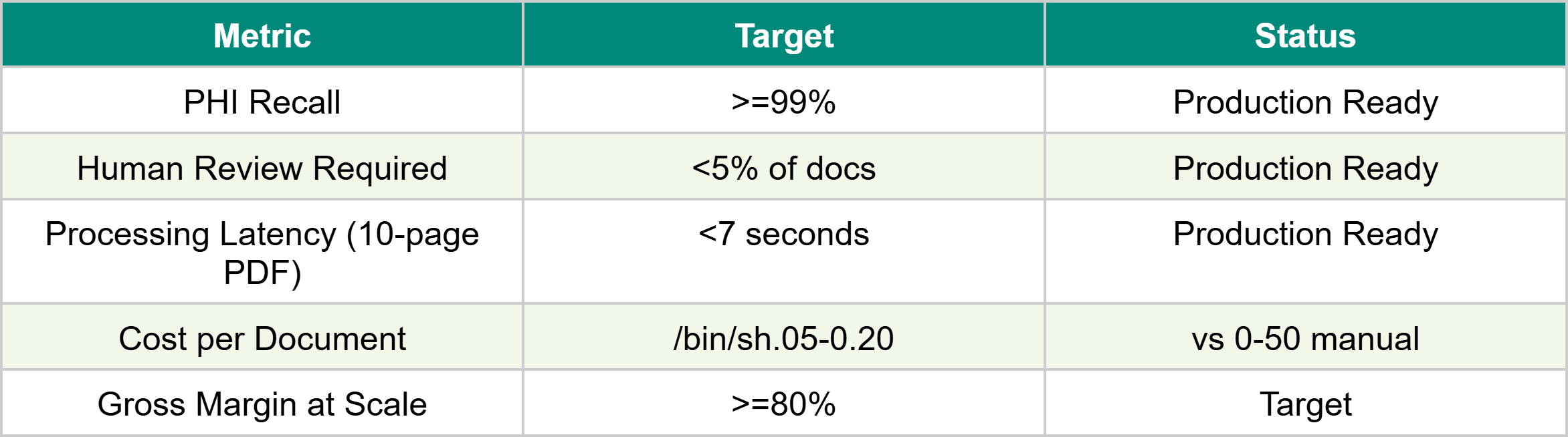
PHI Redaction-as-a-Service (PHI-RaaS) solves this with a three-layer, multi-agent Claude AI architecture paired with selective human-in-the-loop (HITL) review, reducing cost by 80-90%, achieving >=99% PHI recall, and routing fewer than 5% of documents to human review.
“AI adoption is outpacing compliance infrastructure in healthcare. Every LLM API call, RAG retrieval, and analytics export is a new PHI exposure surface. PHI-RaaS is the control layer that sits upstream of all of them.”
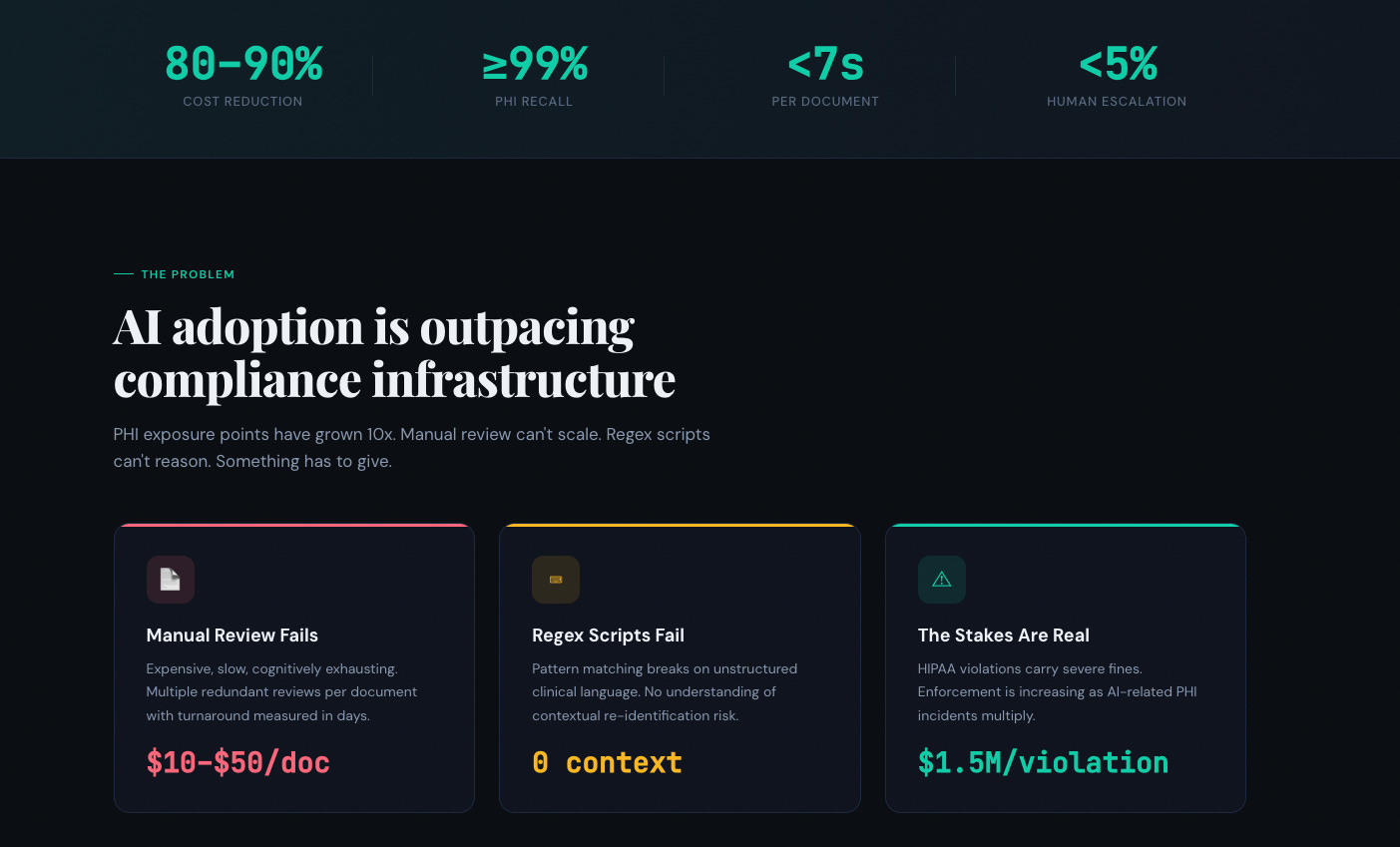
At a Glance: Key Performance Metrics
The Problem: Manual PHI Review Cannot Scale with Healthcare AI
Healthcare organizations are deploying AI faster than their compliance teams can keep up. Before AI, PHI lived in EHRs and left the building only occasionally. With AI, it flows to LLM APIs, fine-tuning pipelines, AI scribes, patient chatbots, and third-party analytics vendors, each a new compliance surface.
Existing solutions all fail in different ways:
Manual review: 0-50/document, days of turnaround, cognitive fatigue, inconsistent results
Deterministic regex: Breaks on unstructured clinical language, no contextual awareness, high false-negative rate
AI-only (no oversight): Probabilistic models miss edge cases, no audit trail, not HIPAA-defensible as standalone
The gap is not AI capability. The gap is workflow-native compliance infrastructure.
The Solution: Three-Layer Multi-Agent AI with Human Oversight
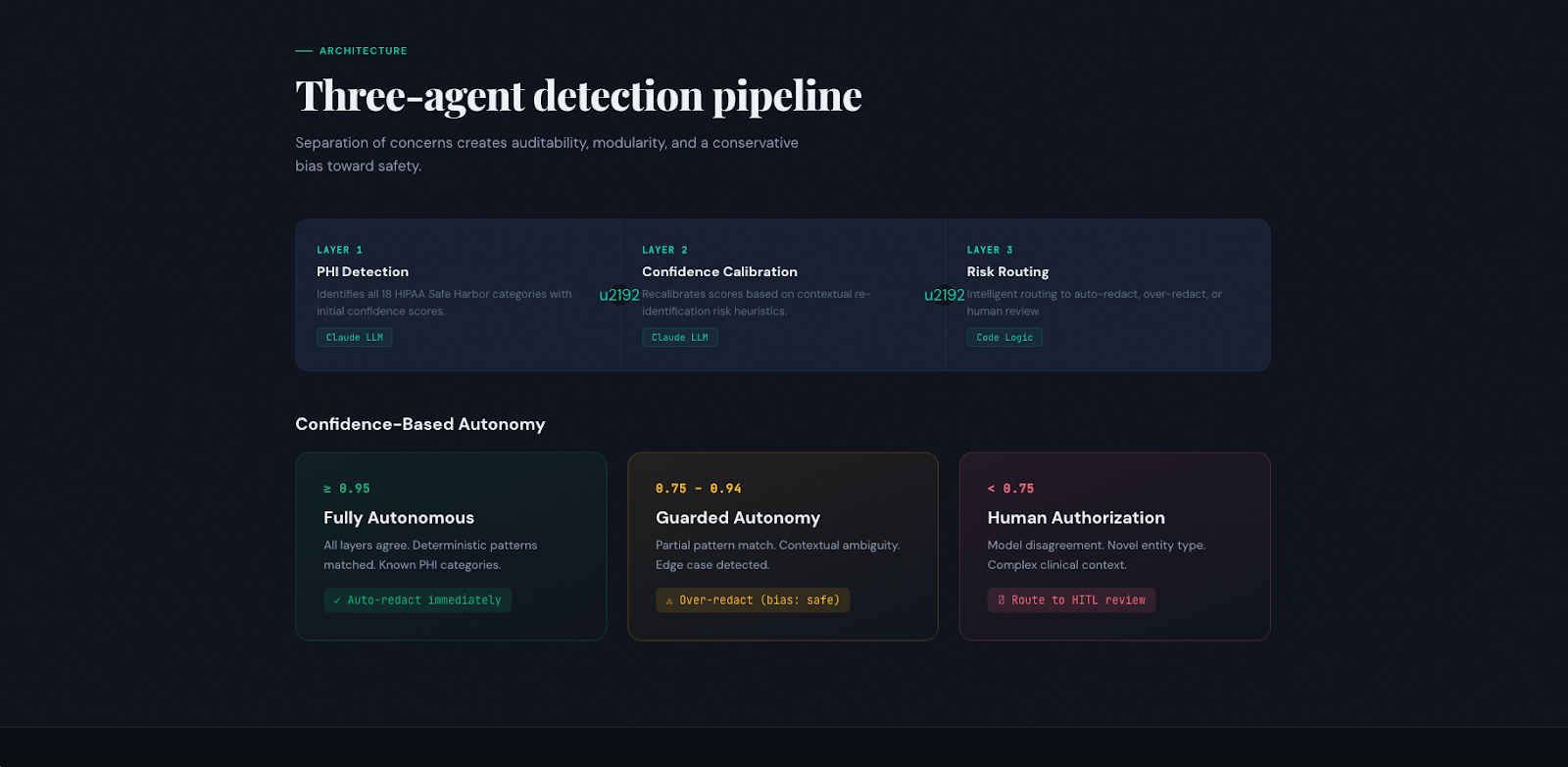
PHI-RaaS uses three agents working in sequence to detect, calibrate, and route every document through the appropriate path:
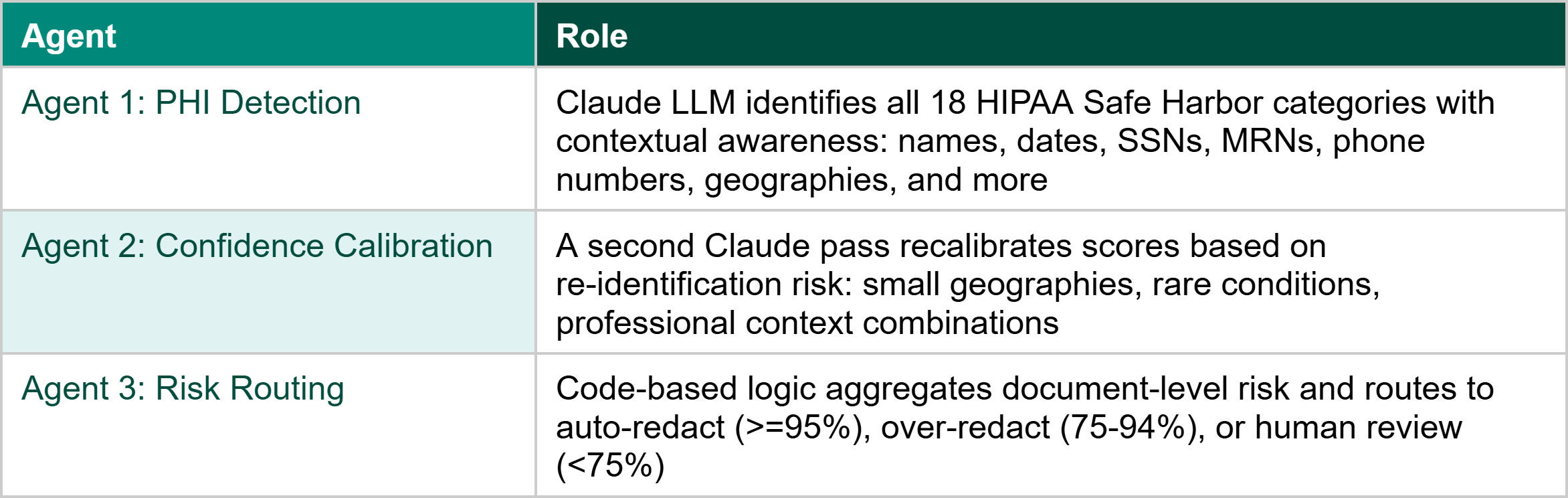
Key insight: Pattern matching sees “Dr. Martinez” and “Elko, Nevada” as separate low-risk items. Claude understands that together, a named physician in a small rural geography, they create uniquely identifying re-identification risk.
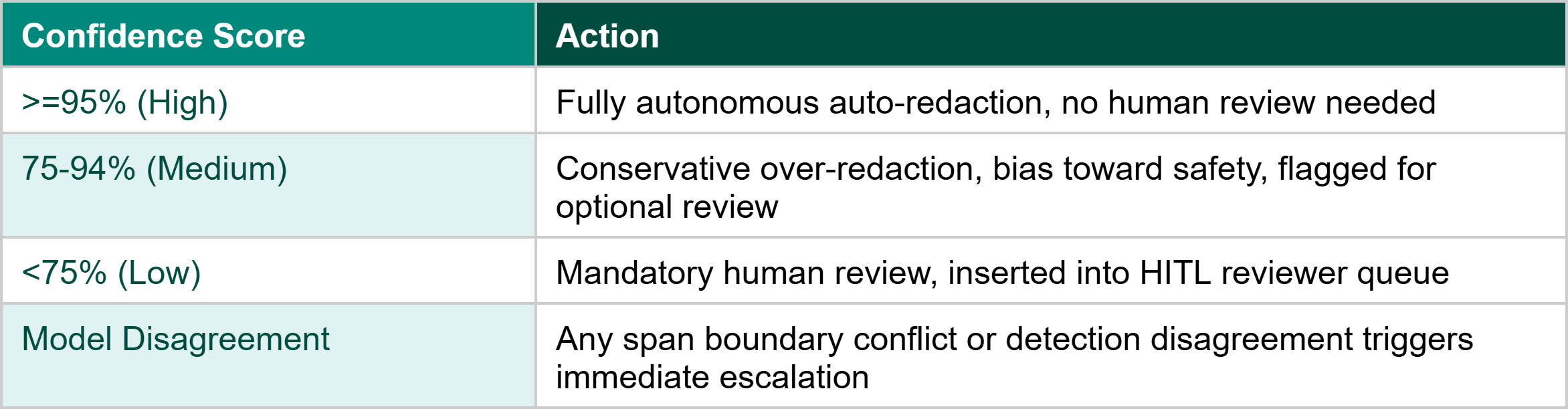
Confidence-Based Routing
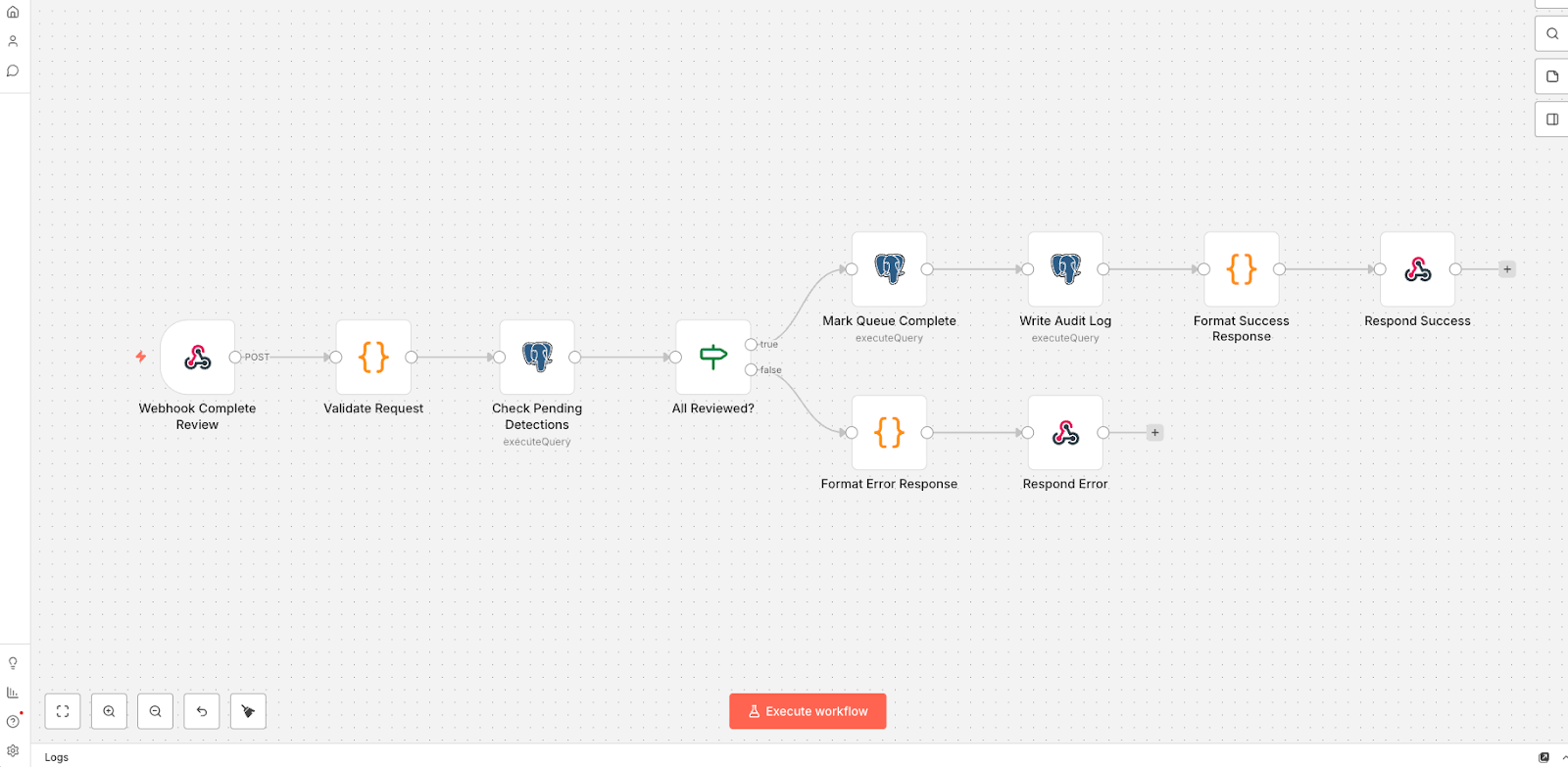
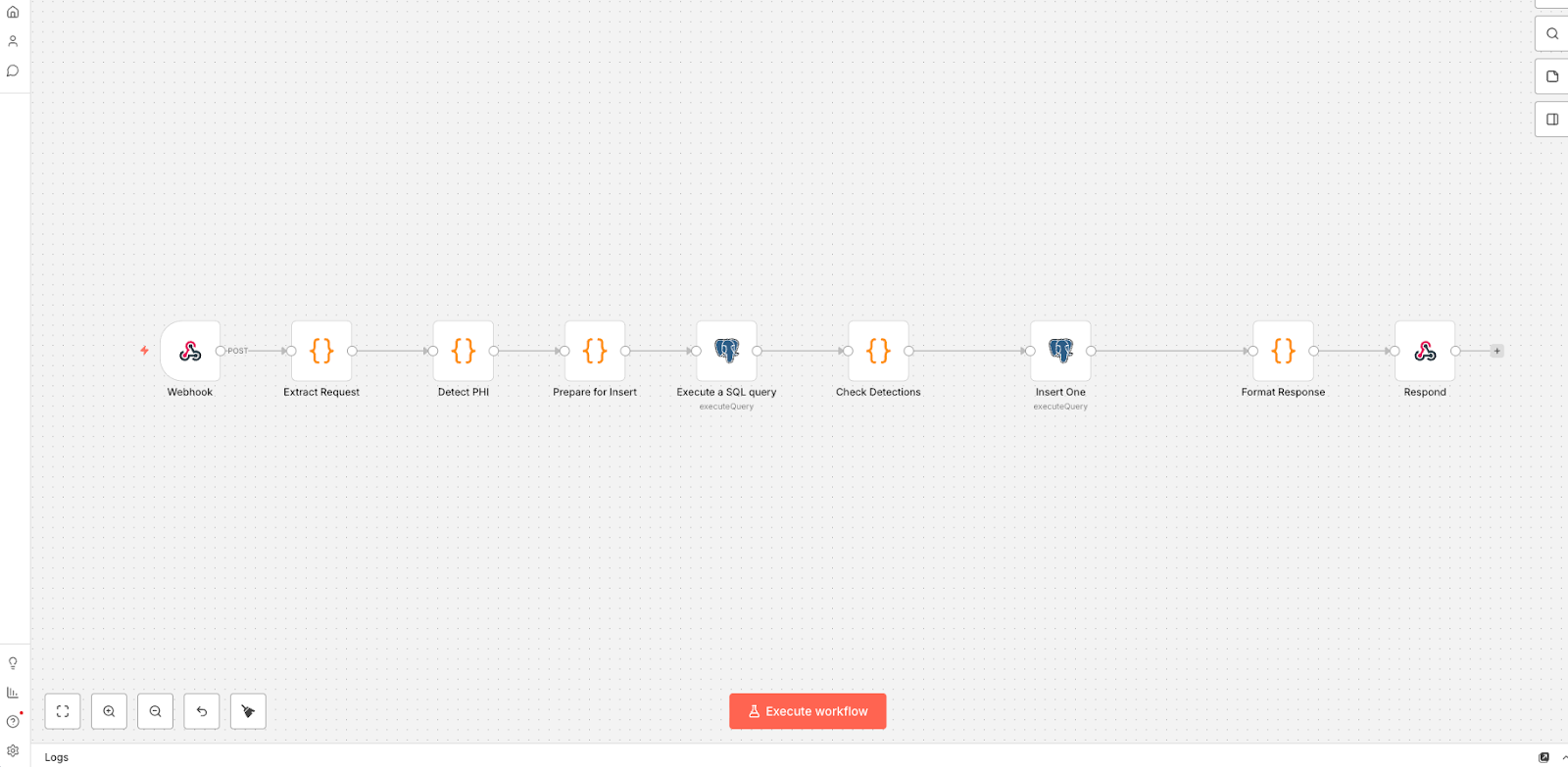
n8n Workflow Orchestration
Five n8n workflows handle the complete document lifecycle: Detection, Fetch, Submit Decision, Complete Review, and Update Document. Each is a webhook-triggered pipeline with PostgreSQL persistence and full error handling.
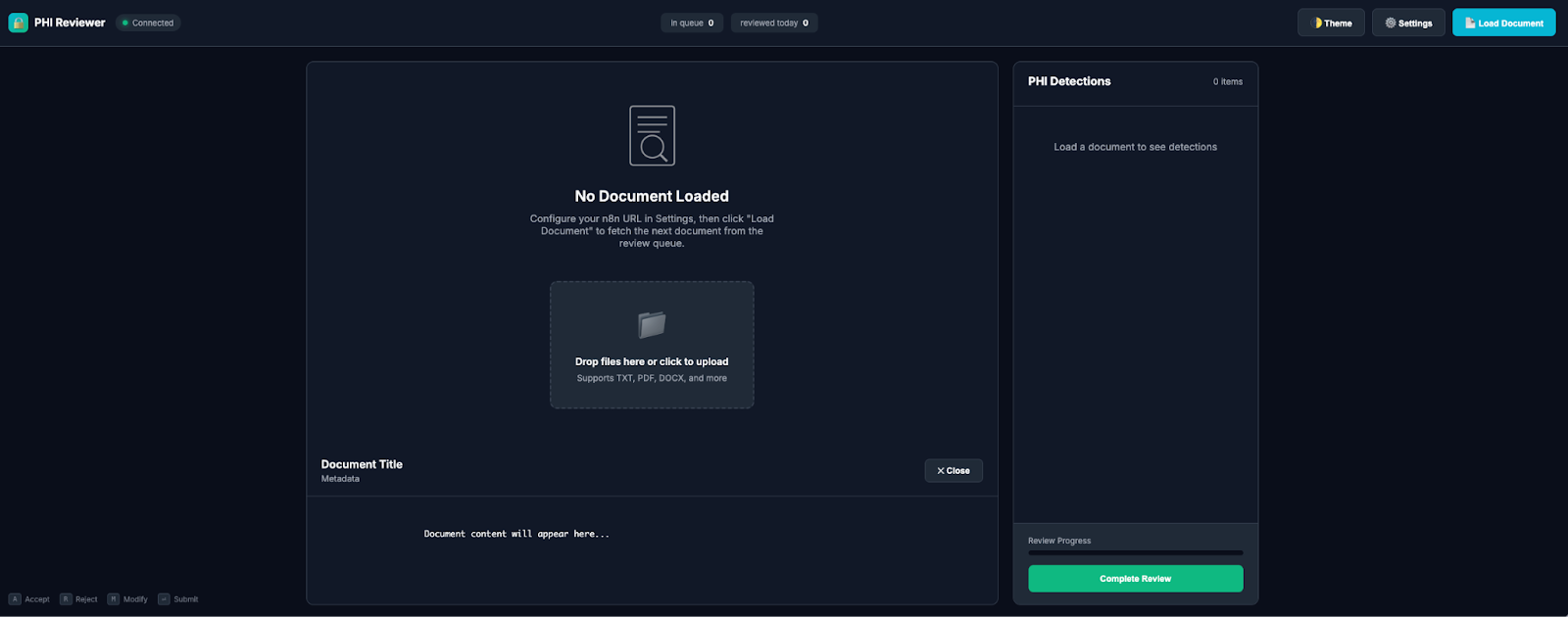
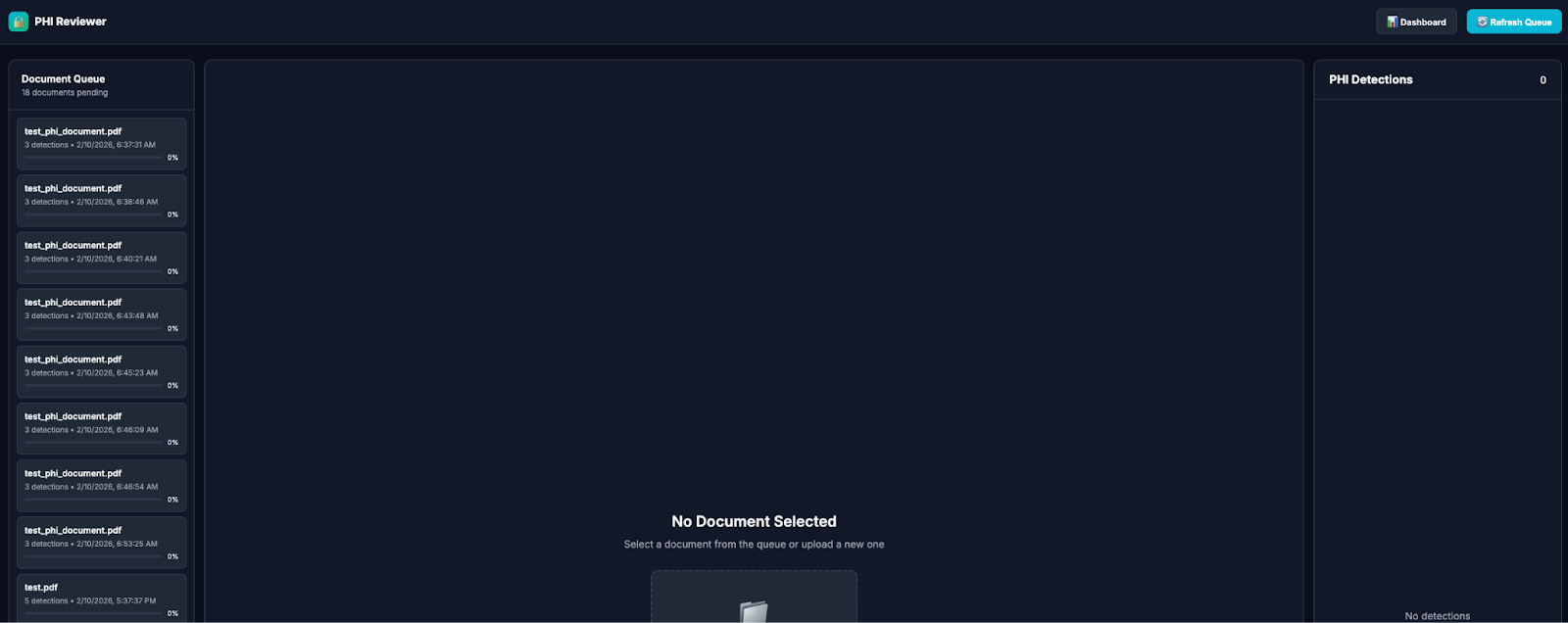
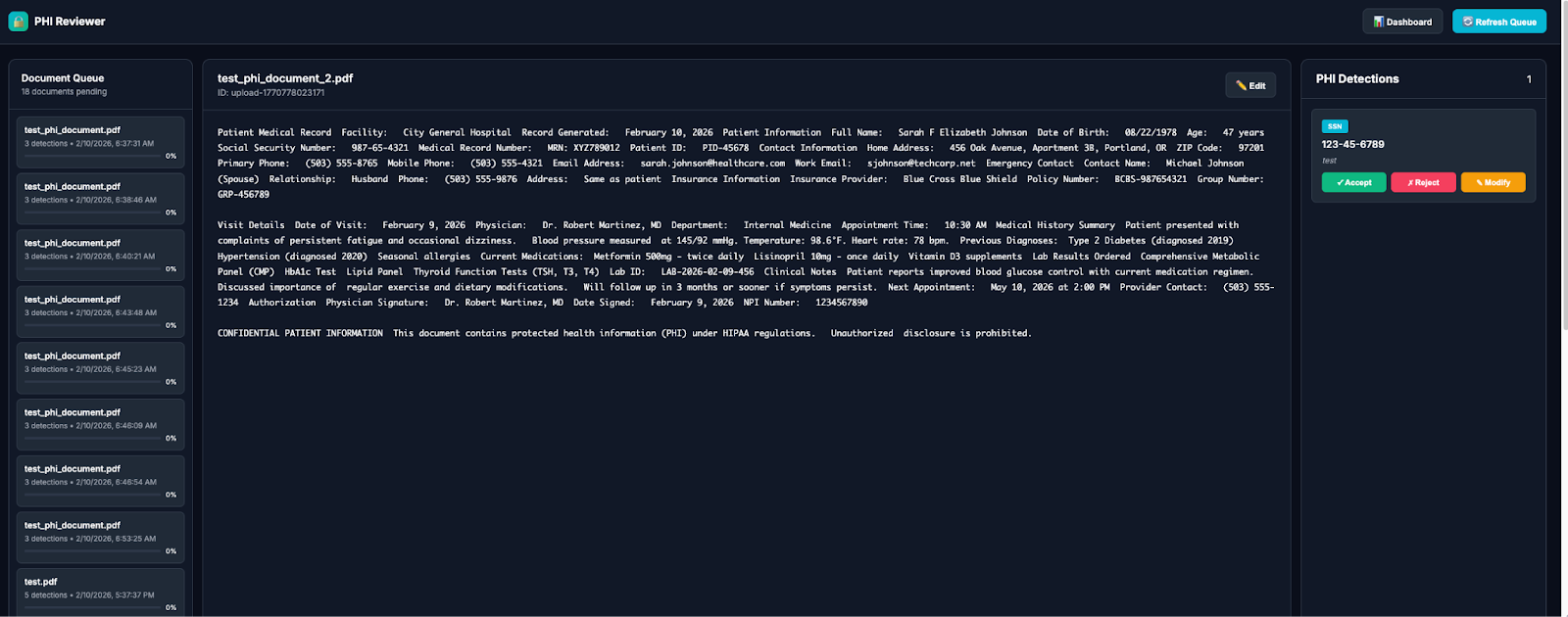
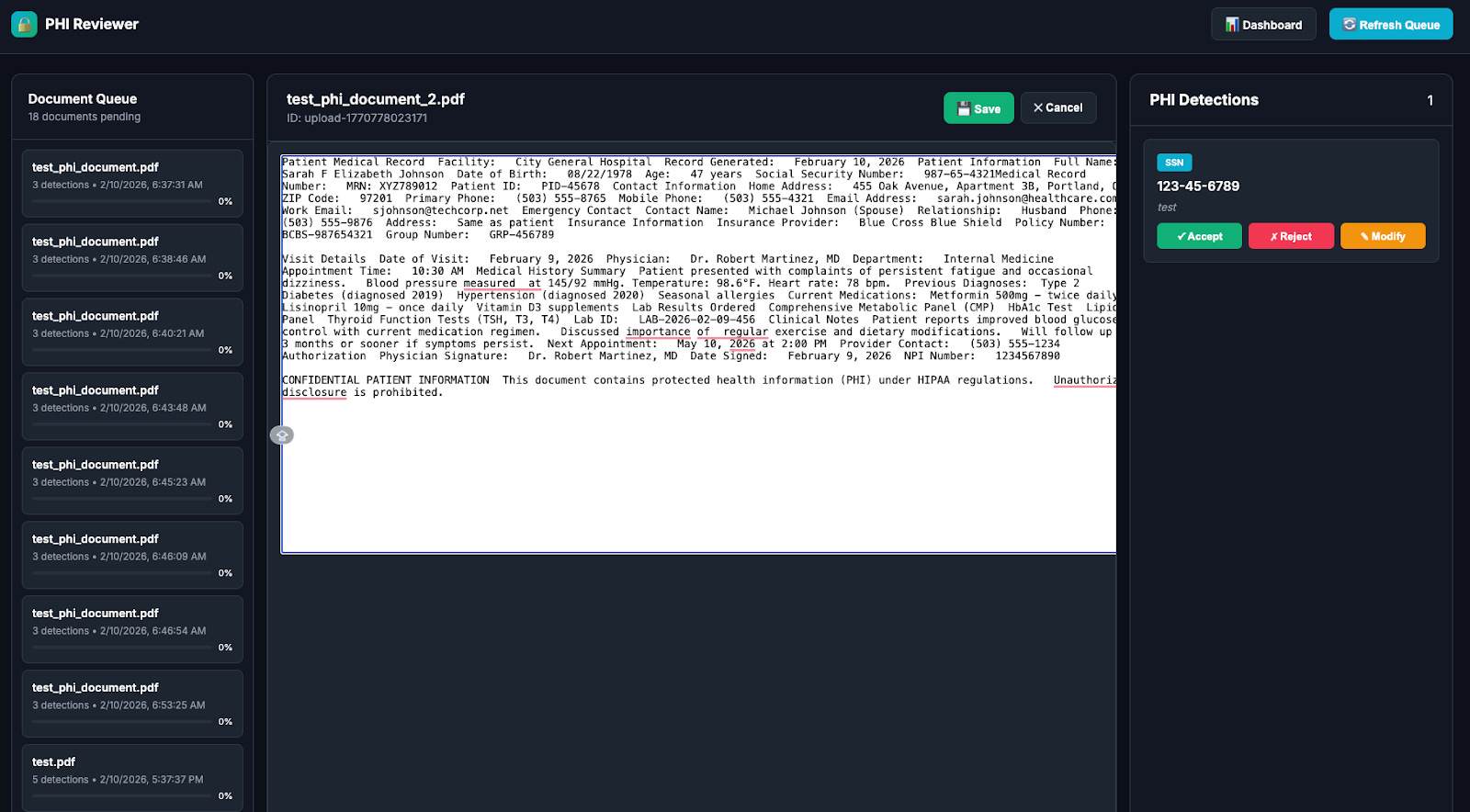
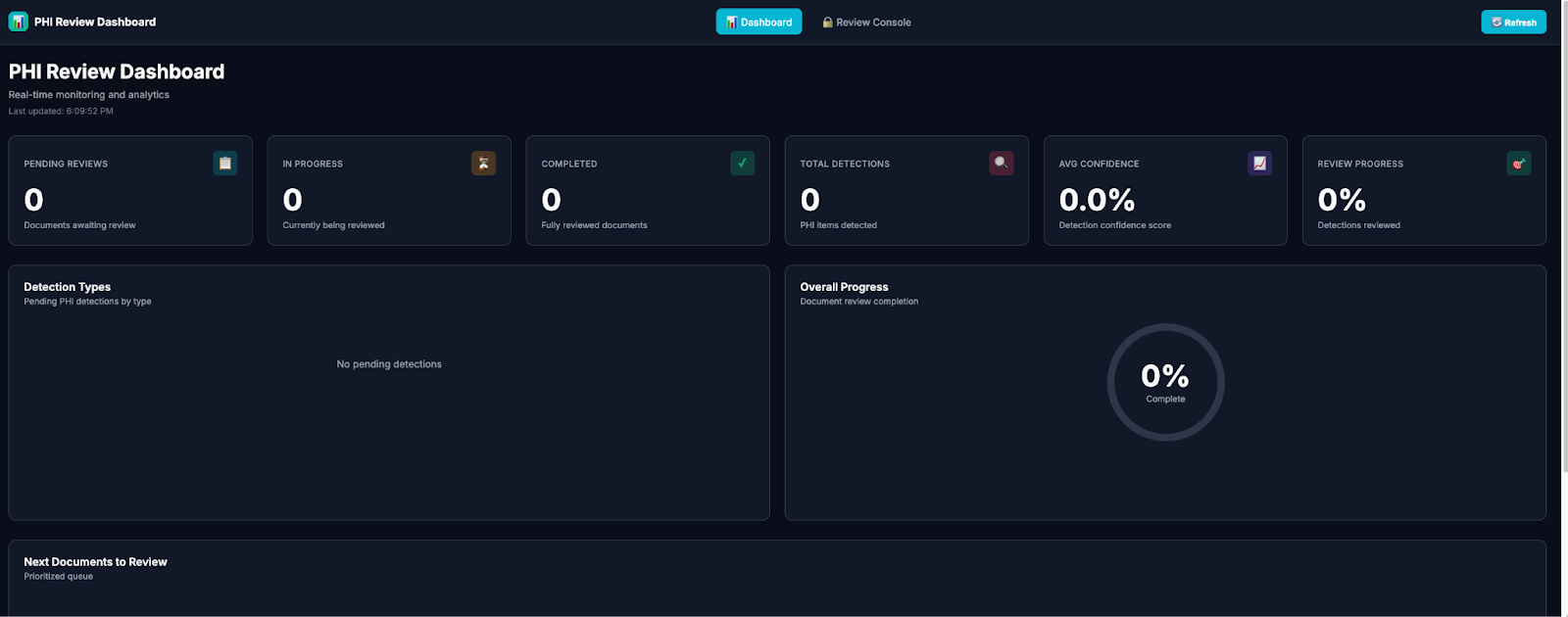
Human-in-the-Loop Reviewer Console
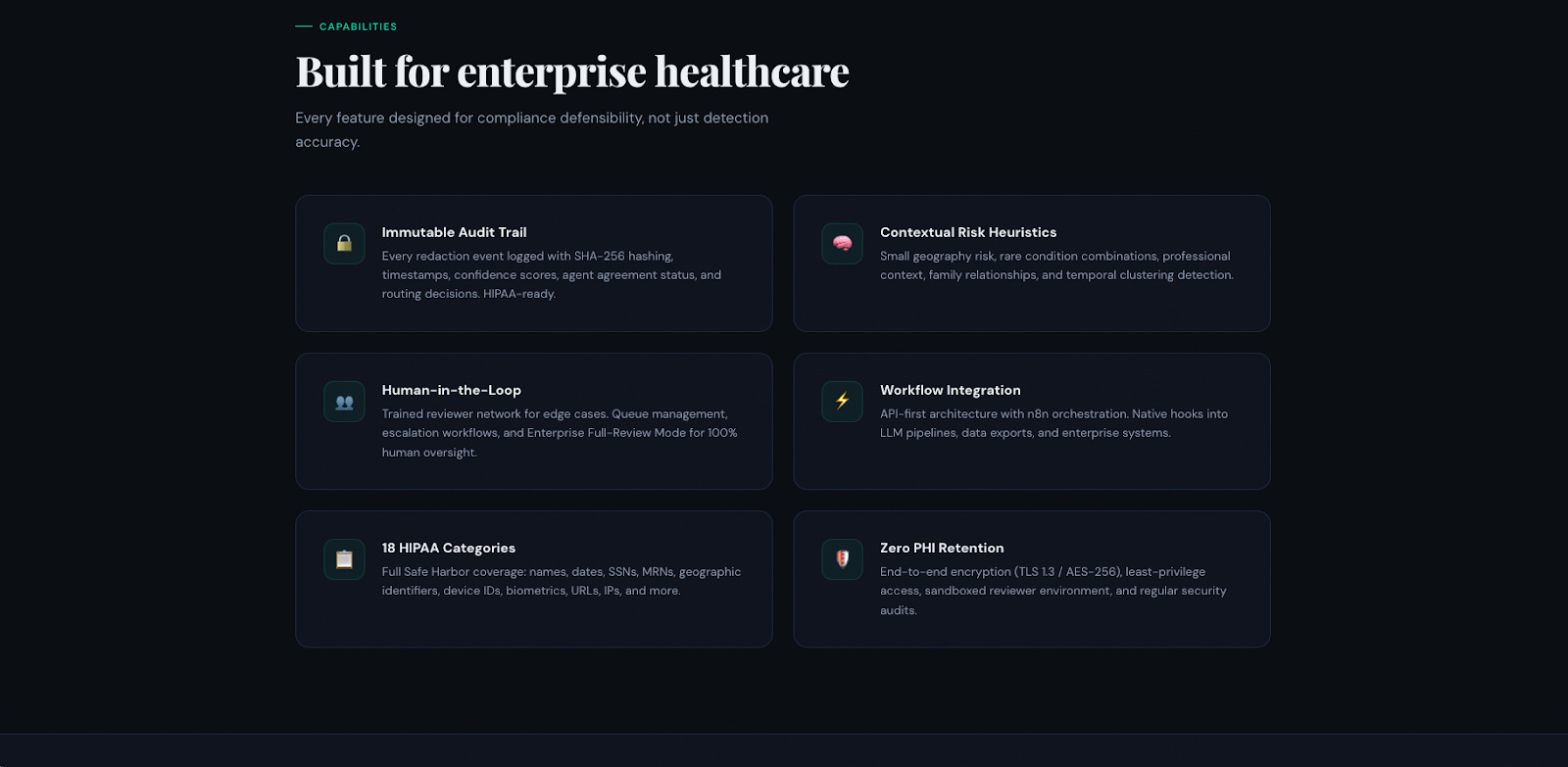
Documents that fall below the confidence threshold are routed to a web-based reviewer console. Trained virtual assistants (HIPAA-trained) can Accept, Reject, or Modify each AI detection. Every decision is logged to the immutable audit trail with reviewer ID and timestamp.
Compliance Infrastructure: Built for Audit, Not Just Detection
Detection alone is not HIPAA-defensible. What auditors actually ask for is the evidence trail: what was detected, by whom or what, when, with what confidence, and what action was taken. PHI-RaaS generates immutable PostgreSQL audit logs for every redaction event.
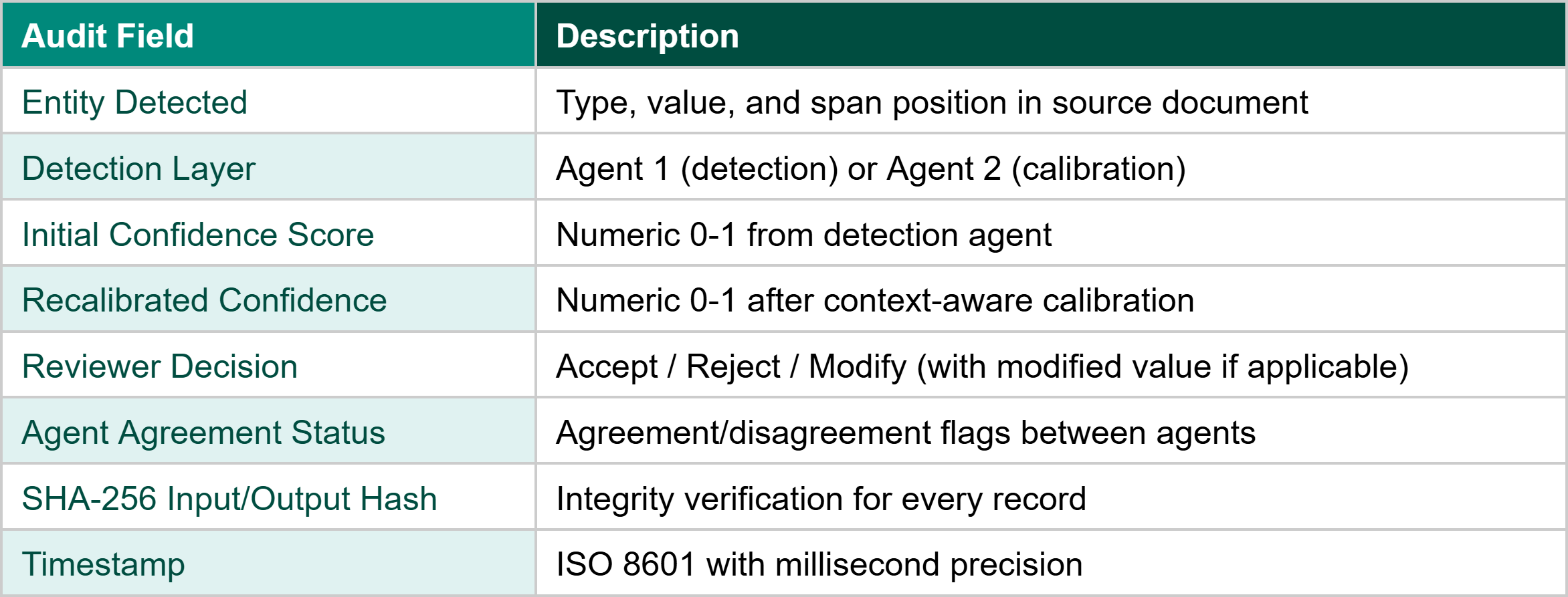
When auditors ask “How did you ensure PHI removal?” you have the proof. Every detection, every decision, every hash.
Why Multi-Agent AI Instead of Regex or Single-Model?
1. Contextual Re-identification Risk
Regex and pattern-matching tools detect individual identifiers in isolation. Claude understands that identifiers combine to create re-identification risk. A common first name near a small-town specialty practice is uniquely identifying even if neither element would trigger a regex pattern alone.
2. Adaptive Intelligence Without Code Deploys
New PHI patterns emerge with every healthcare technology shift: wearable device IDs, telehealth session codes, genomic identifiers. Claude adapts to novel patterns through prompt refinement, not infrastructure changes. Competitors using regex must update pattern libraries for every new edge case.
3. Separation of Concerns for Auditability
Splitting detection, calibration, and routing into independent agents means each decision is independently logged, traceable, and replaceable. In a compliance audit, multi-layer verification is demonstrably stronger than single-pass detection.
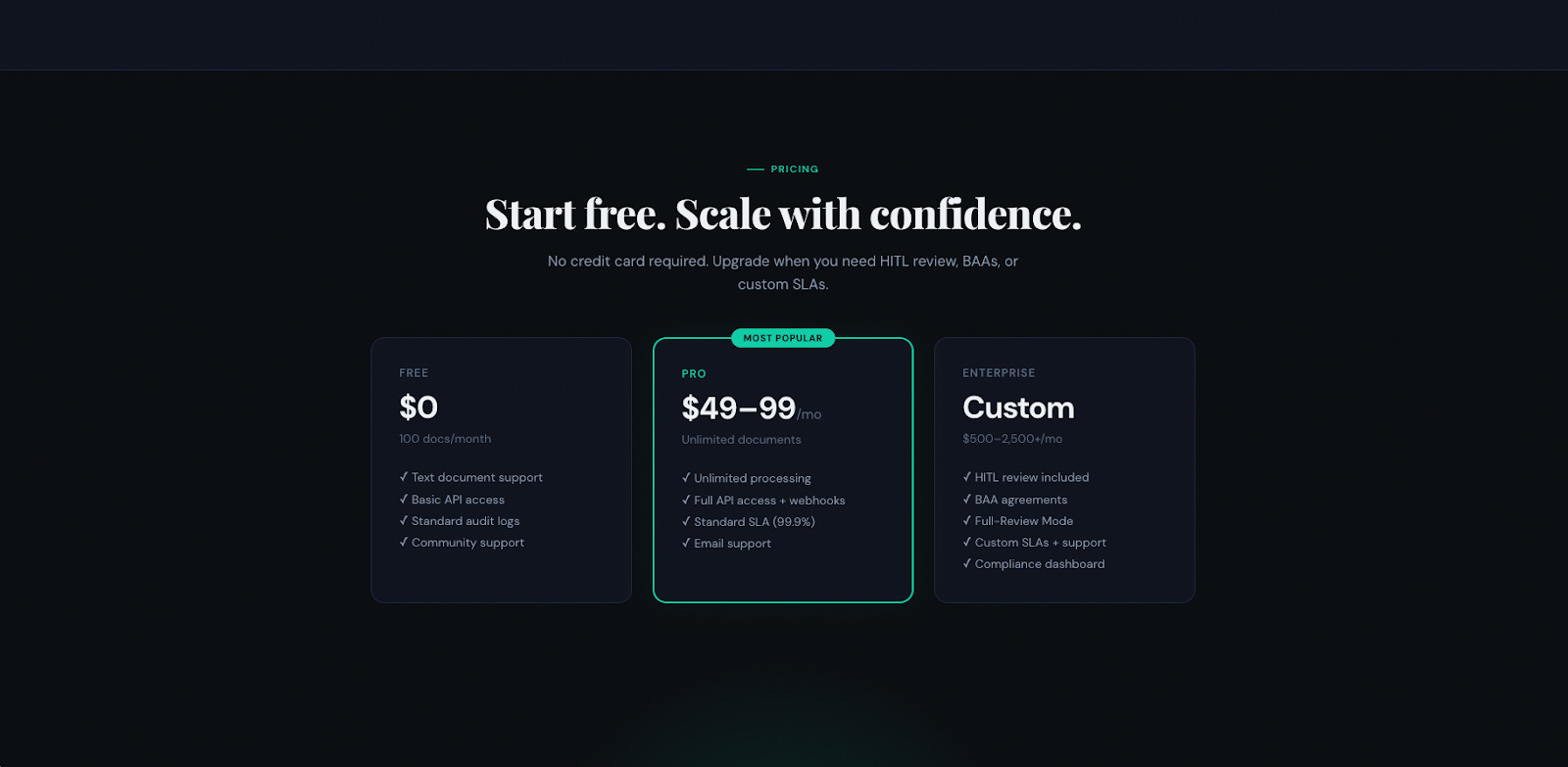
Pricing and Infrastructure Costs

Volume Cost Comparison

Product Roadmap
Frequently Asked Questions
What is automated HIPAA PHI redaction?
Automated HIPAA PHI redaction is the process of using AI or software to detect and remove Protected Health Information (PHI) from clinical documents, EHR exports, and healthcare datasets without manual review. PHI includes names, dates, SSNs, MRNs, phone numbers, addresses, and 14 other HIPAA Safe Harbor categories. Systems like PHI-RaaS use multi-agent AI to identify and redact these identifiers at scale, processing a 10-page document in under 7 seconds.
How does AI PHI de-identification compare to regex/pattern matching?
Regex can only catch PHI that matches predefined patterns. It misses contextual identifiers: a named specialist in a small rural geography is uniquely re-identifying even if neither the name nor the location individually triggers a rule. AI-powered de-identification understands context, handles unstructured clinical language, and adapts to new identifier patterns without code changes.
Is AI-only PHI redaction HIPAA-compliant?
AI detection alone is generally not HIPAA-defensible for high-stakes workflows. A defensible system requires an immutable audit trail documenting what was detected, confidence scores, agent agreement, reviewer decisions, and SHA-256 integrity hashes. PHI-RaaS generates this automatically and routes low-confidence documents to trained human reviewers, making the combined system audit-ready.
What percentage of documents require human review?
Fewer than 5% of documents are routed to human review. Documents with average confidence >=95% are auto-redacted. Documents in the 75-94% range are over-redacted conservatively without human review. Only documents below 75% confidence, or those with model disagreement on entity spans, are sent to the human reviewer queue.
How much does automated PHI redaction cost versus manual review?
Manual PHI review typically costs 0-50 per document. Automated PHI redaction with AI costs /bin/sh.05-0.20 per document at scale, including Claude API costs and selective human review for the ~5% of escalated documents. At 1,000 documents/day, this represents savings of 0,000-50,000 daily compared to a fully manual workflow.
What PHI categories does the system detect?
The system covers all 18 HIPAA Safe Harbor categories: names (patients, relatives, physicians, employers), dates (birth, admission, discharge, death), ages over 89, geographic identifiers (address, city, state, ZIP), telephone numbers, fax numbers, email addresses, Social Security numbers, medical record numbers (MRN), health plan beneficiary numbers, account numbers, certificate/license numbers, vehicle identifiers, device identifiers, web URLs, IP addresses, biometric identifiers, and full-face photographs.
Can this system handle real-time PHI detection in LLM pipelines?
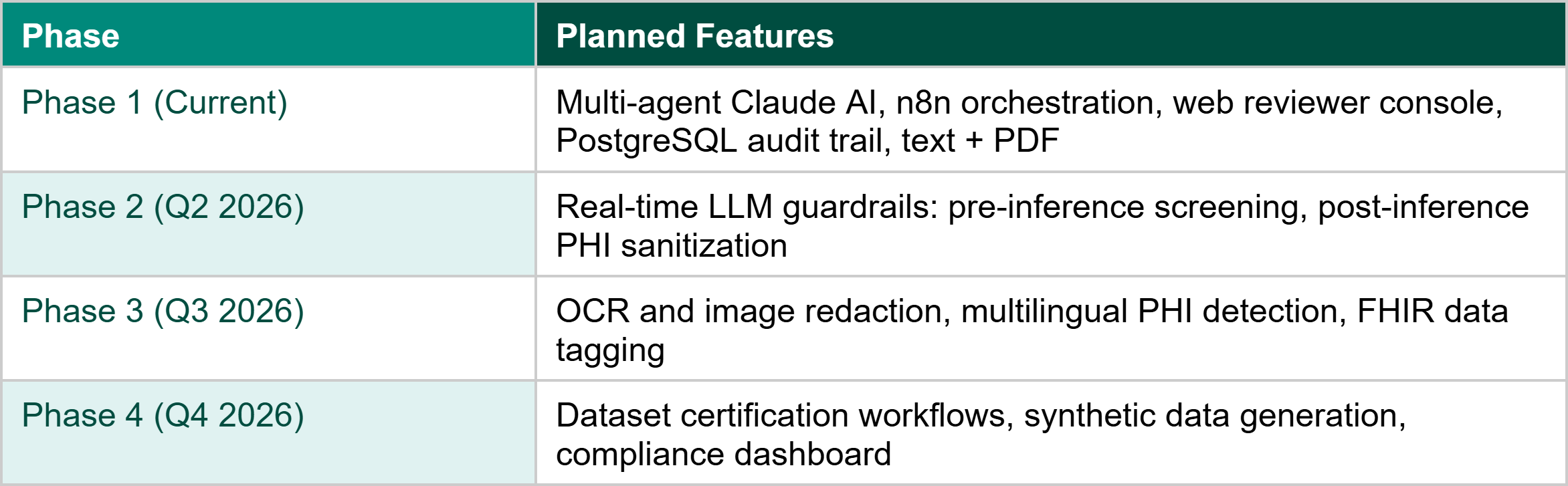
Real-time LLM guardrail mode (pre-inference screening and post-inference sanitization) is on the Phase 2 roadmap targeting Q2 2026. The current system handles batch document processing with sub-7-second latency per document. Enterprise customers can use the webhook API endpoints for near-real-time workflows integrated into their data pipelines.
What is human-in-the-loop (HITL) PHI review?
Human-in-the-loop (HITL) PHI review means AI-generated detection results are presented to trained human reviewers for confirmation on uncertain cases. In PHI-RaaS, HITL review triggers when confidence falls below 0.75 or when agents disagree on entity spans. Enterprise customers can enable Full-Review Mode where 100% of documents receive human confirmation regardless of AI confidence.
How does PHI Redaction-as-a-Service support HIPAA audit requirements?
Every redaction event generates an immutable PostgreSQL audit log entry with the detected entity type, value, position, confidence scores, agent agreement status, routing decision, reviewer ID, reviewer decision, SHA-256 input/output hash, and ISO 8601 timestamp. This provides a complete, queryable evidence trail that directly addresses OCR audit questions about how PHI removal was ensured.
What is the competitive moat for PHI Redaction-as-a-Service?
The primary moat is the compliance relationship. Once an organization signs a BAA, processes production PHI through the system, and passes a compliance audit using the generated logs as evidence, switching vendors means re-proving compliance, re-negotiating BAAs (2-6 months), and explaining the transition to regulators. Secondary moats include accumulated edge case heuristics, trained VA review networks, and client-specific detection calibration.
About PHI Redaction-as-a-Service
PHI Redaction-as-a-Service is a compliance infrastructure platform built for healthcare AI teams, digital health startups, research organizations, and health-tech vendors. Built and maintained by Victor G. Phillips.
Appendix: