
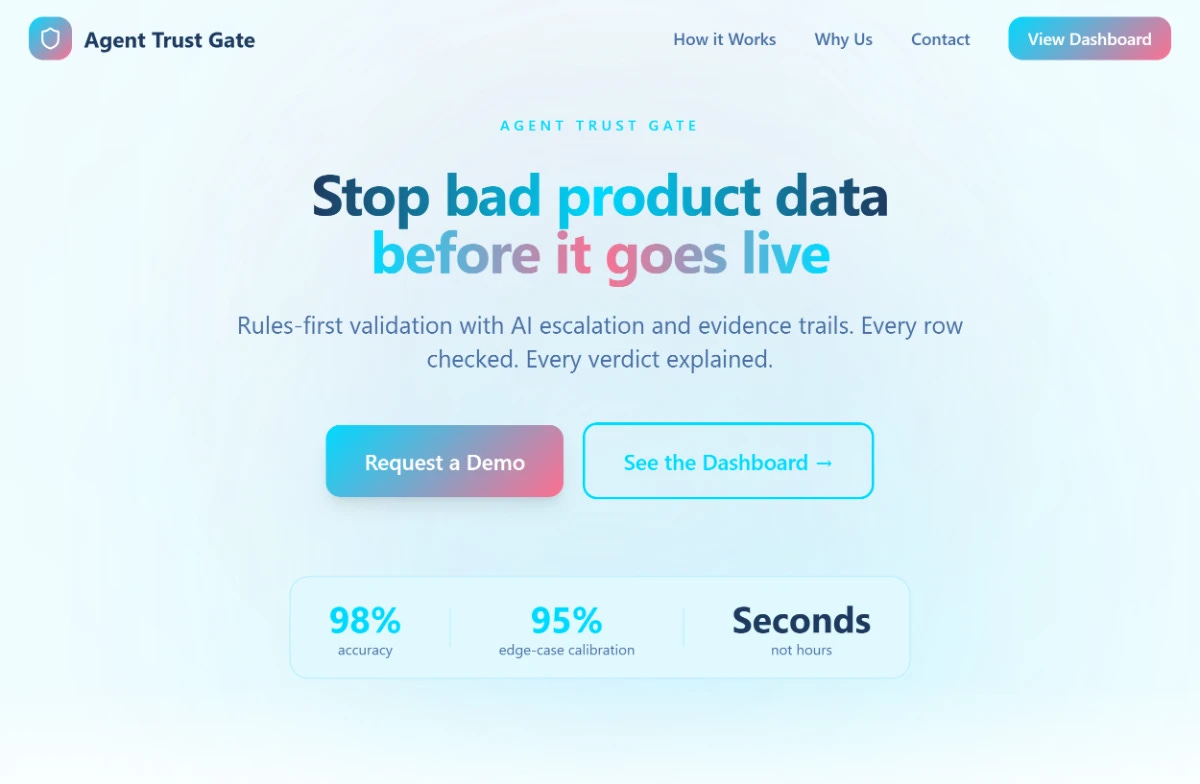
Agent Trust Gate: Stop Bad Product Data Before It Goes Live
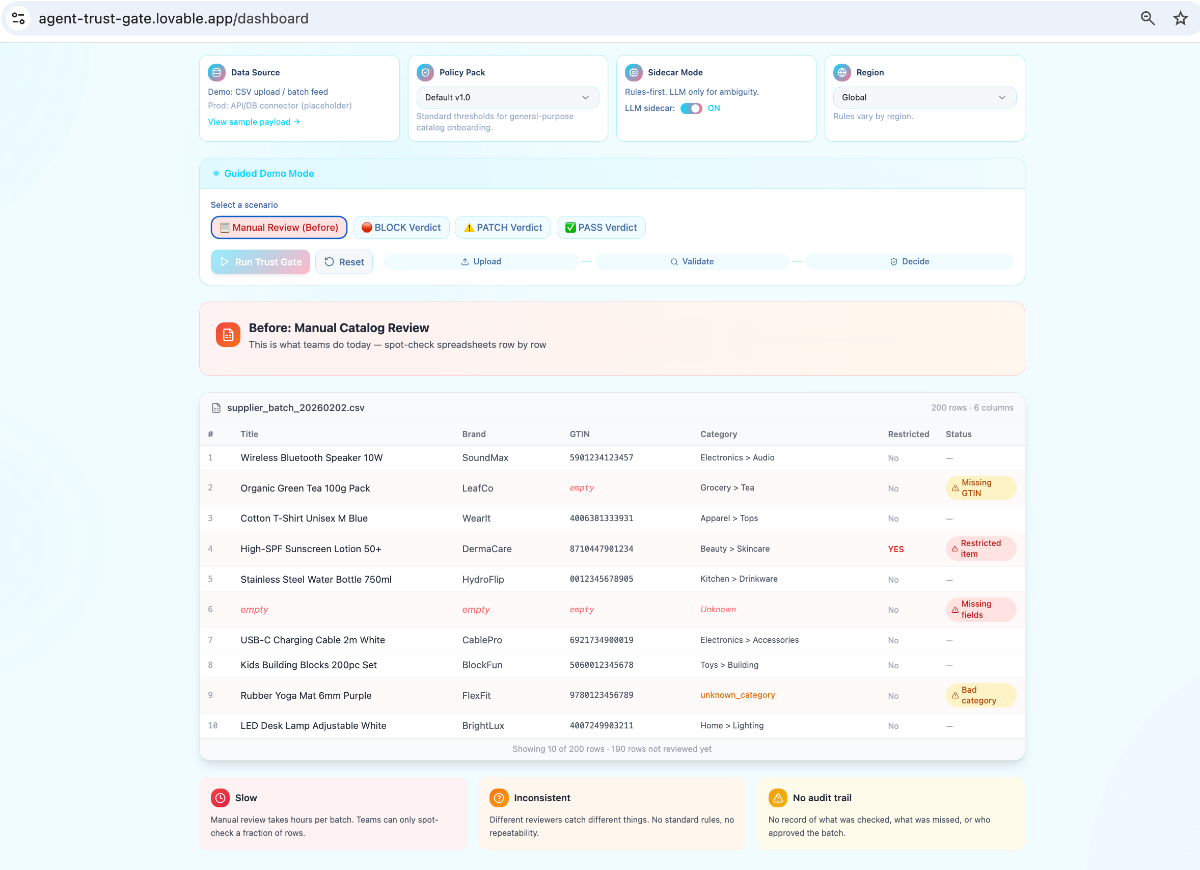
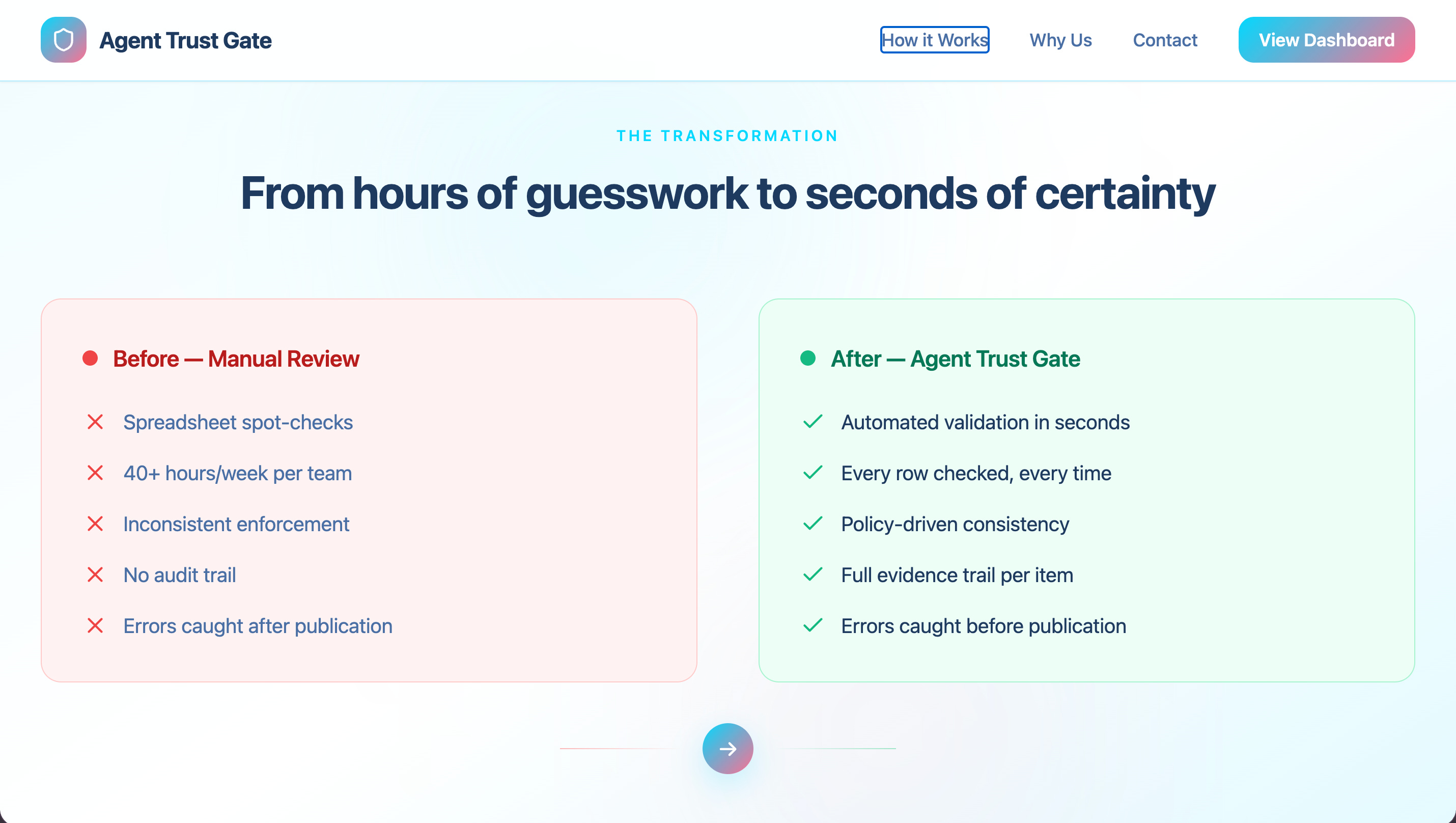
Marketplace platforms process thousands of supplier product listings daily — and most of them arrive broken. 70% of supplier products contain missing or inaccurate data. Only 20% of SKUs pass on first upload. Catalog operations teams spend 40+ hours per week manually reviewing spreadsheets, checking barcodes, verifying categories, and flagging restricted items.
Agent Trust Gate is a rules-first AI validation system that automatically checks every product listing in a supplier batch before it reaches the catalog. It delivers instant PASS, PATCH, or BLOCK verdicts with full evidence — which rows failed, which fields, why, and estimated time to fix.
How It Works
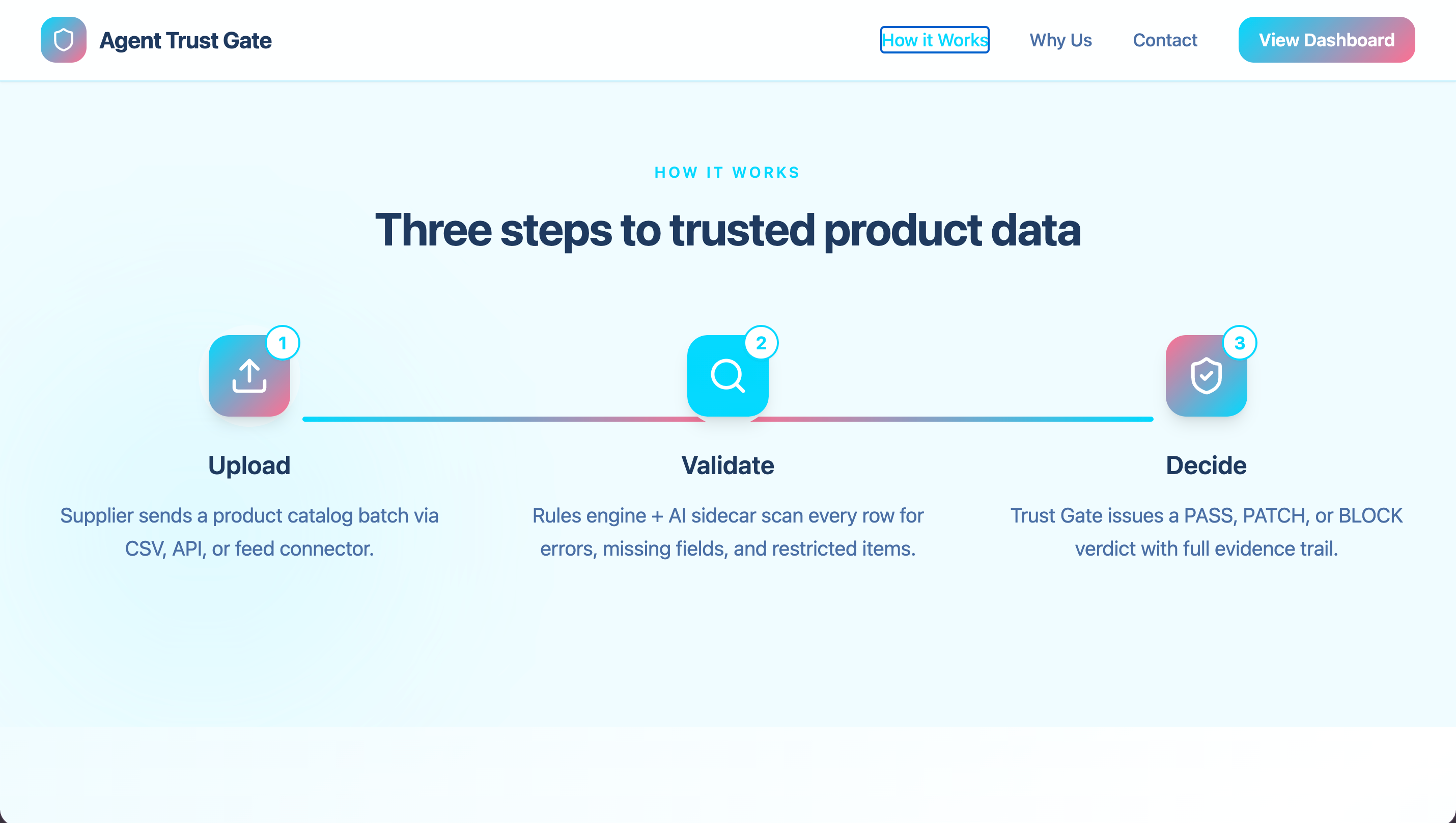
The system uses a hybrid architecture designed for trust and auditability:
Rules Engine (~80% of checks): Deterministic validation handles clear-cut checks — GTIN barcode verification, required field completeness (title, brand, category), restricted product detection, and format consistency. These rules are fast, explainable, and auditable.
LLM Sidecar (~2% of checks): For genuinely ambiguous cases — taxonomy mapping across different supplier formats, fuzzy matching on product descriptions, anomaly detection — a language model handles semantic judgment while maintaining confidence tracking.
Human-in-the-Loop: Low-confidence or high-risk items route to a review queue with full context. The system recommends verdicts; humans decide whether to publish. Zero autonomy for action — this is a deliberate design choice.
Evidence Trail: Every decision — rule-based, AI-assisted, or human-reviewed — is traced with the specific row, field, error type, confidence score, and estimated remediation time.
Key Results
98% accuracy on labeled evaluation data (200-row evaluation set + 40-case gold standard)
$0.09 total API cost — deterministic rules handle ~80% of validation, LLM only touches the ~2% of cases requiring judgment
Seconds, not hours — automated validation replaces 40+ hours/week of manual spreadsheet review
Full audit trail — every verdict comes with evidence rows showing exactly what failed and why
What Makes It Different
Unlike generic data validation tools that only flag format errors, Agent Trust Gate understands catalog-specific quality requirements — restricted product detection, GTIN checksum validation, and category coherence.
Unlike pure AI solutions that risk hallucination, the rules-first architecture ensures ~80% of checks are deterministic and auditable. The LLM sidecar only handles the ~2% of cases requiring semantic judgment, maintaining trust while adding intelligence where it matters.
Architecture
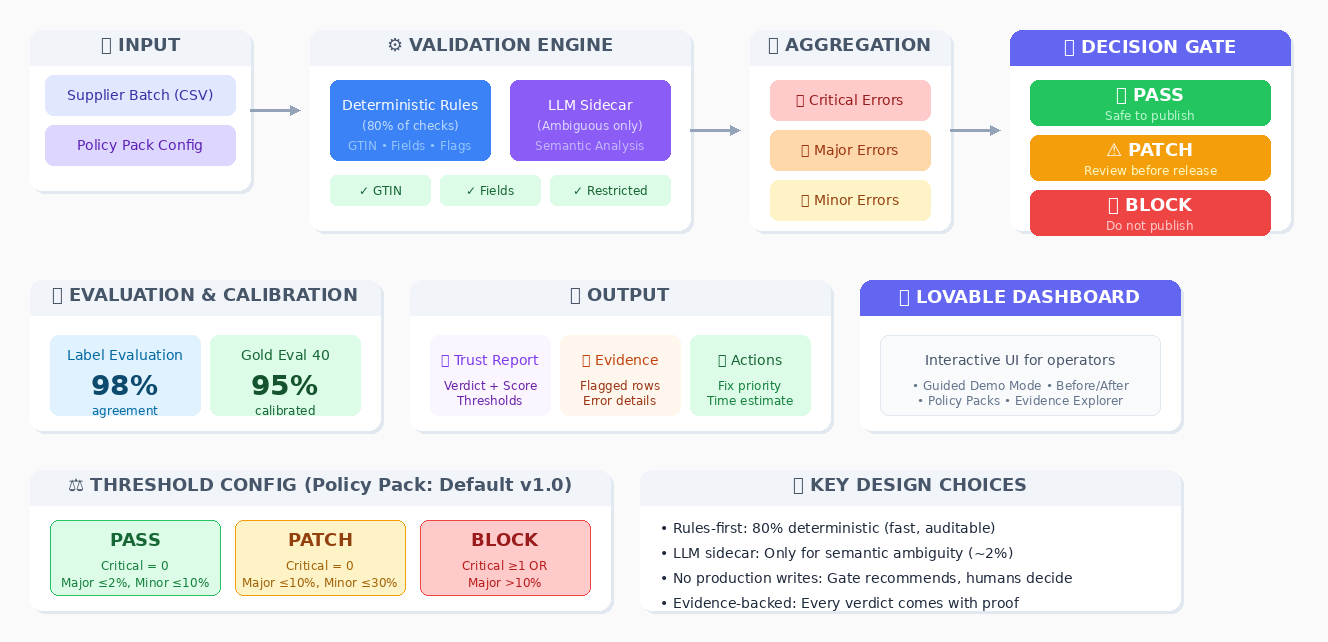
Pipeline: Supplier batch (CSV) → Normalization → Parallel validation (Deterministic Rules + LLM Sidecar) → Error Aggregation (Critical/Major/Minor) → Verdict Engine (applies Policy Pack thresholds) → Trust Report with evidence → Dashboard
Policy Packs: Configurable rule sets with regional compliance variations (EU Strict, US Relaxed)
Orchestration: n8n for pipeline orchestration, Claude API for LLM sidecar, Lovable for frontend dashboard, Google Drive for batch storage
Built During the AI Agents Buildathon
Agent Trust Gate was built as a solo project during the AI Agents Buildathon for PMs, organized by Paweł Huryn and Olia Herbelin.
The buildathon feedback rated it Strong across all four evaluation dimensions — Value Translation, Agent Trust Dynamics, PRD-to-Prototype Fidelity, and Learning Velocity. Evaluators called it “a masterclass in building trust” and noted that the architecture “directly responds to Week 1 feedback — deterministic-first with LLM sidecar hybrid realized.”
Try the live demo of Agent Trust Gate now:
Read the full build journey:

About the Builder

Mandar Deshpande — Product Leader focused on AI products and platforms. 10+ years shipping digital products across B2B, B2C, and B2B2C. Currently at Europcar Mobility Group (AI & Digital Platforms). €10M+ measured impact across growth experiments, lifecycle optimization, and consent platform governance.
FAQ
How do I validate supplier product data at scale?
Agent Trust Gate uses deterministic rules for ~80% of checks and an LLM sidecar for the ~2% of genuinely ambiguous cases, achieving 98% accuracy at $0.09 total API cost. The system processes entire supplier batches in seconds and delivers per-row verdicts with evidence trails.
What is rules-first AI validation?
An architecture where deterministic business rules handle clear-cut checks (schema validation, GTIN barcodes, restricted items) before any AI is involved. This reduces cost, improves explainability, and ensures the majority of decisions are fully auditable — AI only activates for cases that genuinely require semantic judgment.
How do I reduce marketplace product data errors?
By combining automated policy-driven validation with human-in-the-loop review for low-confidence decisions, you catch errors before they reach production. Agent Trust Gate surfaces exactly which products failed, which fields need attention, and provides estimated time to fix for each error.
What is a PASS/PATCH/BLOCK verdict system?
A three-tier classification for incoming supplier data: PASS means the listing meets all quality requirements and can publish. PATCH means fixable issues were found — the system shows exactly what to correct. BLOCK means critical violations (restricted products, missing mandatory fields) that prevent publication until resolved.
How do I make AI validation decisions audit-ready?
Agent Trust Gate traces every decision — which rule fired, what the LLM flagged, what confidence score was assigned, and what the human reviewer decided. This creates per-record evidence packs suitable for compliance reporting and regulatory audit, including EU AI Act documentation requirements.
What is catalog data quality costing my marketplace?
Industry research shows bad product data costs enterprises an average of $12.9M per year. 35-64% of product returns trace back to inaccurate product information. Supplier onboarding takes 30-80 days on average, with significant manual effort in data verification.
Can AI replace manual catalog review?
Not entirely — and that’s the point. Agent Trust Gate automates the ~80% of checks that are deterministic (format, completeness, restricted items) and uses AI for the ~2% that require judgment (taxonomy mapping, ambiguous descriptions). Humans stay in the loop for high-risk decisions. The goal is to reduce 40+ hours/week of spreadsheet review to minutes of focused exception handling.